ASABA (POSSIBLY)(PART OF)
Protected Area
Lizard Point
Why dive here
With 176+ marine species recorded in the area - including blue sharks, dolphins, dwarf minke whales, humpback whales and ocean sunfish (mola mola) - ASABA (POSSIBLY)(PART OF) offers some of Cornwall & Devon's richest wreck diving. Water ranges 10-18°C, warmest July, August, September.
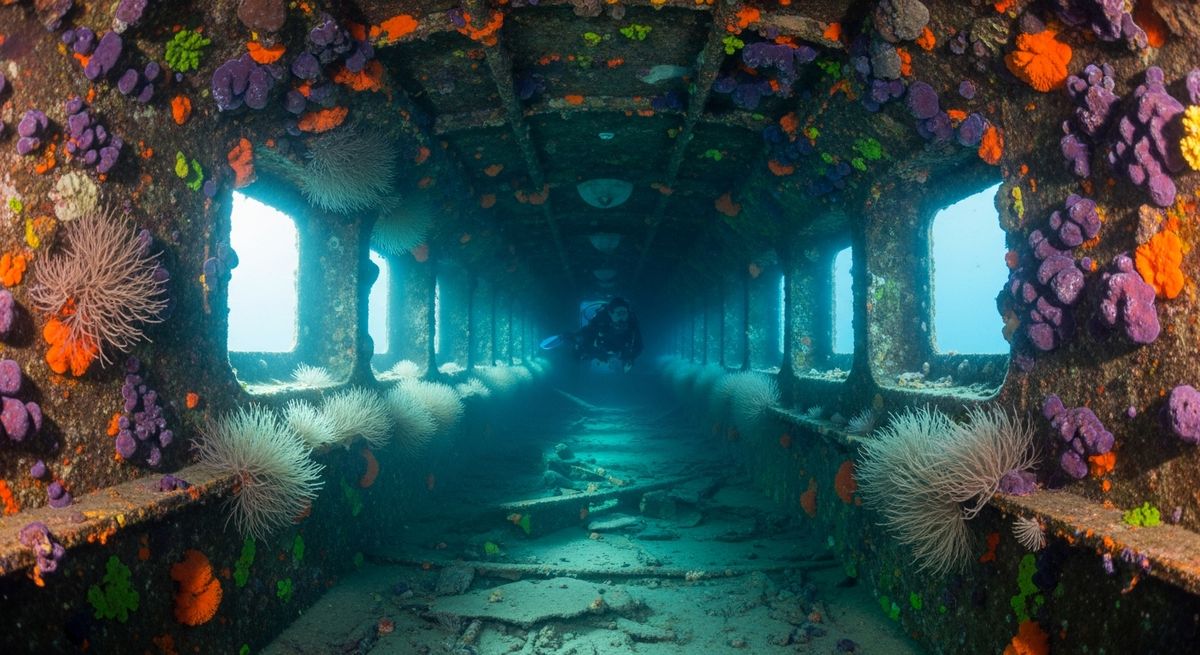
The Asaba, or what we believe to be parts of her scattered across the seabed, offers a proper deep wreck dive off the Cornish coast. Dropping to 52 metres, this isn't one for the casual diver. We love the challenge here, the sense of exploring something truly lost to time, where the visibility can shift from a decent 10 metres to a moody 2 in a heartbeat. It’s a dive where you feel the cold deep, and your torch beam becomes your entire world. What remains is a steamship swallowed by the sand and the years since 1917. You'll navigate through twisted metal plates, sections of hull, and perhaps catch a glimpse of the twin shafts that once propelled her. Ling and conger eels are common residents, slithering through the darker corners, and crabs scuttle across the rusted steel. Our favourite approach is to take it slow, really scour the debris field; you’re not looking for a single intact vessel but rather a story told in fragments. This site suits experienced divers comfortable with depth and variable conditions, who appreciate the historical weight of a wreck over vibrant coral. It’s a rewarding dive for those who enjoy piecing together the past.
Typical ASABA (POSSIBLY)(PART OF) Dive Profile
Illustrative profile based on site depth and type. Actual dive profiles vary - always follow your dive computer and training.
Safety Notes
Maximum depth 52m exceeds recreational limits (40m). Technical diving certification and equipment required.
Wreck site - avoid penetration without wreck diving certification. Watch for sharp metal and entanglement hazards.
Always perform a 3-minute safety stop at 5m before surfacing.
ASABA (POSSIBLY)(PART OF) Wreck History
Year Sunk
1917
Vessel Type
passenger-cargo ship
Cause
torpedo
Tonnage
993 GRT
The SS Asaba was a passenger-cargo steamship built in 1900 for the prominent Elder Dempster Lines. For 17 years, it plied the trade routes, a product of the golden age of steam. Its service came to a violent end during the height of World War I. On December 6, 1917, while sailing off the coast of Cornwall, the Asaba was spotted by the German U-boat U-101. A single torpedo strike sealed its fate, sending the vessel and its cargo to the seabed.
Today, the remains of the Asaba lie at a challenging depth of 52 meters, placing it firmly in the realm of technical diving. The wreck is broken and scattered, a testament to the force of the explosion and the relentless power of the sea over the last century. Divers who make the descent are rewarded with a haunting piece of WWI history. Exploring the decaying hull, boilers, and machinery offers a direct connection to a dramatic moment in the war at sea, a silent memorial patrolled by conger eels and schools of bib.
Nearest Dive Centres to ASABA (POSSIBLY)(PART OF)
Dive shops near ASABA (POSSIBLY)(PART OF)
Porthkerris Divers
DiveUK
Seaways Diving
Karleyth Diving Ltd.
Wavecrest Scuba
Reviews for ASABA (POSSIBLY)(PART OF)
Conditions
Ocean conditions, forecast and tides for ASABA (POSSIBLY)(PART OF)
ASABA (POSSIBLY)(PART OF) Ocean Conditions
Monthly averages for ASABA (POSSIBLY)(PART OF), sourced from Open-Meteo marine data - nearest station: Open-Meteo marine grid (50.44, -2.73) (3km away)
October Averages
Sea Temperature
17°C
62°F · Range: 15.1–17.5°C
Air Temperature
13°C
56°F
Wind Speed
8.14 m/s
15.8 knots
Atmospheric Pressure
1011 hPa
Based on 4 years of monitoring data · Data sources: Open-Meteo marine data
Plan & book
Ways to dive Cornwall & Devon, from day trips to liveaboards.
Day trips & courses
via GetYourGuideGuided dives, courses and snorkel trips with instant booking.
Find dive trips in Cornwall & DevonPlaces to stay
via Booking.comHotels and dive resorts near Cornwall & Devon.
Search stays in Cornwall & DevonDive insurance
Most travel insurance excludes or limits scuba. Check what you need before you go.
Dive insurance explainedPartner links: we may earn a commission if you book, at no extra cost to you. How we make money
Where to Stay near ASABA (POSSIBLY)(PART OF)
Prices from Booking.com. We may earn a commission at no extra cost to you.