ASHMUN J CLOUGH (POSSIBLY)
Protected Area
Wight-Barfleur Reef
Why dive here
With 176+ marine species recorded in the area - including blue sharks, dolphins, dwarf minke whales, humpback whales and ocean sunfish (mola mola) - ASHMUN J CLOUGH (POSSIBLY) offers some of Cornwall & Devon's richest wreck diving. Water ranges 10-18°C, warmest July, August, September.
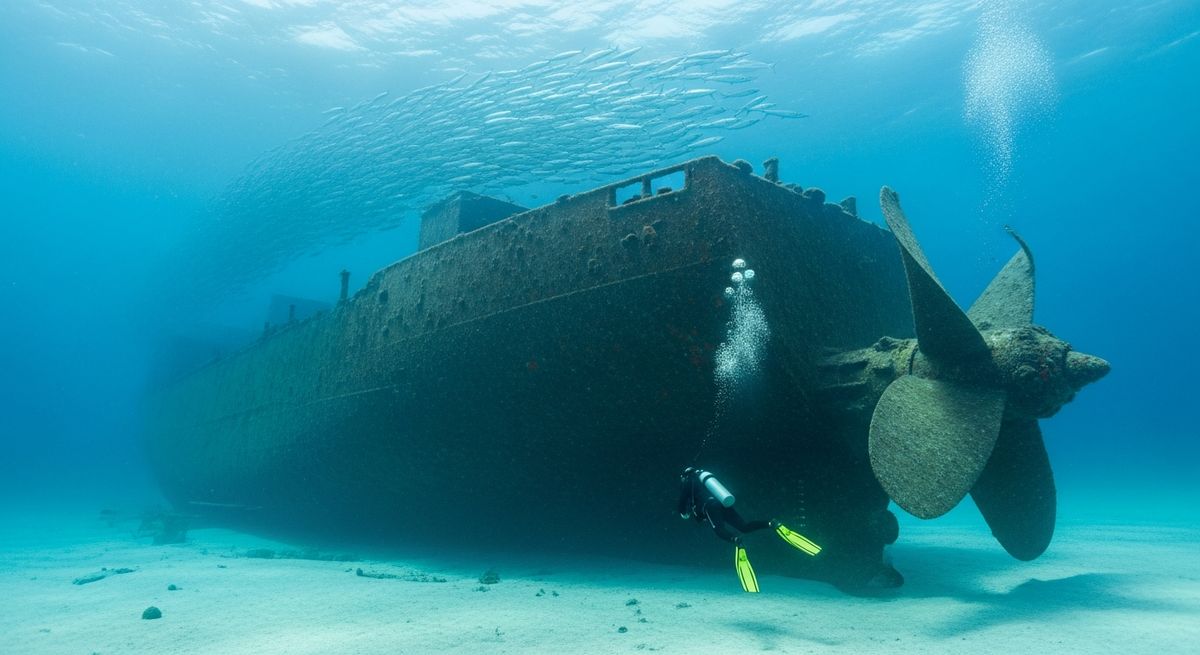
The Ashmun J. Clough, or what we strongly suspect is her, offers a deep, moody dive that’s a real challenge but incredibly rewarding. Dropping to 53 metres, you’re looking at a serious commitment, so this is one strictly for experienced technical divers. We love the sheer scale of her down there. The stern sits quite proud, her massive propeller blades still largely intact and looming out of the gloom. Visibility can be a mixed bag, but on a good day, the light filtering down through the green Cornish waters gives the whole site an atmospheric, almost ghostly feel. What really makes this wreck sing for us is the way marine life has utterly colonised it. You’ll see conger eels tucked into every available crevice, their heads poking out with surprising curiosity. Schools of pollack often hang just off the deck plates, shimmering as you approach. Keep an eye out for the jewel anemones, their tiny, vibrant tentacles clinging to the exposed metalwork – a pop of colour against the rust. Penetration is possible in places, especially into the engine room, but it requires careful planning and precise buoyancy control. It's a proper expedition, a delve into history and a testament to the ocean's reclaiming power.
Typical ASHMUN J CLOUGH (POSSIBLY) Dive Profile
Illustrative profile based on site depth and type. Actual dive profiles vary - always follow your dive computer and training.
Safety Notes
Maximum depth 53m exceeds recreational limits (40m). Technical diving certification and equipment required.
Wreck site - avoid penetration without wreck diving certification. Watch for sharp metal and entanglement hazards.
Always perform a 3-minute safety stop at 5m before surfacing.
ASHMUN J CLOUGH (POSSIBLY) Wreck History
Year Sunk
1944
Vessel Type
cargo ship
Cause
torpedo
The ASHMUN J CLOUGH was a product of the Second World War, built in 1943 to serve the Allied cause. As part of the vast merchant fleet managed for the Ministry of War Transport, she played a crucial role in the lifeline of supplies, munitions, and goods that sustained the war effort. Like many such vessels, she was built for utility and pressed into dangerous service almost immediately.
Her wartime career was tragically short. On August 26, 1944, while sailing in a convoy off the coast of Cornwall, the ASHMUN J CLOUGH was targeted by the German submarine U-989. A torpedo found its mark, and the resulting explosion sent the steamship to the bottom of the English Channel, a casualty of the long and brutal Battle of the Atlantic.
Today, the wreck lies at a depth of 53 meters, placing it firmly in the realm of technical diving. The cold, deep waters have helped preserve the vessel's structure, offering a compelling and atmospheric dive. For experienced, mixed-gas divers, a descent to the ASHMUN J CLOUGH is a journey back in time, providing a solemn and poignant encounter with a largely intact piece of WWII history.
Nearest Dive Centres to ASHMUN J CLOUGH (POSSIBLY)
Dive shops near ASHMUN J CLOUGH (POSSIBLY)
View all dive centres in Cornwall & DevonReviews for ASHMUN J CLOUGH (POSSIBLY)
Conditions
Ocean conditions, forecast and tides for ASHMUN J CLOUGH (POSSIBLY)
ASHMUN J CLOUGH (POSSIBLY) Ocean Conditions
Monthly averages for ASHMUN J CLOUGH (POSSIBLY), sourced from Open-Meteo marine data - nearest station: Open-Meteo marine grid (50.44, -2.73) (3km away)
October Averages
Sea Temperature
17°C
62°F · Range: 15.1–17.5°C
Air Temperature
13°C
56°F
Wind Speed
8.14 m/s
15.8 knots
Atmospheric Pressure
1011 hPa
Based on 4 years of monitoring data · Data sources: Open-Meteo marine data
Plan & book
Ways to dive Cornwall & Devon, from day trips to liveaboards.
Day trips & courses
via GetYourGuideGuided dives, courses and snorkel trips with instant booking.
Find dive trips in Cornwall & DevonPlaces to stay
via Booking.comHotels and dive resorts near Cornwall & Devon.
Search stays in Cornwall & DevonDive insurance
Most travel insurance excludes or limits scuba. Check what you need before you go.
Dive insurance explainedPartner links: we may earn a commission if you book, at no extra cost to you. How we make money
Where to Stay near ASHMUN J CLOUGH (POSSIBLY)
Prices from Booking.com. We may earn a commission at no extra cost to you.