ATLAS (PROBABLY)
Protected Area
Offshore Overfalls
Why dive here
With 176+ marine species recorded in the area - including blue sharks, dolphins, dwarf minke whales, humpback whales and ocean sunfish (mola mola) - ATLAS (PROBABLY) offers some of Cornwall & Devon's richest wreck diving. Water ranges 10-18°C, warmest July, August, September.
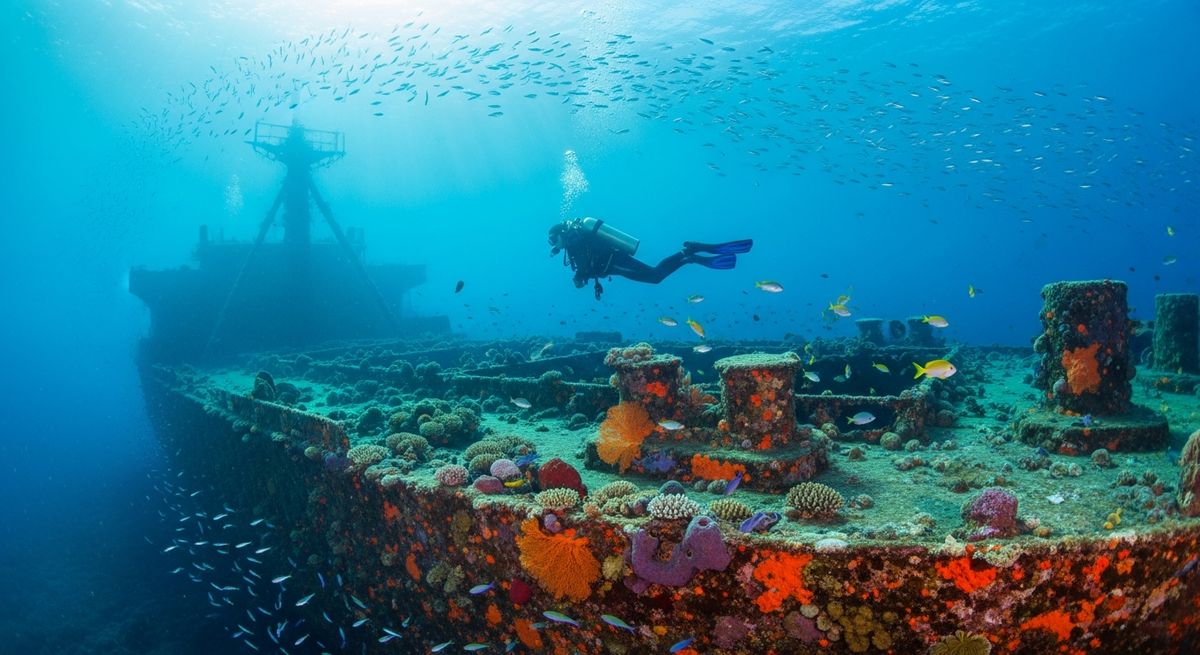
The Atlas, or what we’re pretty sure is the Atlas, sits upright at 40 metres, a proper deep dive that’ll test your gas planning. We love a good mystery, and the identity of this wreck has kept local divers guessing for years, adding a cool layer of intrigue to an already impressive site. She’s a decent sized steamship, 66 metres long, and while the superstructure is largely gone, her bones are still very much there, laid out on the seabed. You’ll drop down onto the bow, often seeing some impressive conger eels poking out from the plates. Moving aft, the single boiler is a real focal point, and the triple expansion engine stands proud, a ghostly monument to a bygone era of steam. The visibility can be hit or miss, typical of the Channel, but when it’s good, you can make out the scale of the wreck from above, schools of pouting swarming the deck like a living cloud. Our advice? Hit this on a slack tide, obviously, but also look for a day with minimal surface chop – that’ll make the whole descent and ascent a lot more comfortable. It’s a dive for those comfortable with depth and who appreciate a proper historical wreck, not just the critters, though the critters are certainly here.
Typical ATLAS (PROBABLY) Dive Profile
Illustrative profile based on site depth and type. Actual dive profiles vary - always follow your dive computer and training.
Safety Notes
Deep dive (40m) - monitor air consumption closely. Advanced certification recommended.
Wreck site - avoid penetration without wreck diving certification. Watch for sharp metal and entanglement hazards.
Always perform a 3-minute safety stop at 5m before surfacing.
ATLAS (PROBABLY) Wreck History
Year Sunk
1917
Vessel Type
cargo ship
Cause
torpedo
Tonnage
1,173 GRT
Built in Frederikstad, Norway, in 1896, the steamship Atlas was a Norwegian vessel pressed into service for the Allied cause during World War I. By 1917, she was operating under the control of the British Shipping Controller, a wartime measure to manage merchant shipping. On November 13, 1917, while navigating the English Channel off the coast of Cornwall, she crossed paths with the German U-boat UC-51. The resulting torpedo attack was swift and fatal.
Today, the wreck of the Atlas rests at 40 metres, making it an excellent deep air or entry-level trimix dive. Located in an area rich with maritime history, the wreck is a popular site for local divers. Its modest size allows for a comprehensive tour on a single dive, where explorers can identify key features like its single boiler and triple-expansion engine. The Atlas offers a compelling and accessible window into the relentless U-boat campaign that defined the war at sea.
Nearest Dive Centres to ATLAS (PROBABLY)
Dive shops near ATLAS (PROBABLY)
Sussex Diving & Leisure
Mulberry Marine Experiences CIC
Abyss Scuba School
Ocean View
In2 Diving
Reviews for ATLAS (PROBABLY)
Conditions
Ocean conditions, forecast and tides for ATLAS (PROBABLY)
ATLAS (PROBABLY) Ocean Conditions
Monthly averages for ATLAS (PROBABLY), sourced from Open-Meteo marine data - nearest station: Open-Meteo marine grid (50.44, -2.73) (3km away)
October Averages
Sea Temperature
17°C
62°F · Range: 15.1–17.5°C
Air Temperature
13°C
56°F
Wind Speed
8.14 m/s
15.8 knots
Atmospheric Pressure
1011 hPa
Based on 4 years of monitoring data · Data sources: Open-Meteo marine data
Plan & book
Ways to dive Cornwall & Devon, from day trips to liveaboards.
Day trips & courses
via GetYourGuideGuided dives, courses and snorkel trips with instant booking.
Find dive trips in Cornwall & DevonPlaces to stay
via Booking.comHotels and dive resorts near Cornwall & Devon.
Search stays in Cornwall & DevonDive insurance
Most travel insurance excludes or limits scuba. Check what you need before you go.
Dive insurance explainedPartner links: we may earn a commission if you book, at no extra cost to you. How we make money
Where to Stay near ATLAS (PROBABLY)
Prices from Booking.com. We may earn a commission at no extra cost to you.