BALTIC SURVEYOR
Protected Area
St John's Lake
Why dive here
With 176+ marine species recorded in the area - including blue sharks, dolphins, dwarf minke whales, humpback whales and ocean sunfish (mola mola) - BALTIC SURVEYOR offers some of Cornwall & Devon's richest wreck diving. Water ranges 10-18°C, warmest July, August, September.
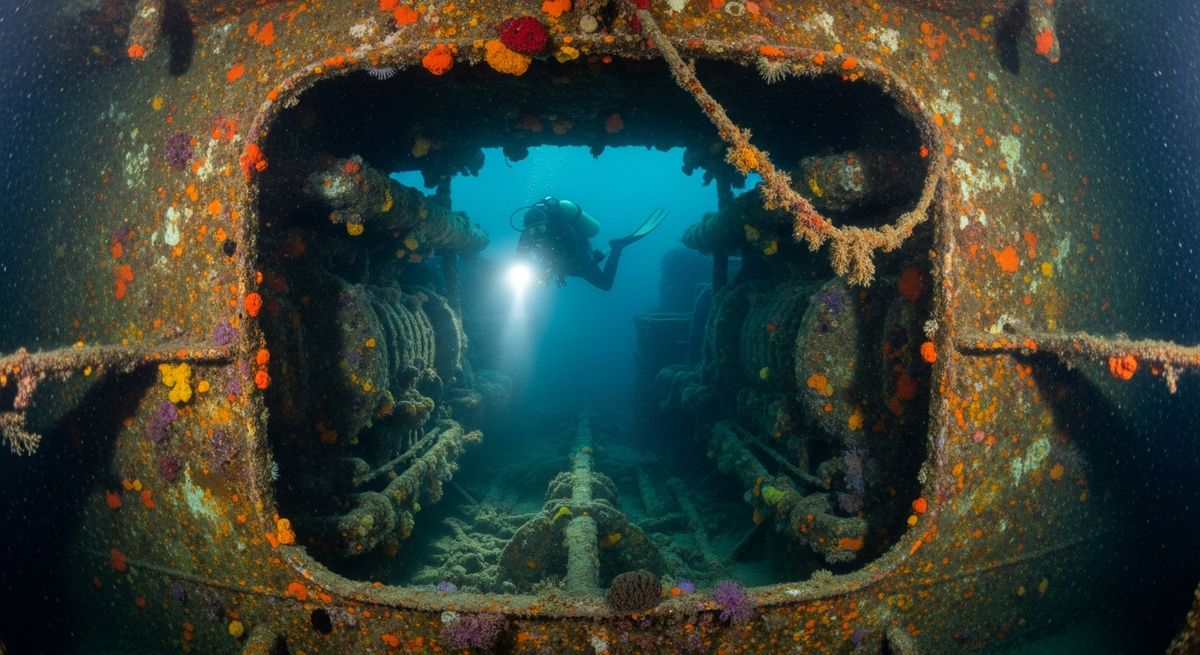
The Baltic Surveyor is a cracking dive, shallow and full of character. We love the way she sits upright, almost like she’s still sailing, just on the seabed now. You can really get a sense of her shape, the wheelhouse is still largely intact and the hold offers some nice swim-throughs if you're comfortable with overhead environments. This wreck is a magnet for life. We often find conger eels tucked away in every crevice, sometimes just their heads poking out looking grumpy. Crab and lobster are everywhere, scuttling amongst the plates, and the deck often has flatfish settled on it, perfectly camouflaged. It’s a great site for photographers because the light penetrates well, and the growth on the wreck is wonderfully colourful – lots of jewel anemones and dead man’s fingers. Best dived on a slack tide, obviously, to really take your time exploring her.
Typical BALTIC SURVEYOR Dive Profile
Illustrative profile based on site depth and type. Actual dive profiles vary - always follow your dive computer and training.
Safety Notes
Wreck site - avoid penetration without wreck diving certification. Watch for sharp metal and entanglement hazards.
BALTIC SURVEYOR Wreck History
Year Sunk
1996
Vessel Type
unknown
Cause
grounding
Tonnage
170 GRT
The Baltic Surveyor was a small survey vessel tasked with mapping the seabed, a crucial job for navigation and construction. Its career was cut short on October 28, 1996, when it fell victim to the notoriously rough seas off the Cornish coast. Caught in severe weather, the vessel was driven ashore and ran aground near Hannafore Point, West Looe, where it was battered by the relentless waves.
Despite attempts to salvage the vessel, the powerful sea conditions proved too much, and the Baltic Surveyor was declared a total loss. The wreck was broken apart by subsequent storms, scattering its remains across the shallow reef. Because of its proximity to shore and shallow depth, it was designated a "Dangerous Wreck" to warn other vessels of the navigational hazard.
Lying in just 9 meters of water, the wreckage of the Baltic Surveyor is now a popular and highly accessible dive site, especially for novice divers and training agencies. While no longer intact, the scattered plates, engine block, and other components create a fascinating artificial reef. The twisted metal provides shelter for a surprising amount of marine life, including wrasse, pollack, crabs, and lobsters. It's a perfect example of how nature quickly reclaims man-made objects, turning a maritime disaster into a thriving underwater habitat.
Nearest Dive Centres to BALTIC SURVEYOR
Dive shops near BALTIC SURVEYOR
Plymouth Diving Centre
Sound Diving Limited
Dive Looe
Scuba 2000
Viewpoint Diving Centre
Reviews for BALTIC SURVEYOR
Conditions
Ocean conditions, forecast and tides for BALTIC SURVEYOR
BALTIC SURVEYOR Ocean Conditions
Monthly averages for BALTIC SURVEYOR, sourced from Open-Meteo marine data - nearest station: Open-Meteo marine grid (50.44, -2.73) (3km away)
October Averages
Sea Temperature
17°C
62°F · Range: 15.1–17.5°C
Air Temperature
13°C
56°F
Wind Speed
8.14 m/s
15.8 knots
Atmospheric Pressure
1011 hPa
Based on 4 years of monitoring data · Data sources: Open-Meteo marine data
Plan & book
Ways to dive Cornwall & Devon, from day trips to liveaboards.
Day trips & courses
via GetYourGuideGuided dives, courses and snorkel trips with instant booking.
Find dive trips in Cornwall & DevonPlaces to stay
via Booking.comHotels and dive resorts near Cornwall & Devon.
Search stays in Cornwall & DevonDive insurance
Most travel insurance excludes or limits scuba. Check what you need before you go.
Dive insurance explainedPartner links: we may earn a commission if you book, at no extra cost to you. How we make money
Where to Stay near BALTIC SURVEYOR
Prices from Booking.com. We may earn a commission at no extra cost to you.