BARD (POSSIBLY)
Protected Area
Godrevy - Portreath
Why dive here
With 176+ marine species recorded in the area - including blue sharks, dolphins, dwarf minke whales, humpback whales and ocean sunfish (mola mola) - BARD (POSSIBLY) offers some of Cornwall & Devon's richest wreck diving. Water ranges 10-18°C, warmest July, August, September.
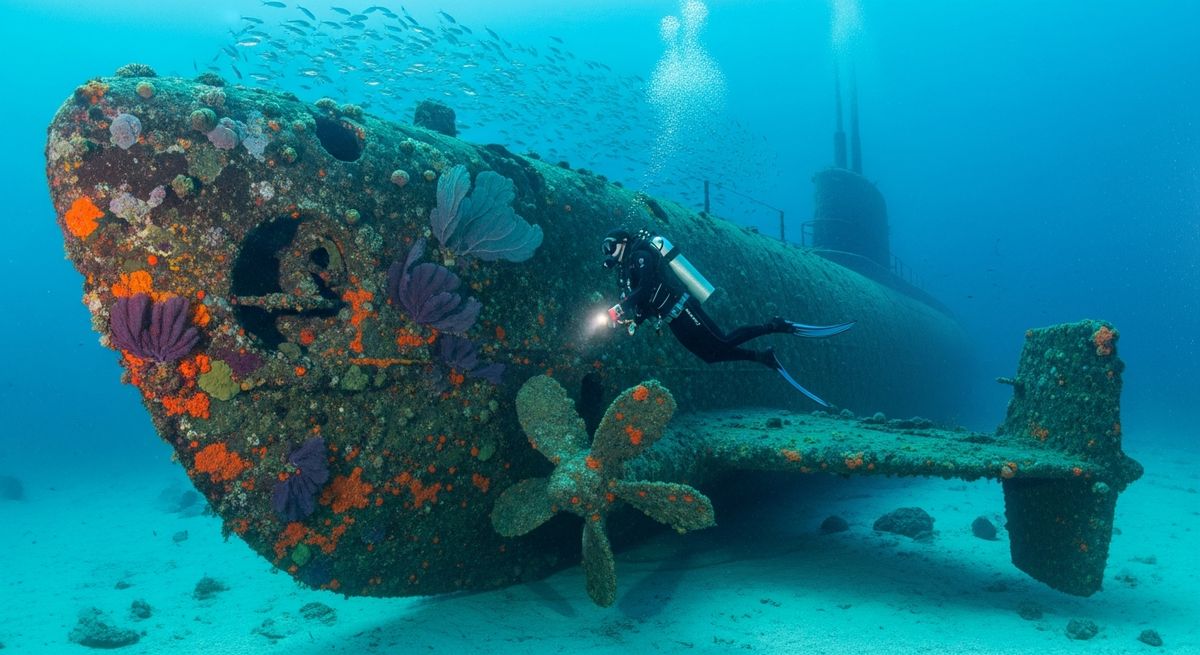
The Bard, or what we believe is the Bard, is a proper dive for proper wreck enthusiasts. Lying at 32 metres, she’s a steamship torpedoed in 1917, and her story feels etched into the twisted metal. We love poking around the stern, where the triple expansion engine still sits, a hulking testament to her past. You’ll find plenty of resident bib and pollock darting through the gaps, and often some impressive conger eels peering out from deeper crevices – always worth a slow look. This isn't a dive for the faint of heart or the inexperienced. Currents can be tricky here, so picking your day is key. Aim for slack water, and you'll get a good 30 minutes to explore her 56-metre length. Our favourite moments are drifting over the two boilers, just imagining the heat and clang that once echoed through them. It’s a dive that really makes you feel the history.
Typical BARD (POSSIBLY) Dive Profile
Illustrative profile based on site depth and type. Actual dive profiles vary - always follow your dive computer and training.
Safety Notes
Deep dive (32m) - monitor air consumption closely. Advanced certification recommended.
Wreck site - avoid penetration without wreck diving certification. Watch for sharp metal and entanglement hazards.
Always perform a 3-minute safety stop at 5m before surfacing.
BARD (POSSIBLY) Wreck History
Year Sunk
1917
Vessel Type
cargo ship
Cause
torpedo
Originally christened the SS Jens Meinich, this Norwegian-built steamship was constructed in 1892 and served as a typical cargo hauler of its era. Powered by a 79-horsepower triple-expansion engine and two large boilers, she plied the seas for a quarter of a century before being renamed the SS Bard.
Her final voyage took place during the height of the First World War. On December 11, 1917, while transporting a cargo of coal from Glasgow to Hennebont, France, the Bard was intercepted by the German submarine UB-31. A single torpedo struck the vessel, sealing its fate. The ship sank beneath the waves, becoming another casualty of the unrestricted submarine warfare that defined the conflict at sea.
Today, the wreck of the Bard rests at a depth of 32 meters off the coast of Cornwall. As a WWI-era wreck, it offers a poignant glimpse into history. Divers can explore the remains of the ship's structure, with the prominent boilers and the triple-expansion engine providing key landmarks. Over the decades, the wreck has transformed into a thriving artificial reef, attracting a variety of marine life and offering a compelling dive for those interested in maritime history.
Nearest Dive Centres to BARD (POSSIBLY)
Dive shops near BARD (POSSIBLY)
Wavecrest Scuba
Dive Newquay
Seaways Diving
DiveUK
Karleyth Diving Ltd.
Porthkerris Divers
Reviews for BARD (POSSIBLY)
Conditions
Ocean conditions, forecast and tides for BARD (POSSIBLY)
BARD (POSSIBLY) Ocean Conditions
Monthly averages for BARD (POSSIBLY), sourced from Open-Meteo marine data - nearest station: Open-Meteo marine grid (50.44, -2.73) (3km away)
October Averages
Sea Temperature
17°C
62°F · Range: 15.1–17.5°C
Air Temperature
13°C
56°F
Wind Speed
8.14 m/s
15.8 knots
Atmospheric Pressure
1011 hPa
Based on 4 years of monitoring data · Data sources: Open-Meteo marine data
Plan & book
Ways to dive Cornwall & Devon, from day trips to liveaboards.
Day trips & courses
via GetYourGuideGuided dives, courses and snorkel trips with instant booking.
Find dive trips in Cornwall & DevonPlaces to stay
via Booking.comHotels and dive resorts near Cornwall & Devon.
Search stays in Cornwall & DevonDive insurance
Most travel insurance excludes or limits scuba. Check what you need before you go.
Dive insurance explainedPartner links: we may earn a commission if you book, at no extra cost to you. How we make money
Where to Stay near BARD (POSSIBLY)
Prices from Booking.com. We may earn a commission at no extra cost to you.