BARON SALTOUN
Protected Area
Les Ecrehous
Why dive here
With 176+ marine species recorded in the area - including blue sharks, dolphins, dwarf minke whales, humpback whales and ocean sunfish (mola mola) - BARON SALTOUN offers some of Cornwall & Devon's richest wreck diving. Water ranges 10-18°C, warmest July, August, September.
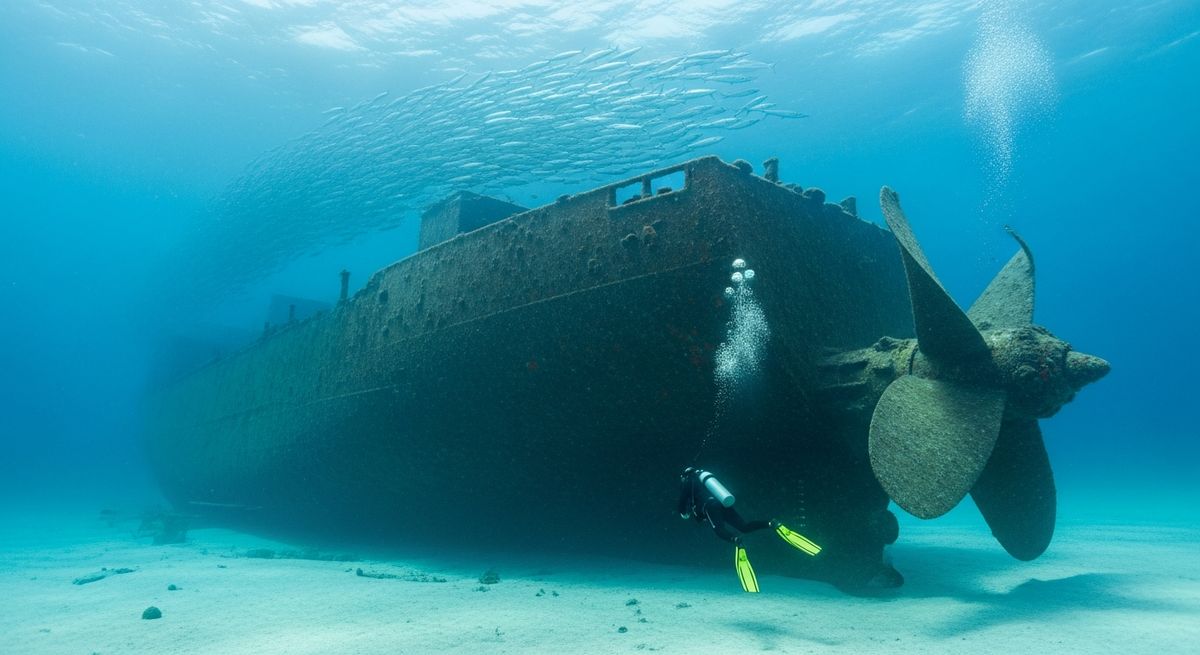
The Baron Saltoun is a proper wreck dive, sitting upright and pretty intact in a modest 12 metres of water. We love it because it’s so accessible for most divers, especially when the conditions are good, meaning less current and decent visibility. The bow points west and you can make out the anchor chains and winches fairly easily. Drop down into the holds, which are often swarming with schools of pollack and wrasse. We’ve even seen a few conger eels tucked away in the darker recesses. It’s a bit of a historical dive too, a WWII casualty, mined in 1940. You get a real sense of its past as you explore the structure; the metalwork is heavily encrusted with plumose anemones and dead man’s fingers, which really bloom in the current. Our favourite spot is usually around the stern, where the prop shaft can still be seen and there’s often a lively display of blennies and gobies flitting about. It's a great site for photographers keen on macro subjects and those looking for a relaxed wreck exploration without the usual deep dive headaches.
Typical BARON SALTOUN Dive Profile
Illustrative profile based on site depth and type. Actual dive profiles vary - always follow your dive computer and training.
Safety Notes
Wreck site - avoid penetration without wreck diving certification. Watch for sharp metal and entanglement hazards.
Always perform a 3-minute safety stop at 5m before surfacing.
BARON SALTOUN Wreck History
Year Sunk
1940
Vessel Type
cargo ship
Cause
mine
The SS Baron Saltoun was a British freighter caught in the maelstrom of the Second World War. By June 1940, the English Channel and its approaches were a deadly theatre of war, with German U-boats and aircraft laying extensive minefields to disrupt the vital shipping that kept Britain alive. The Baron Saltoun was one of the many merchant vessels sailing under this constant threat, carrying essential cargo for the war effort.
On June 12, 1940, the ship's luck ran out when it struck a German mine off the coast of Cornwall. The explosion was devastating, sending the freighter to the bottom. Today, the Baron Saltoun lies at a depth of 12 metres. Its designation as a 'Dangerous Wreck' is a warning to divers of potential hazards from snagging on twisted metal. For those who dive it, the wreck is a poignant and accessible piece of WWII history, its structure now serving as an artificial reef teeming with marine life, a silent monument to the perils of the Battle of the Atlantic.
Reviews for BARON SALTOUN
Conditions
Ocean conditions, forecast and tides for BARON SALTOUN
BARON SALTOUN Ocean Conditions
Monthly averages for BARON SALTOUN, sourced from Open-Meteo marine data - nearest station: Open-Meteo marine grid (50.44, -2.73) (3km away)
October Averages
Sea Temperature
17°C
62°F · Range: 15.1–17.5°C
Air Temperature
13°C
56°F
Wind Speed
8.14 m/s
15.8 knots
Atmospheric Pressure
1011 hPa
Based on 4 years of monitoring data · Data sources: Open-Meteo marine data
Plan & book
Ways to dive Cornwall & Devon, from day trips to liveaboards.
Day trips & courses
via GetYourGuideGuided dives, courses and snorkel trips with instant booking.
Find dive trips in Cornwall & DevonPlaces to stay
via Booking.comHotels and dive resorts near Cornwall & Devon.
Search stays in Cornwall & DevonDive insurance
Most travel insurance excludes or limits scuba. Check what you need before you go.
Dive insurance explainedPartner links: we may earn a commission if you book, at no extra cost to you. How we make money
Where to Stay near BARON SALTOUN
Prices from Booking.com. We may earn a commission at no extra cost to you.