BARSAC
Why dive here
With 176+ marine species recorded in the area - including blue sharks, dolphins, dwarf minke whales, humpback whales and ocean sunfish (mola mola) - BARSAC offers some of Cornwall & Devon's richest wreck diving. Water ranges 10-18°C, warmest July, August, September.
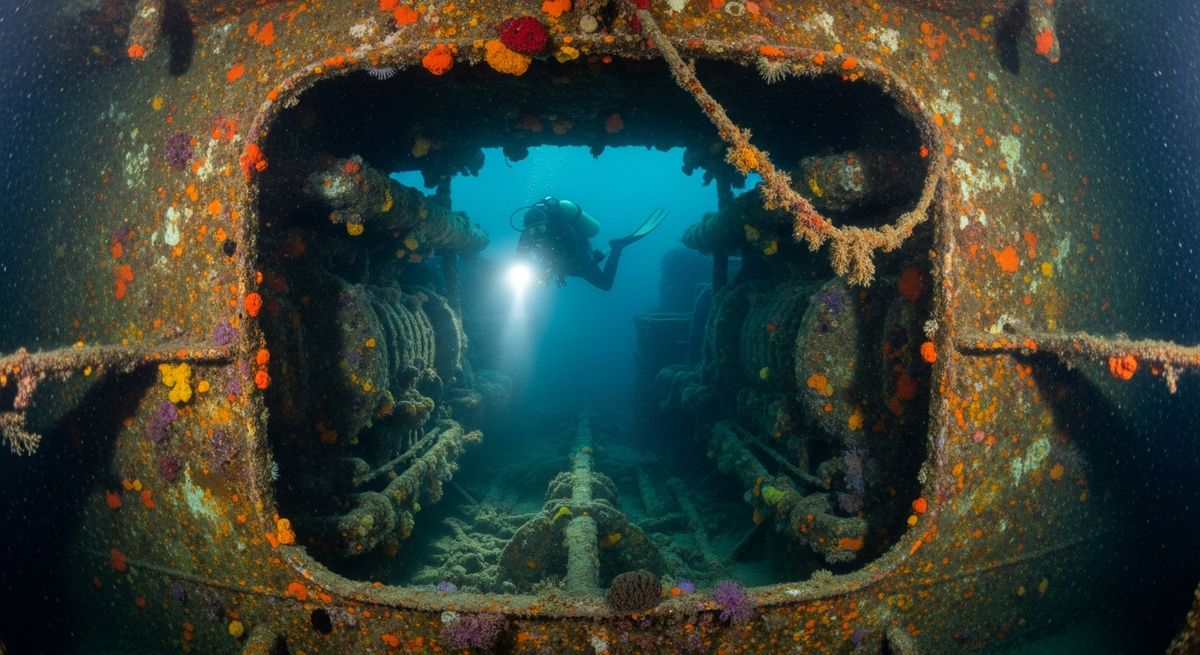
The BARSAC is a moody old girl, sitting upright at 34 metres, and for us, she’s a standout on the UK wreck roster. What makes her special isn’t just the history – torpedoed in 1918 off Le Havre – it’s the way she’s come to rest. The bow points west, split down the middle by the impact, creating a dramatic V-shape as you descend into the gloom. We love hovering over that broken bow, looking into the cargo holds, sometimes spotting a shy anglerfish tucked away. She’s well-colonised now, with dead man's fingers coating the bulkheads and huge bib shoals swirling through the superstructure. Our favourite is the stern, still quite intact, where you can often find conger eels peering from pipes. This isn't a wreck for beginners, mind you. The depth means careful planning, and currents can be a factor, so pick your weather window. Come with a good torch; the BARSAC truly reveals herself in the beams. You’ll feel the weight of history here, a real connection to the past.
Typical BARSAC Dive Profile
Illustrative profile based on site depth and type. Actual dive profiles vary - always follow your dive computer and training.
Safety Notes
Deep dive (34m) - monitor air consumption closely. Advanced certification recommended.
Wreck site - avoid penetration without wreck diving certification. Watch for sharp metal and entanglement hazards.
Always perform a 3-minute safety stop at 5m before surfacing.
BARSAC Wreck History
Year Sunk
1918
Vessel Type
cargo ship
Cause
torpedo
Tonnage
1,838 GRT
The SS Barsac was a British steamship that served during the height of the First World War, ferrying vital supplies across the English Channel. Built in 1904, the 1,838-ton vessel played a crucial role in the war effort, navigating the dangerous, submarine-infested waters between Britain and France. Its career came to an abrupt and violent end on January 11, 1918, while on a voyage from Brest to Le Havre with a cargo of hay for the war effort on the Western Front.
Just 15 miles from its destination, the Barsac was spotted by the German submarine UB-58. A single torpedo struck the vessel, sealing its fate. The ship sank quickly, becoming another casualty of the unrestricted submarine warfare that defined the era. The wreck now lies on the seabed as a solemn memorial to the perils faced by the merchant navy during WWI.
Today, the Barsac rests at a depth of 34 metres. Classified as a dangerous wreck, it presents a challenging and rewarding dive for experienced wreck enthusiasts exploring the waters off the French coast. The structure is broken but offers a fascinating glimpse into a WWI-era steamship, with its boilers and machinery often visible. The wreck is a poignant reminder of a conflict that reached far beneath the waves.
Reviews for BARSAC
Conditions
Ocean conditions, forecast and tides for BARSAC
BARSAC Ocean Conditions
Monthly averages for BARSAC, sourced from Open-Meteo marine data - nearest station: Open-Meteo marine grid (50.44, -2.73) (3km away)
October Averages
Sea Temperature
17°C
62°F · Range: 15.1–17.5°C
Air Temperature
13°C
56°F
Wind Speed
8.14 m/s
15.8 knots
Atmospheric Pressure
1011 hPa
Based on 4 years of monitoring data · Data sources: Open-Meteo marine data
Plan & book
Ways to dive Cornwall & Devon, from day trips to liveaboards.
Day trips & courses
via GetYourGuideGuided dives, courses and snorkel trips with instant booking.
Find dive trips in Cornwall & DevonPlaces to stay
via Booking.comHotels and dive resorts near Cornwall & Devon.
Search stays in Cornwall & DevonDive insurance
Most travel insurance excludes or limits scuba. Check what you need before you go.
Dive insurance explainedPartner links: we may earn a commission if you book, at no extra cost to you. How we make money
Where to Stay near BARSAC
Prices from Booking.com. We may earn a commission at no extra cost to you.