BATH CITY (POSSIBLY)
Protected Area
Lundy
Why dive here
With 176+ marine species recorded in the area - including blue sharks, dolphins, dwarf minke whales, humpback whales and ocean sunfish (mola mola) - BATH CITY (POSSIBLY) offers some of Cornwall & Devon's richest wreck diving. Water ranges 10-18°C, warmest July, August, September.
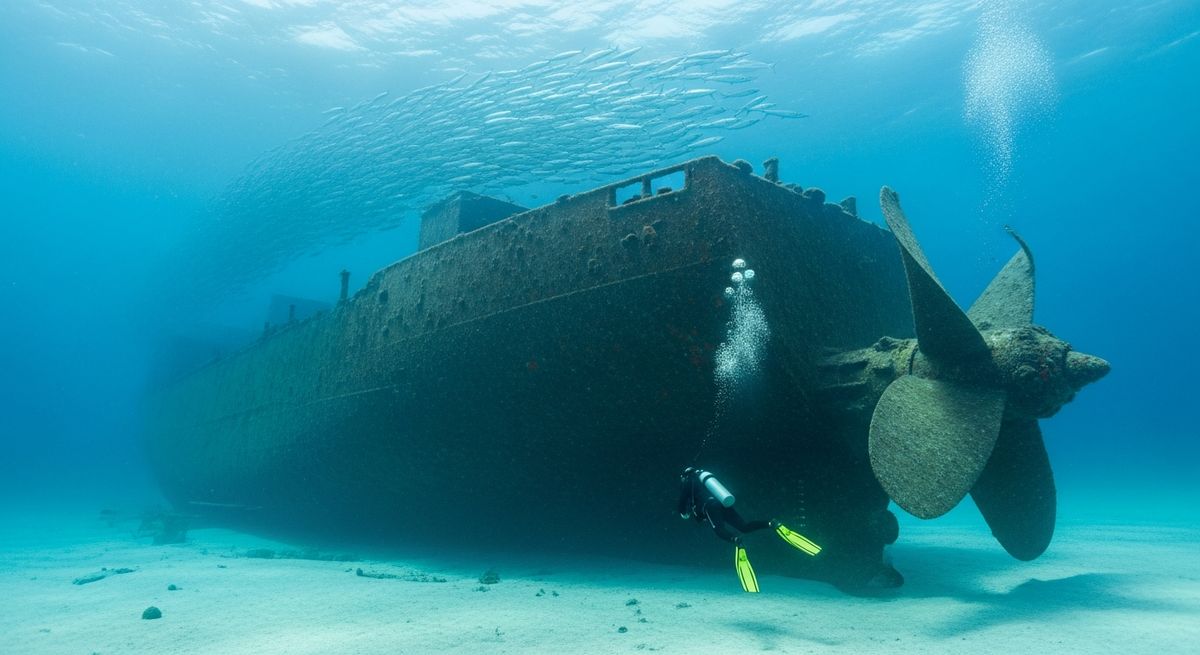
The Bath City. We say 'possibly' because while the chart shows her here, and it's definitely a wreck of the right era, absolute confirmation still eludes us. But what a wreck it is, at 42m, she’s a proper expedition. Dropping onto the bridge amidships, the sheer scale hits you; this 94.5-meter steamship is substantial. You’ll find sections of plating peeling away like ancient parchment, revealing the ribs of the ship beneath, now thick with plumose anemones – pure white against the gloom. Our favourite part is the stern, where the triple-expansion engine room is still quite recognisable. You can swim down into the holds, feeling the chill of the deep, seeing conger eels snaking through the shadowy crevices. We've seen ling here the size of small torpedoes, just hanging in the current, unfazed by divers. It’s a site for experienced wreck divers, no question, comfortable with depth and overhead environments. The Bath City is a journey back in time, a tangible piece of maritime history, and a fantastic deep dive. Just be prepared for the chill, even in summer.
Typical BATH CITY (POSSIBLY) Dive Profile
Illustrative profile based on site depth and type. Actual dive profiles vary - always follow your dive computer and training.
Safety Notes
Maximum depth 42m exceeds recreational limits (40m). Technical diving certification and equipment required.
Wreck site - avoid penetration without wreck diving certification. Watch for sharp metal and entanglement hazards.
Always perform a 3-minute safety stop at 5m before surfacing.
BATH CITY (POSSIBLY) Wreck History
Year Sunk
1900
Vessel Type
cargo ship
Cause
grounding
The SS Bath City was a modern steamship with a tragically short life. Built in 1899 by the respected J.L. Thompson & Sons shipyard, she was equipped with a powerful triple-expansion steam engine, representing the cutting edge of maritime technology at the turn of the 20th century. However, her career would last less than a year.
On February 24, 1900, while navigating the notoriously treacherous waters around Lundy Island in the Bristol Channel, the Bath City made a fatal error. She struck the infamous Needle Rock, tearing a catastrophic hole in her hull. The damage was too severe to overcome, and the new steamship foundered and sank. While the wreck is widely identified as the Bath City, a degree of uncertainty remains, adding a layer of intrigue for visiting divers.
Today, the wreck lies at 42 meters, making it a dive reserved for experienced and deep-certified divers. The conditions off the Devon coast can be challenging, but the reward is a visit to a beautifully preserved piece of maritime history. Divers can explore the substantial remains, including the prominent boilers, the engine block, and large sections of the hull. The structure is heavily encrusted with jewel anemones and home to conger eels, lobsters, and dense schools of bib, offering a stunning and atmospheric deep dive into the past.
Nearest Dive Centres to BATH CITY (POSSIBLY)
Dive shops near BATH CITY (POSSIBLY)
View all dive centres in Cornwall & DevonReviews for BATH CITY (POSSIBLY)
Conditions
Ocean conditions, forecast and tides for BATH CITY (POSSIBLY)
BATH CITY (POSSIBLY) Ocean Conditions
Monthly averages for BATH CITY (POSSIBLY), sourced from Open-Meteo marine data - nearest station: Open-Meteo marine grid (50.44, -2.73) (3km away)
October Averages
Sea Temperature
17°C
62°F · Range: 15.1–17.5°C
Air Temperature
13°C
56°F
Wind Speed
8.14 m/s
15.8 knots
Atmospheric Pressure
1011 hPa
Based on 4 years of monitoring data · Data sources: Open-Meteo marine data
Plan & book
Ways to dive Cornwall & Devon, from day trips to liveaboards.
Day trips & courses
via GetYourGuideGuided dives, courses and snorkel trips with instant booking.
Find dive trips in Cornwall & DevonPlaces to stay
via Booking.comHotels and dive resorts near Cornwall & Devon.
Search stays in Cornwall & DevonDive insurance
Most travel insurance excludes or limits scuba. Check what you need before you go.
Dive insurance explainedPartner links: we may earn a commission if you book, at no extra cost to you. How we make money
Where to Stay near BATH CITY (POSSIBLY)
Prices from Booking.com. We may earn a commission at no extra cost to you.