BAYAWAHHA
Protected Area
Start Point to Plymouth Sound and Eddystone
Why dive here
With 176+ marine species recorded in the area - including blue sharks, dolphins, dwarf minke whales, humpback whales and ocean sunfish (mola mola) - BAYAWAHHA offers some of Cornwall & Devon's richest wreck diving. Water ranges 10-18°C, warmest July, August, September.
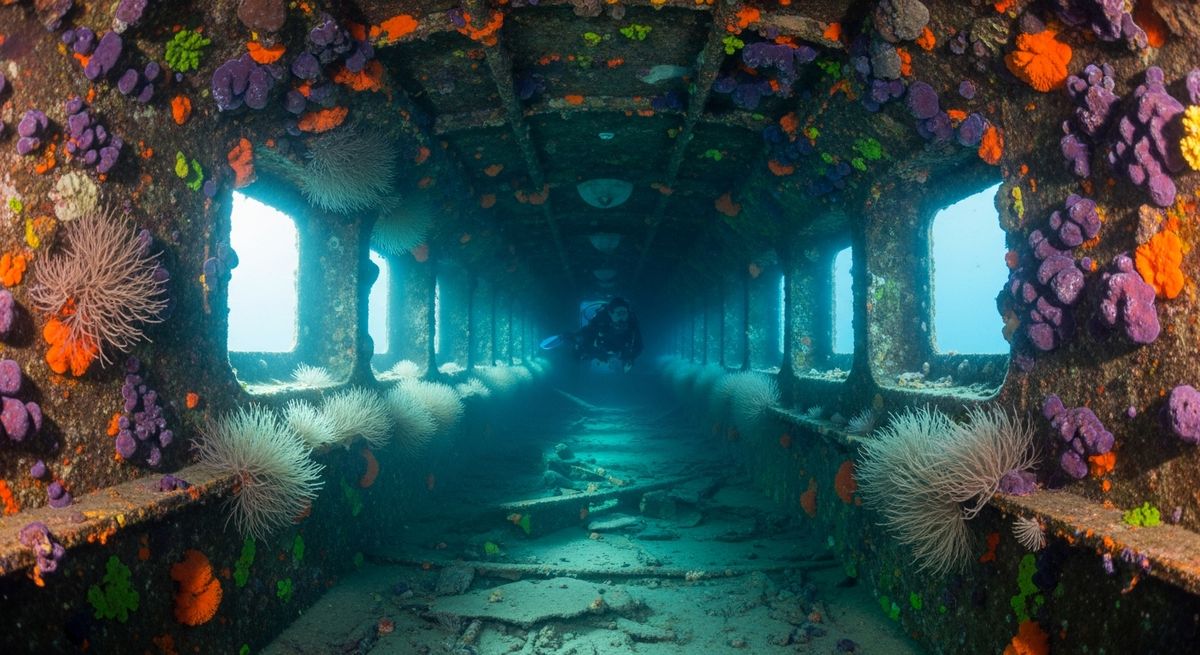
Bayawaha. Even the name has a certain mysterious ring to it, doesn’t it? This isn't a sunny tropical reef, but for those who love a good piece of history beneath the waves, she's a proper find off the Cornish coast. Dropping down to 38 metres, you're looking at a serious deep dive here, so save it for when you're feeling sharp and properly qualified. We love the Bayawaha because she's more than just a pile of metal; she's a time capsule from New Year's Eve, 1916. Sunk en route from Plymouth to Dartmouth, the wreck sits upright, remarkably intact in places. You can pick out engine room components and parts of her structure, which is always satisfying for wreck aficionados. Visibility, like much of the UK, can be a bit of a lottery, but on a good day, the low light filtering through the green water gives her a truly atmospheric feel. Look closely and you'll spot plenty of dab and dogfish lurking in the shadows, along with spider crabs scuttling over corroded plates. It's a dive that rewards patience and a good torch, perfect for experienced wreck divers who appreciate maritime history over colourful corals.
Typical BAYAWAHHA Dive Profile
Illustrative profile based on site depth and type. Actual dive profiles vary - always follow your dive computer and training.
Safety Notes
Deep dive (38m) - monitor air consumption closely. Advanced certification recommended.
Wreck site - avoid penetration without wreck diving certification. Watch for sharp metal and entanglement hazards.
Always perform a 3-minute safety stop at 5m before surfacing.
BAYAWAHHA Wreck History
Year Sunk
1916
Vessel Type
cargo ship
Cause
mine
Tonnage
3,626 GRT
The SS Bayawahha was a British steam cargo ship that, like so many merchant vessels of her time, found herself playing a crucial role during the First World War. At over 3,600 tons, she was a workhorse of the merchant fleet, tasked with transporting vital supplies to keep the country running and to support the ongoing war effort against the Central Powers.
Her career was cut short on New Year's Eve, 1916. While undertaking a short coastal journey from Plymouth to Dartmouth, a seemingly safe passage, she had the misfortune of striking a German mine. The mine had been laid by the submarine UC-16, part of Germany's campaign to cripple British shipping. The explosion was catastrophic, and the Bayawahha sank with the loss of four of her crew.
Resting at 38 meters, the wreck of the Bayawahha is now a popular site for experienced UK divers. She lies on her starboard side and is significantly broken up, with her bow and stern sections being the most prominent features. Her boilers stand tall from the wreckage, providing an unmissable landmark for navigation. The scattered remains have transformed into an excellent artificial reef, providing a home for conger eels, lobsters, and dense schools of bib and pollack.
Nearest Dive Centres to BAYAWAHHA
Dive shops near BAYAWAHHA
Sound Diving Limited
Plymouth Diving Centre
Dive Looe
Teign Diving Centre
Reviews for BAYAWAHHA
Conditions
Ocean conditions, forecast and tides for BAYAWAHHA
BAYAWAHHA Ocean Conditions
Monthly averages for BAYAWAHHA, sourced from Open-Meteo marine data - nearest station: Open-Meteo marine grid (50.44, -2.73) (3km away)
October Averages
Sea Temperature
17°C
62°F · Range: 15.1–17.5°C
Air Temperature
13°C
56°F
Wind Speed
8.14 m/s
15.8 knots
Atmospheric Pressure
1011 hPa
Based on 4 years of monitoring data · Data sources: Open-Meteo marine data
Plan & book
Ways to dive Cornwall & Devon, from day trips to liveaboards.
Day trips & courses
via GetYourGuideGuided dives, courses and snorkel trips with instant booking.
Find dive trips in Cornwall & DevonPlaces to stay
via Booking.comHotels and dive resorts near Cornwall & Devon.
Search stays in Cornwall & DevonDive insurance
Most travel insurance excludes or limits scuba. Check what you need before you go.
Dive insurance explainedPartner links: we may earn a commission if you book, at no extra cost to you. How we make money
Where to Stay near BAYAWAHHA
Prices from Booking.com. We may earn a commission at no extra cost to you.