BAYCHATTAN
Protected Area
Skerries Bank and Surrounds
Why dive here
With 176+ marine species recorded in the area - including blue sharks, dolphins, dwarf minke whales, humpback whales and ocean sunfish (mola mola) - BAYCHATTAN offers some of Cornwall & Devon's richest wreck diving. Water ranges 10-18°C, warmest July, August, September.
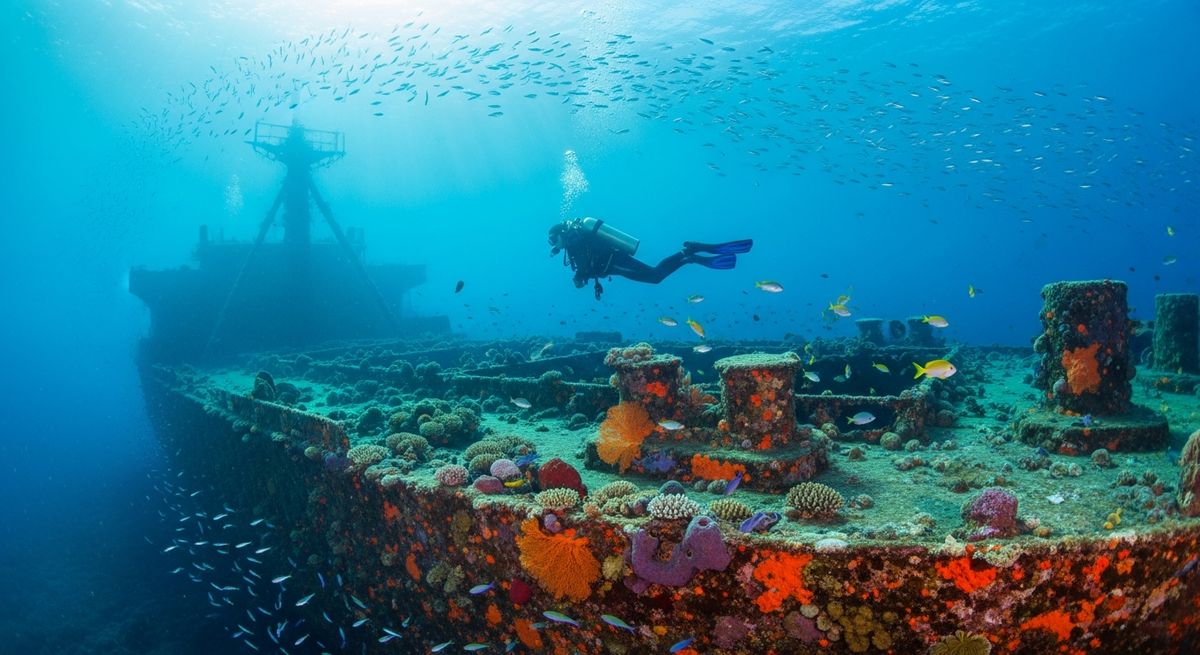
Dropping onto the Baychattan is like stepping back in time, if time travel involved a cold plunge into the Atlantic. This isn’t a shallow reef bimble, so bring your twinset and make sure your drysuit is sealed tight. We love how intact she is for a ship that met her end over a century ago. You’ll trace her massive 110-meter length, starting with the bow, often upright and proud, before working your way along the deck. The bridge area is our favourite, where the telegraphs and helm often remain, encrusted with dead man’s fingers and hydroids. Visibility can be a real mixed bag; if you catch it on a good day, the light filters down, illuminating schools of pollock that dart between the superstructure. Even when it's murky, the sheer scale of the ship is impressive, looming out of the gloom. This site truly suits experienced wreck divers who appreciate history and don't mind a proper expedition.
Typical BAYCHATTAN Dive Profile
Illustrative profile based on site depth and type. Actual dive profiles vary - always follow your dive computer and training.
Safety Notes
Maximum depth 53m exceeds recreational limits (40m). Technical diving certification and equipment required.
Wreck site - avoid penetration without wreck diving certification. Watch for sharp metal and entanglement hazards.
Always perform a 3-minute safety stop at 5m before surfacing.
BAYCHATTAN Wreck History
Year Sunk
1917
Vessel Type
cargo ship
Cause
torpedo
Tonnage
3,758 GRT
The SS Baychattan began her life in 1906 as the Kilchattan, built in the famous shipyards of Glasgow. She was later acquired by The Bay Steamship Co. Ltd., joining their fleet of cargo vessels. During World War I, she was engaged in long-haul transport, bringing essential goods from across the British Empire to the home islands. In the autumn of 1917, she was on the final leg of a long voyage from Karachi, carrying a general cargo destined for London.
On October 11th, 1917, as she navigated the English Channel south of the Eddystone Lighthouse, she was spotted by the German submarine UB-40. Without warning, a torpedo struck the vessel, sealing her fate. The Baychattan sank beneath the waves, another victim of Germany's unrestricted submarine warfare campaign which aimed to starve Britain into submission.
Today, the Baychattan is a deep technical dive, lying upright on the seabed at 53 meters. Her significant depth has helped preserve her, and while the wooden superstructure has long since rotted away, her hull remains impressively intact. The most prominent features for divers are the massive triple-expansion engine and two large boilers, which stand proud amidships. The wreck is often subject to strong currents, but this can result in excellent visibility, offering a spectacular view of this historic vessel and the deep-water marine life that now calls her home.
Nearest Dive Centres to BAYCHATTAN
Dive shops near BAYCHATTAN
Sound Diving Limited
Plymouth Diving Centre
Teign Diving Centre
Reviews for BAYCHATTAN
Conditions
Ocean conditions, forecast and tides for BAYCHATTAN
BAYCHATTAN Ocean Conditions
Monthly averages for BAYCHATTAN, sourced from Open-Meteo marine data - nearest station: Open-Meteo marine grid (50.44, -2.73) (3km away)
October Averages
Sea Temperature
17°C
62°F · Range: 15.1–17.5°C
Air Temperature
13°C
56°F
Wind Speed
8.14 m/s
15.8 knots
Atmospheric Pressure
1011 hPa
Based on 4 years of monitoring data · Data sources: Open-Meteo marine data
Plan & book
Ways to dive Cornwall & Devon, from day trips to liveaboards.
Day trips & courses
via GetYourGuideGuided dives, courses and snorkel trips with instant booking.
Find dive trips in Cornwall & DevonPlaces to stay
via Booking.comHotels and dive resorts near Cornwall & Devon.
Search stays in Cornwall & DevonDive insurance
Most travel insurance excludes or limits scuba. Check what you need before you go.
Dive insurance explainedPartner links: we may earn a commission if you book, at no extra cost to you. How we make money
Where to Stay near BAYCHATTAN
Prices from Booking.com. We may earn a commission at no extra cost to you.