BELFORT
Protected Area
Gouliot Caves and Headland, Sark
Why dive here
With 176+ marine species recorded in the area - including blue sharks, dolphins, dwarf minke whales, humpback whales and ocean sunfish (mola mola) - BELFORT offers some of Cornwall & Devon's richest wreck diving. Water ranges 10-18°C, warmest July, August, September.
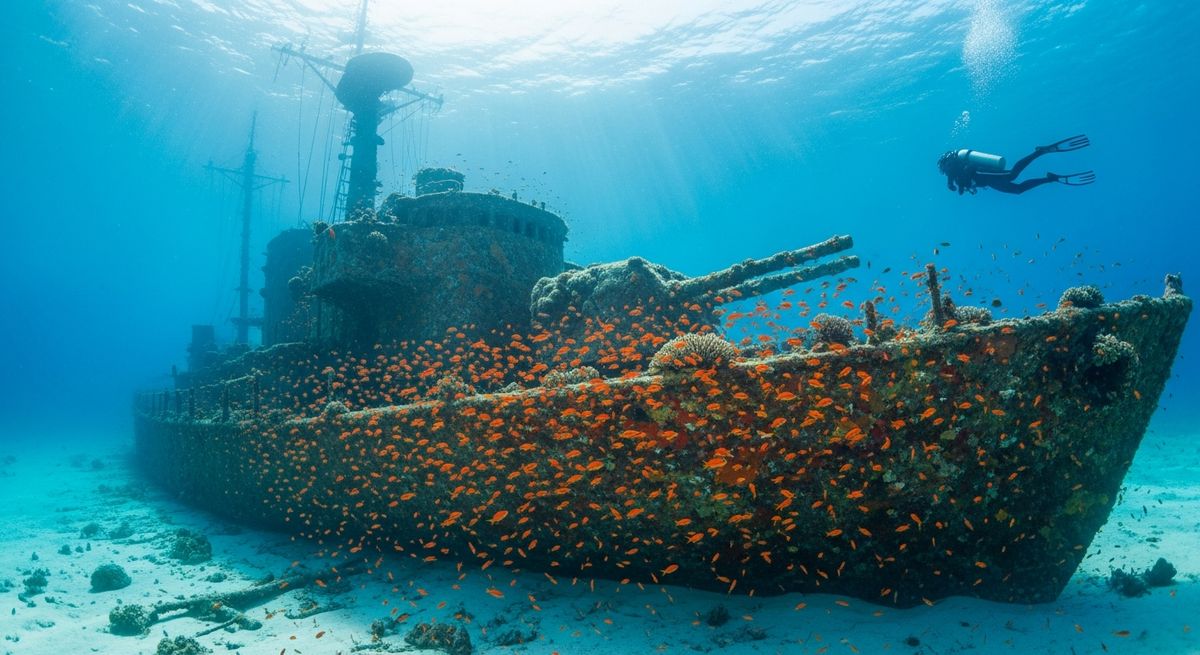
The BELFORT. What a story, right? Sunk way back in 1886, carrying iron ore from Bilbao, and now she’s a scattered, shallow secret off Selle Rock. At just two metres deep, this isn't about penetration or grand structures. It's about history you can touch, and frankly, a perfect spot for those days when you just want to potter about with a camera, or introduce someone to wreck diving without the faff of depth. We love finning slowly over the low-lying plates and frames. The iron is heavily concreted, of course, but you can still make out the distinct shapes of her hull. Schools of juvenile pollack often shimmer above the wreckage, and we’ve seen some seriously chunky spider crabs hunkering down amongst the larger pieces of twisted metal. Look closely, and you’ll spot nudibranchs, often the colourful sea lemon, grazing on the encrusting sponges. It’s a very gentle dive, often with surprisingly good visibility for the area, especially on a neap tide. Our tip? Go at slack water on a sunny day. The way the light plays on the scattered remains, illuminating the kelp and the inquisitive wrasse, is just magic.
Typical BELFORT Dive Profile
Illustrative profile based on site depth and type. Actual dive profiles vary - always follow your dive computer and training.
Safety Notes
Wreck site - avoid penetration without wreck diving certification. Watch for sharp metal and entanglement hazards.
BELFORT Wreck History
Year Sunk
1886
Vessel Type
cargo ship
Cause
grounding
On August 30, 1886, the steamship Belfort was on a commercial voyage from Bilbao, Spain, to Dunkirk, France, likely laden with a heavy cargo. While navigating the treacherous waters off the Cornish coast, she struck Selle Rock and became hopelessly stranded. The powerful Atlantic swell quickly sealed her fate, and the ship was declared a total loss. Over the subsequent years, the sea has relentlessly pounded the wreck, breaking it into countless pieces.
At a mere 2 meters deep, the remains of the Belfort are now a widely scattered debris field. This is not a dive for those seeking an intact structure, but rather a snorkel or a very shallow exploration for history enthusiasts. Divers and snorkelers can spend time hunting among the rocks and kelp for signs of the vessel-a piece of hull plating, a twisted pipe, or other remnants of the 19th-century steamer. It serves as a stark reminder of the power of the sea and the dangers faced by mariners in the age of steam.
Nearest Dive Centres to BELFORT
Dive shops near BELFORT
View all dive centres in Cornwall & DevonReviews for BELFORT
Conditions
Ocean conditions, forecast and tides for BELFORT
BELFORT Ocean Conditions
Monthly averages for BELFORT, sourced from Open-Meteo marine data - nearest station: Open-Meteo marine grid (50.44, -2.73) (3km away)
October Averages
Sea Temperature
17°C
62°F · Range: 15.1–17.5°C
Air Temperature
13°C
56°F
Wind Speed
8.14 m/s
15.8 knots
Atmospheric Pressure
1011 hPa
Based on 4 years of monitoring data · Data sources: Open-Meteo marine data
Plan & book
Ways to dive Cornwall & Devon, from day trips to liveaboards.
Day trips & courses
via GetYourGuideGuided dives, courses and snorkel trips with instant booking.
Find dive trips in Cornwall & DevonPlaces to stay
via Booking.comHotels and dive resorts near Cornwall & Devon.
Search stays in Cornwall & DevonDive insurance
Most travel insurance excludes or limits scuba. Check what you need before you go.
Dive insurance explainedPartner links: we may earn a commission if you book, at no extra cost to you. How we make money
Where to Stay near BELFORT
Prices from Booking.com. We may earn a commission at no extra cost to you.