BELLE COLOMBE
Protected Area
Gouliot Caves and Headland, Sark
Why dive here
With 176+ marine species recorded in the area - including blue sharks, dolphins, dwarf minke whales, humpback whales and ocean sunfish (mola mola) - BELLE COLOMBE offers some of Cornwall & Devon's richest wreck diving. Water ranges 10-18°C, warmest July, August, September.
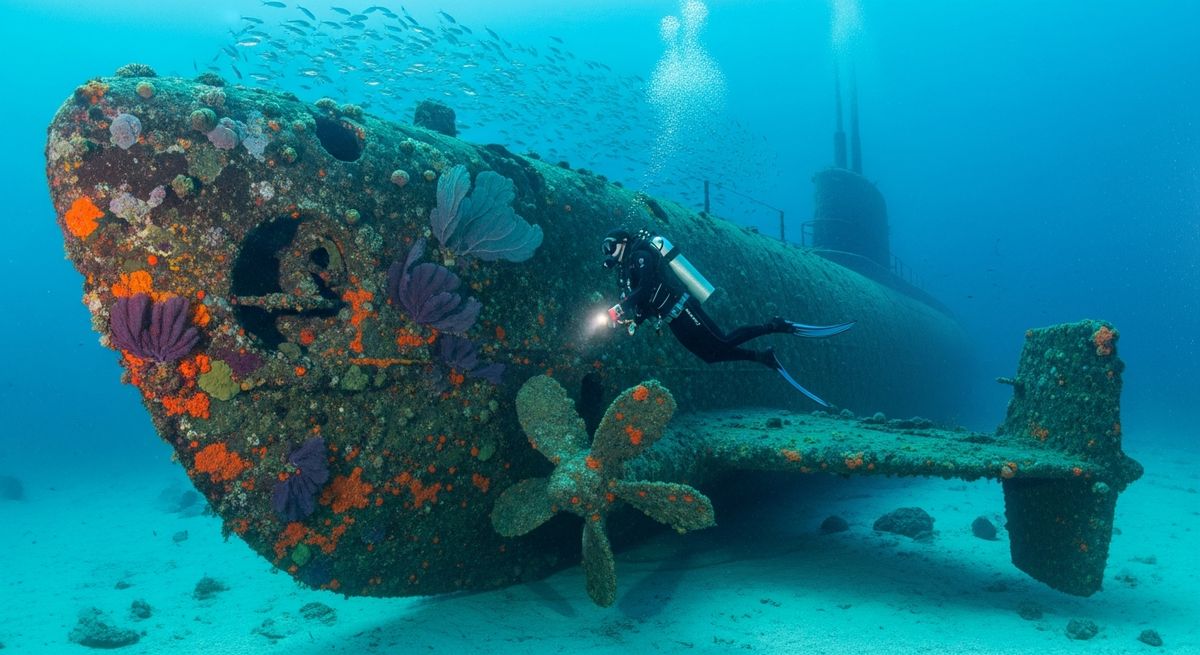
The Belle Colombe, sunk after a collision with a ferry in 1986, is one of those wrecks we keep coming back to off the Cornish coast. She's a wooden-hulled fishing vessel, only 17.4 metres long, sitting upright at 35 metres. The current can be brisk here, so it’s best suited for experienced divers comfortable in low visibility and stronger flow. We love dropping down onto her, seeing the deck still largely intact, the rigging draped like seaweed. The stern is our favourite spot, often swarming with pollack and wrasse. Look closely and you’ll find conger eels tucked into what’s left of the wheelhouse, their eyes following you. The wooden hull is collapsing gently in places, creating little caverns where spider crabs huddle. Dive her on a slack tide, if you can time it right, and you’ll have a more relaxed exploration, with the details of her working life as a fishing boat still evident beneath the layers of marine growth.
Typical BELLE COLOMBE Dive Profile
Illustrative profile based on site depth and type. Actual dive profiles vary - always follow your dive computer and training.
Safety Notes
Deep dive (35m) - monitor air consumption closely. Advanced certification recommended.
Wreck site - avoid penetration without wreck diving certification. Watch for sharp metal and entanglement hazards.
Always perform a 3-minute safety stop at 5m before surfacing.
BELLE COLOMBE Wreck History
Year Sunk
1986
Vessel Type
fishing vessel
Cause
collision
The story of the Belle Colombe is one of a sudden and dramatic end. On April 20, 1986, the wooden-hulled fishing vessel was on passage from Ireland to Guernsey in good weather conditions. Its journey was tragically interrupted when it was struck by the French passenger and vehicle ferry, Breizh Izel. The collision was catastrophic for the smaller vessel, and the Belle Colombe sank quickly, coming to rest on the seabed 35 metres below.
Today, the Belle Colombe is a fascinating dive for appropriately certified divers. Lying at 35 metres, the wreck is subject to the steady decay that affects all wooden vessels, meaning the hull has largely broken down. However, the more resilient metal components, such as the engine, winches, and other machinery, remain proud of the seabed, providing a clear outline of the vessel's former life. These structures have become an artificial reef, attracting schools of fish and sheltering various crustaceans, offering a poignant and beautiful dive site born from a sudden maritime incident.
Nearest Dive Centres to BELLE COLOMBE
Dive shops near BELLE COLOMBE
View all dive centres in Cornwall & DevonReviews for BELLE COLOMBE
Conditions
Ocean conditions, forecast and tides for BELLE COLOMBE
BELLE COLOMBE Ocean Conditions
Monthly averages for BELLE COLOMBE, sourced from Open-Meteo marine data - nearest station: Open-Meteo marine grid (50.44, -2.73) (3km away)
October Averages
Sea Temperature
17°C
62°F · Range: 15.1–17.5°C
Air Temperature
13°C
56°F
Wind Speed
8.14 m/s
15.8 knots
Atmospheric Pressure
1011 hPa
Based on 4 years of monitoring data · Data sources: Open-Meteo marine data
Plan & book
Ways to dive Cornwall & Devon, from day trips to liveaboards.
Day trips & courses
via GetYourGuideGuided dives, courses and snorkel trips with instant booking.
Find dive trips in Cornwall & DevonPlaces to stay
via Booking.comHotels and dive resorts near Cornwall & Devon.
Search stays in Cornwall & DevonDive insurance
Most travel insurance excludes or limits scuba. Check what you need before you go.
Dive insurance explainedPartner links: we may earn a commission if you book, at no extra cost to you. How we make money
Where to Stay near BELLE COLOMBE
Prices from Booking.com. We may earn a commission at no extra cost to you.