BELLE ROCK (POSSIBLY)
Protected Area
Monknash Coast
Why dive here
With 176+ marine species recorded in the area - including blue sharks, dolphins, dwarf minke whales, humpback whales and ocean sunfish (mola mola) - BELLE ROCK (POSSIBLY) offers some of Cornwall & Devon's richest wreck diving. Water ranges 10-18°C, warmest July, August, September.
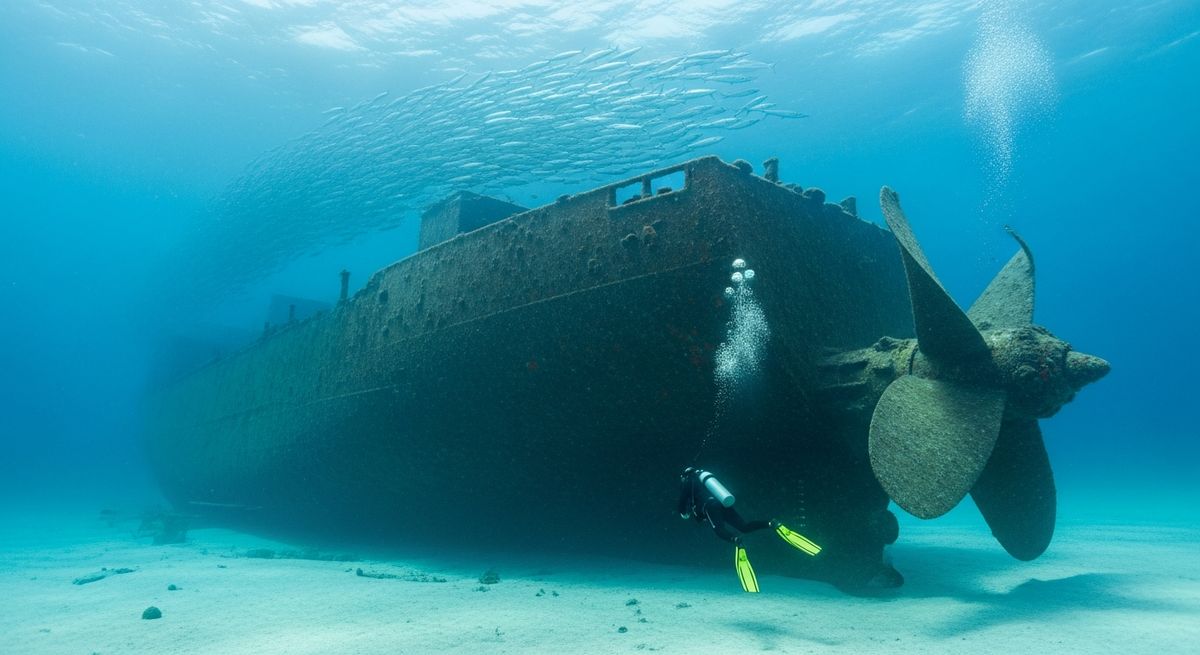
Belle Rock, and yes, it’s a 'possibly' because the exact identity can be a bit fluid down here, offers a proper slice of history. This steamship, built in 1909 and sunk in 1940, lies at a comfortable 19 metres. It’s not about huge pelagics here; it's about the wreck itself and the life that’s made it home. We love the feeling of exploring something so tangible from another era, especially with that deep green Cornwall light filtering through. The wreck is quite broken up, but you can still pick out the bow and stern, and the two boilers are a prominent feature, often swarming with pollack. Around the machinery, you’ll find plenty of inquisitive cuckoo wrasse darting in and out, and the nooks and crannies are perfect for conger eels – keep an eye out for those heads peeking from the shadows. Visibility can be hit or miss, typical for the UK, but on a good day, the atmosphere is incredible. We’d suggest diving this one on a slack tide; it makes navigating the scattered remains much more enjoyable and gives you more time to appreciate the structure. It’s a great dive for anyone who enjoys a historical wreck that’s been thoroughly reclaimed by the sea.
Typical BELLE ROCK (POSSIBLY) Dive Profile
Illustrative profile based on site depth and type. Actual dive profiles vary - always follow your dive computer and training.
Safety Notes
Depth of 19m - Advanced Open Water certification recommended.
Wreck site - avoid penetration without wreck diving certification. Watch for sharp metal and entanglement hazards.
Always perform a 3-minute safety stop at 5m before surfacing.
BELLE ROCK (POSSIBLY) Wreck History
Year Sunk
1940
Vessel Type
cargo ship
Cause
bombing
Tonnage
1,177 GRT
The SS Belle Rock was a classic steamship built in 1909 by the Ailsa Shipbuilding Co. in Troon, Scotland. Originally named the SS Lavernock, she served as a coastal cargo carrier for over three decades. Her civilian career came to a violent end on July 16, 1940, during the early stages of World War II. While sailing off the Cornish coast, she was attacked by a German aircraft and struck by a bomb. The explosion proved fatal, and the Belle Rock sank beneath the waves, becoming another casualty of the war at sea.
Lying at a depth of 19 metres, the Belle Rock is a fantastic and highly accessible wreck dive. As a vessel from the golden age of steam, its remains offer a classic wreck diving experience. Divers can explore the ship's prominent features, including its two large boilers and the impressive triple-expansion steam engine, which still stand upright. The hull is broken but largely intact, allowing for easy navigation and exploration. Over the decades, the wreck has been colonised by a rich variety of marine life, with schools of bib, pollack, and colourful wrasse making their home amongst the steel plates.
Nearest Dive Centres to BELLE ROCK (POSSIBLY)
Dive shops near BELLE ROCK (POSSIBLY)
View all dive centres in Cornwall & DevonReviews for BELLE ROCK (POSSIBLY)
Conditions
Ocean conditions, forecast and tides for BELLE ROCK (POSSIBLY)
BELLE ROCK (POSSIBLY) Ocean Conditions
Monthly averages for BELLE ROCK (POSSIBLY), sourced from Open-Meteo marine data - nearest station: Open-Meteo marine grid (50.44, -2.73) (3km away)
October Averages
Sea Temperature
17°C
62°F · Range: 15.1–17.5°C
Air Temperature
13°C
56°F
Wind Speed
8.14 m/s
15.8 knots
Atmospheric Pressure
1011 hPa
Based on 4 years of monitoring data · Data sources: Open-Meteo marine data
Plan & book
Ways to dive Cornwall & Devon, from day trips to liveaboards.
Day trips & courses
via GetYourGuideGuided dives, courses and snorkel trips with instant booking.
Find dive trips in Cornwall & DevonPlaces to stay
via Booking.comHotels and dive resorts near Cornwall & Devon.
Search stays in Cornwall & DevonDive insurance
Most travel insurance excludes or limits scuba. Check what you need before you go.
Dive insurance explainedPartner links: we may earn a commission if you book, at no extra cost to you. How we make money
Where to Stay near BELLE ROCK (POSSIBLY)
Prices from Booking.com. We may earn a commission at no extra cost to you.