BELLUCIA
Protected Area
Lizard Point
Why dive here
With 176+ marine species recorded in the area - including blue sharks, dolphins, dwarf minke whales, humpback whales and ocean sunfish (mola mola) - BELLUCIA offers some of Cornwall & Devon's richest wreck diving. Water ranges 10-18°C, warmest July, August, September.
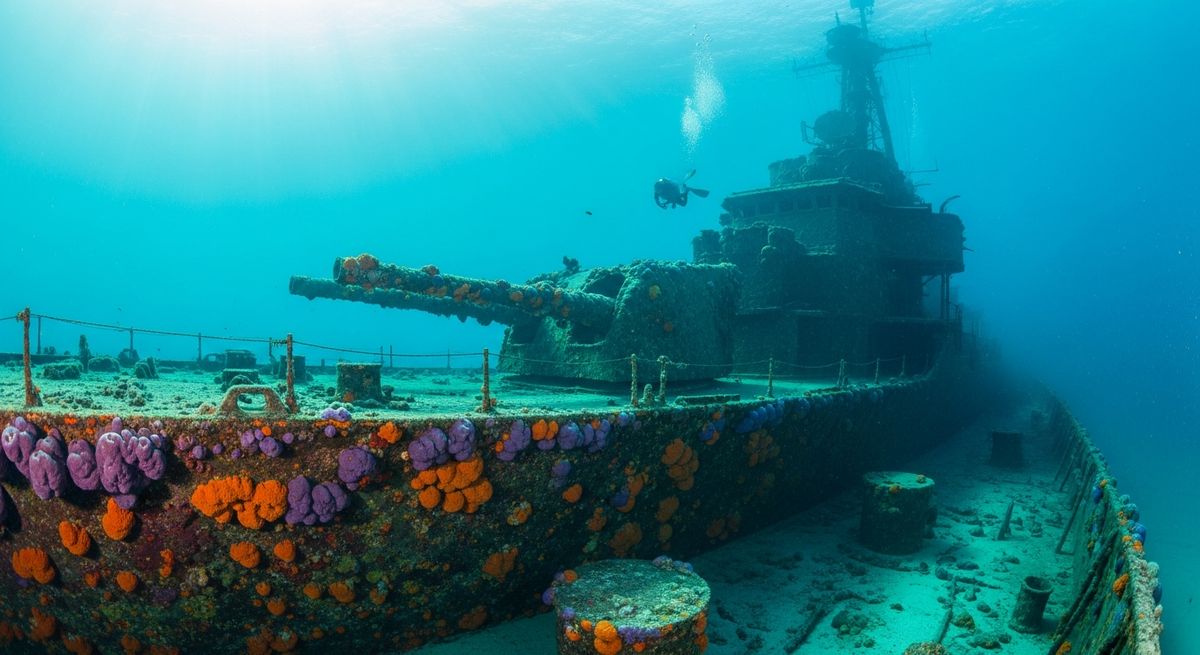
The Bellucia, torpedoed in 1917, is a proper wreck dive, sitting upright and surprisingly intact at 12 metres. It’s an ideal depth for extended bottom times, letting you properly take in the scale of the 117-metre steamship. We love how the bow points directly into the current, often making the forward sections the best place to find shelter and watch the fish. You can trace the deck from bow to stern, spotting the two massive boilers standing proud amidships. The triple expansion engine is a tangle of machinery, now home to plump conger eels. Look closely and you’ll find scorpionfish tucked into crevices and plumose anemones waving like furry fingers in the gentle surge. Our favourite part is exploring the intact holds, often filled with schools of juvenile pollock swirling in the dim light. It’s a dive for those who appreciate history and the slow, inexorable reclamation by the sea. Just be mindful of fishing line, particularly around the mast sections, and always bring a good torch – even at 12 metres, the British light can be deceiving.
Typical BELLUCIA Dive Profile
Illustrative profile based on site depth and type. Actual dive profiles vary - always follow your dive computer and training.
Safety Notes
Wreck site - avoid penetration without wreck diving certification. Watch for sharp metal and entanglement hazards.
Always perform a 3-minute safety stop at 5m before surfacing.
BELLUCIA Wreck History
Year Sunk
1917
Vessel Type
cargo ship
Cause
torpedo
Tonnage
4,368 GRT
The SS Bellucia was a substantial steamship built in Glasgow in 1909. During World War I, she was tasked with the vital role of transporting supplies across the Atlantic. In the summer of 1917, she was on a voyage from Montreal to London, her holds filled with wheat and steel. On July 7, as she neared the Cornish coast, she was spotted by the German submarine UB-31. A single torpedo sealed her fate, and the Bellucia sank with her valuable cargo.
Located at a shallow depth of 12 metres, the Bellucia is an accessible and fascinating dive. Due to her shallow resting place and subsequent salvage efforts, the wreck is heavily broken up and spread over a wide area. Despite this, key features are still easily identifiable, including her two large boilers and the remains of her triple-expansion engine. The scattered steel plates and debris have created an ideal artificial reef, attracting a dense covering of marine life and providing shelter for fish, crabs, and lobsters, making it a vibrant dive into a piece of WWI history.
Nearest Dive Centres to BELLUCIA
Dive shops near BELLUCIA
Porthkerris Divers
DiveUK
Seaways Diving
Karleyth Diving Ltd.
Wavecrest Scuba
Viewpoint Diving Centre
Reviews for BELLUCIA
Conditions
Ocean conditions, forecast and tides for BELLUCIA
BELLUCIA Ocean Conditions
Monthly averages for BELLUCIA, sourced from Open-Meteo marine data - nearest station: Open-Meteo marine grid (50.44, -2.73) (3km away)
October Averages
Sea Temperature
17°C
62°F · Range: 15.1–17.5°C
Air Temperature
13°C
56°F
Wind Speed
8.14 m/s
15.8 knots
Atmospheric Pressure
1011 hPa
Based on 4 years of monitoring data · Data sources: Open-Meteo marine data
Plan & book
Ways to dive Cornwall & Devon, from day trips to liveaboards.
Day trips & courses
via GetYourGuideGuided dives, courses and snorkel trips with instant booking.
Find dive trips in Cornwall & DevonPlaces to stay
via Booking.comHotels and dive resorts near Cornwall & Devon.
Search stays in Cornwall & DevonDive insurance
Most travel insurance excludes or limits scuba. Check what you need before you go.
Dive insurance explainedPartner links: we may earn a commission if you book, at no extra cost to you. How we make money
Where to Stay near BELLUCIA
Prices from Booking.com. We may earn a commission at no extra cost to you.