BETSY ANNA
Protected Area
Southbourne Rough
Why dive here
With 176+ marine species recorded in the area - including blue sharks, dolphins, dwarf minke whales, humpback whales and ocean sunfish (mola mola) - BETSY ANNA offers some of Cornwall & Devon's richest wreck diving. Water ranges 10-18°C, warmest July, August, September.
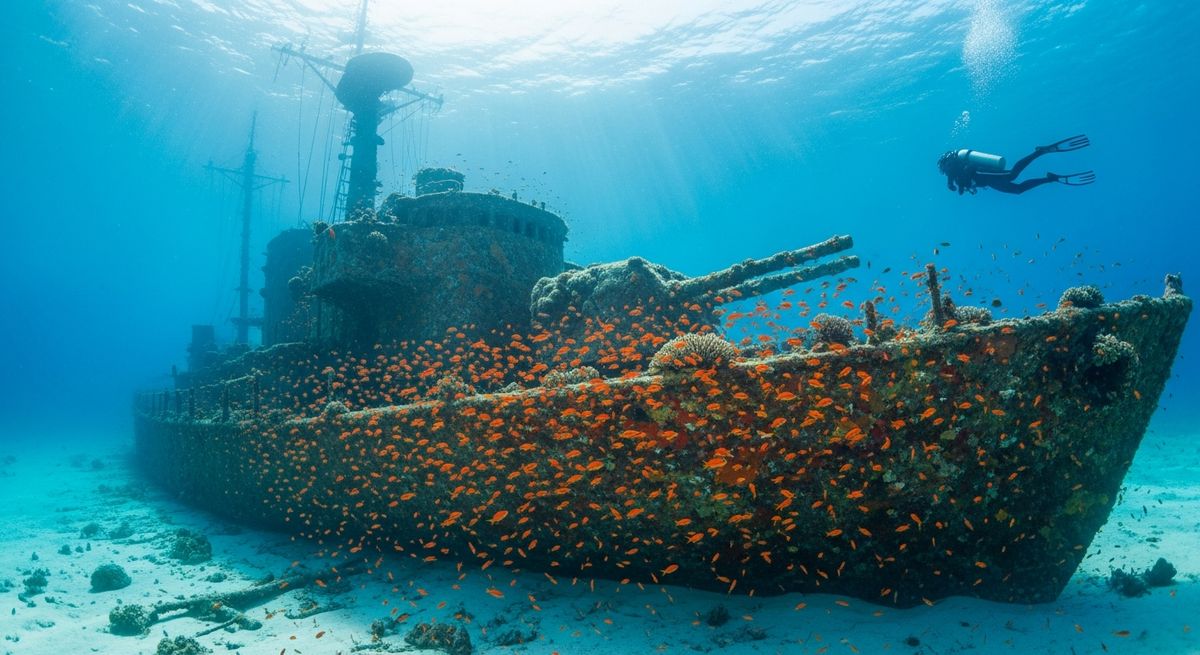
The Betsy Anna, off the coast of Cornwall, is one of our favourite wreck dives in the area, offering a proper sense of history, even if visibility can sometimes be a bit moody. She went down in 1926, a 63-meter steamship, and now lies upright on the seabed at 24 metres. We love how intact she feels, with the bow and stern still well-defined and the hold accessible for a careful peek. You’ll spot the huge boiler, a real focal point, with shoals of bib and pouting swirling around it, almost like a living cloud. Head towards the stern, and you’ll find conger eels tucked into every dark crevice, their heads poking out with a wary glance. The general current here is usually mild enough for an unhurried exploration, but we’d always suggest checking the local tides; a slack water dive makes all the difference when you're navigating the superstructure. Keep an eye out for dogfish resting on the sand nearby, perfectly camouflaged against the often silty bottom. It’s a dive that rewards slow observation, letting you soak in the atmosphere of a ship frozen in time.
Typical BETSY ANNA Dive Profile
Illustrative profile based on site depth and type. Actual dive profiles vary - always follow your dive computer and training.
Safety Notes
Depth of 24m - Advanced Open Water certification recommended.
Wreck site - avoid penetration without wreck diving certification. Watch for sharp metal and entanglement hazards.
Always perform a 3-minute safety stop at 5m before surfacing.
BETSY ANNA Wreck History
Year Sunk
1926
Vessel Type
cargo ship
Cause
unknown
The SS Betsy Anna is a classic steamship from a bygone era, offering a fantastic dive into industrial history off the coast of Cornwall. Built in 1892 in Newcastle as the SS Ashington, this vessel was a workhorse of its time, powered by a single boiler and a triple-expansion steam engine. For 34 years, she plied the coastal routes of Europe before her career came to an end on October 12, 1926, when she sank for reasons that are not clearly recorded.
Resting at a depth of 24 meters, the Betsy Anna is an ideal wreck for intermediate-level divers. The wreck is relatively intact for its age, and its main attraction is the machinery that once powered it. Divers can explore the impressive boiler and the framework of the triple-expansion engine, getting a tangible sense of the power of the steam age. The surrounding structure has become a vibrant artificial reef, often patrolled by schools of pollack and bib, with colorful anemones and soft corals adorning the rusting steel plates. It's a rewarding dive that perfectly combines history and marine biology.
Nearest Dive Centres to BETSY ANNA
Dive shops near BETSY ANNA
Divers Down
Mayim Mermaid Academy
TAL Scuba Ltd.
Dorset Diving Services
Dive Beyond Limited
Old Harbour Dive Centre
Reviews for BETSY ANNA
Conditions
Ocean conditions, forecast and tides for BETSY ANNA
BETSY ANNA Ocean Conditions
Monthly averages for BETSY ANNA, sourced from Open-Meteo marine data - nearest station: Open-Meteo marine grid (50.44, -2.73) (3km away)
October Averages
Sea Temperature
17°C
62°F · Range: 15.1–17.5°C
Air Temperature
13°C
56°F
Wind Speed
8.14 m/s
15.8 knots
Atmospheric Pressure
1011 hPa
Based on 4 years of monitoring data · Data sources: Open-Meteo marine data
Plan & book
Ways to dive Cornwall & Devon, from day trips to liveaboards.
Day trips & courses
via GetYourGuideGuided dives, courses and snorkel trips with instant booking.
Find dive trips in Cornwall & DevonPlaces to stay
via Booking.comHotels and dive resorts near Cornwall & Devon.
Search stays in Cornwall & DevonDive insurance
Most travel insurance excludes or limits scuba. Check what you need before you go.
Dive insurance explainedPartner links: we may earn a commission if you book, at no extra cost to you. How we make money
Where to Stay near BETSY ANNA
Prices from Booking.com. We may earn a commission at no extra cost to you.