BETTANN (STERN SECTION)
Protected Area
Whitecliff Bay and Bembridge Ledges
Why dive here
With 176+ marine species recorded in the area - including blue sharks, dolphins, dwarf minke whales, humpback whales and ocean sunfish (mola mola) - BETTANN (STERN SECTION) offers some of Cornwall & Devon's richest wreck diving. Water ranges 10-18°C, warmest July, August, September.
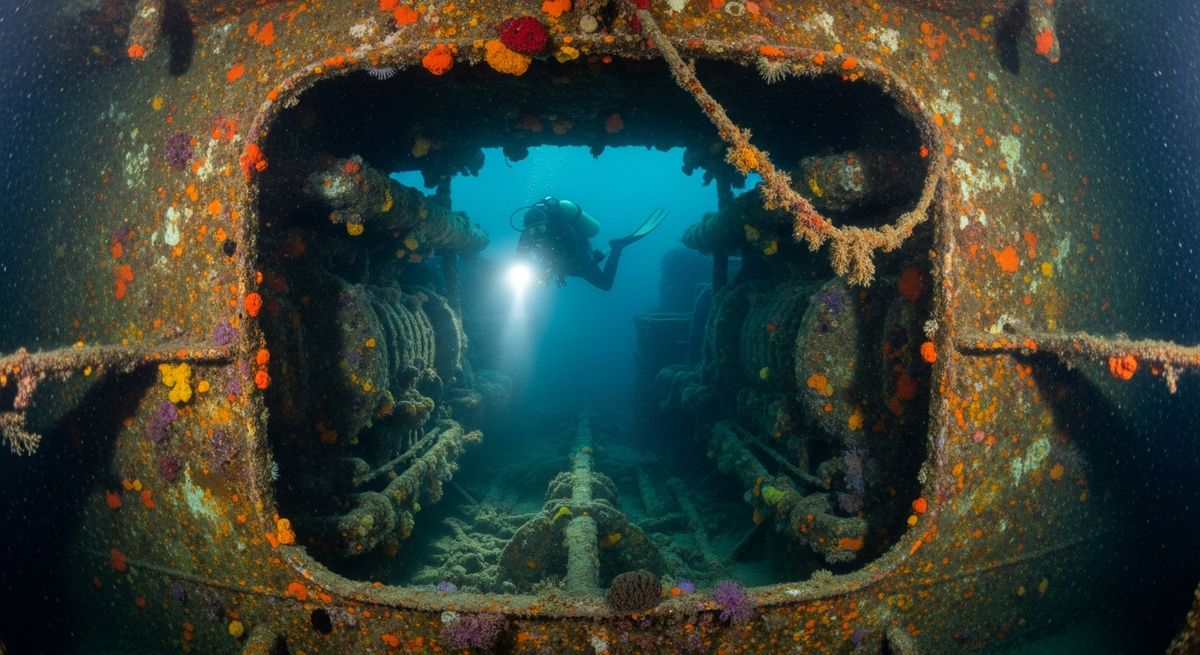
The Bettann’s stern section, resting at a gentle 13 metres, is one of our go-to wreck dives when we’re in Cornwall. It’s a proper piece of history, scuttled back in ‘67 after being chopped in half during salvage. We love how the bow lies elsewhere, making this a distinct, explorable chunk. You can really get a feel for the ship’s guts here. Drop down and you're met with substantial plates and beams, now home to clouds of jewel anemones, all oranges and purples that glow in your torch beam. Conger eels, some surprisingly large, peer from nooks in the collapsed superstructure, their heads thick as your arm. If you take your time and really look, you'll spot scorpion fish camouflaged against the rust, perfectly still. This site is brilliant for wreck fanatics who appreciate a bit of backstory, and for photographers keen on colourful macro life against a dramatic, decaying backdrop. It’s not a deep dive, making bottom time plentiful for a good, thorough explore.
Typical BETTANN (STERN SECTION) Dive Profile
Illustrative profile based on site depth and type. Actual dive profiles vary - always follow your dive computer and training.
Safety Notes
Wreck site - avoid penetration without wreck diving certification. Watch for sharp metal and entanglement hazards.
Always perform a 3-minute safety stop at 5m before surfacing.
BETTANN (STERN SECTION) Wreck History
Year Sunk
1967
Vessel Type
cargo ship
Cause
foundered
The motor vessel Bettann met her end on January 19th, 1967, after taking on water and sinking while at anchor in St Helen's Roads. The wreck was deemed a navigational hazard, and a salvage operation was launched to remove it. To facilitate this, the ship was cut into two distinct sections, creating two separate wreck sites that divers can explore today.
While the bow section sank into deeper water, the stern of the Bettann now rests in a much more accessible depth of just 13 metres. This makes it an ideal dive for novice wreck divers or those looking for a longer, more relaxed exploration. Divers can explore the aft superstructure and imagine the final moments of this vessel before she was split in two. The shallow depth allows for excellent light penetration on a clear day, illuminating the marine life that now calls the Bettann's stern home.
Nearest Dive Centres to BETTANN (STERN SECTION)
Dive shops near BETTANN (STERN SECTION)
In2 Diving
Sussex Diving & Leisure
Mulberry Marine Experiences CIC
Andark Diving
Abyss Scuba School
Reviews for BETTANN (STERN SECTION)
Conditions
Ocean conditions, forecast and tides for BETTANN (STERN SECTION)
BETTANN (STERN SECTION) Ocean Conditions
Monthly averages for BETTANN (STERN SECTION), sourced from Open-Meteo marine data - nearest station: Open-Meteo marine grid (50.44, -2.73) (3km away)
October Averages
Sea Temperature
17°C
62°F · Range: 15.1–17.5°C
Air Temperature
13°C
56°F
Wind Speed
8.14 m/s
15.8 knots
Atmospheric Pressure
1011 hPa
Based on 4 years of monitoring data · Data sources: Open-Meteo marine data
Plan & book
Ways to dive Cornwall & Devon, from day trips to liveaboards.
Day trips & courses
via GetYourGuideGuided dives, courses and snorkel trips with instant booking.
Find dive trips in Cornwall & DevonPlaces to stay
via Booking.comHotels and dive resorts near Cornwall & Devon.
Search stays in Cornwall & DevonDive insurance
Most travel insurance excludes or limits scuba. Check what you need before you go.
Dive insurance explainedPartner links: we may earn a commission if you book, at no extra cost to you. How we make money
Where to Stay near BETTANN (STERN SECTION)
Prices from Booking.com. We may earn a commission at no extra cost to you.