BINNENDIJK
Protected Area
Studland to Portland
Why dive here
With 176+ marine species recorded in the area - including blue sharks, dolphins, dwarf minke whales, humpback whales and ocean sunfish (mola mola) - BINNENDIJK offers some of Cornwall & Devon's richest wreck diving. Water ranges 10-18°C, warmest July, August, September.
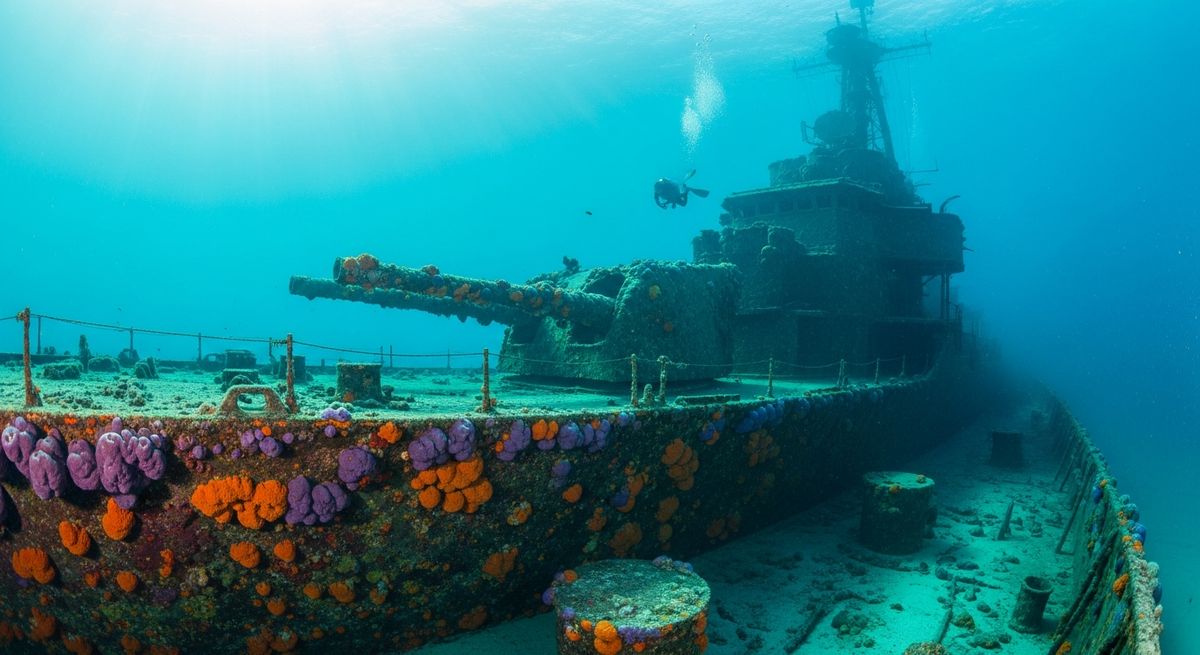
The Binnendijk is a proper behemoth of a wreck, and that’s why we love it. Sunk by a mine in 1939, this 121-meter steamship sits upright on the seabed at 25m, practically begging to be explored. You drop down onto the stern, which is still impressively intact, with the deck guns providing an immediate focal point. We always make a point of heading into the aft holds, where the light plays through the gaps and you can sometimes spot conger eels tucked away in the shadows. What sets the Binnendijk apart is the scale; you can spend an entire dive exploring just one section and still not see everything. The bow section, though more broken, has some fantastic nooks and crannies for lobster and crabs. Our favourite time to dive it is on a slack tide, naturally, but if you catch it just right, the mild current can actually help with visibility, clearing out some of the suspended particulate. Expect good numbers of wrasse, pollack, and sometimes even a curious seal giving you the once-over. It’s a site for the experienced wreck diver who appreciates a bit of history and a lot of metal to poke around.
Typical BINNENDIJK Dive Profile
Illustrative profile based on site depth and type. Actual dive profiles vary - always follow your dive computer and training.
Safety Notes
Depth of 25m - Advanced Open Water certification recommended.
Wreck site - avoid penetration without wreck diving certification. Watch for sharp metal and entanglement hazards.
Always perform a 3-minute safety stop at 5m before surfacing.
BINNENDIJK Wreck History
Year Sunk
1939
Vessel Type
cargo ship
Cause
unknown
Tonnage
6,873 GRT
The SS Binnendijk was a proud cargo steamship of the Holland America Line and one of the company's first to be powered by modern steam turbines. Launched in 1921, she served trade routes for nearly two decades, a testament to Dutch engineering and maritime commerce. Her peaceful career came to an abrupt end at the very beginning of World War II. In October 1939, just a month after the war began, the Binnendijk became the first vessel the Holland America Line would lose, a harbinger of the immense shipping losses to come.
On October 7th, 1939, while navigating the English Channel, the Binnendijk struck a German-laid mine off the coast of Dorset. The explosion was catastrophic, and despite the crew's efforts, the ship succumbed to its wounds and sank the following day. She was carrying a general cargo, and her loss marked one of the earliest Allied merchant casualties of the war at sea.
Today, the wreck is affectionately known to the UK diving community as "The Benny." Lying at a depth of 25 meters, the 122-meter-long vessel is a popular and impressive dive. Although the years have taken their toll, the wreck is still recognizable, with its boilers, engine, and hull structure providing a fascinating playground for exploration. The site is teeming with life, including large shoals of bib, pollack, and the classic wreck-dwelling conger eels and lobsters, making it a premier destination for divers exploring the rich maritime history of the English Channel.
Nearest Dive Centres to BINNENDIJK
Dive shops near BINNENDIJK
Dive Beyond Limited
Old Harbour Dive Centre
Divers Down
Mayim Mermaid Academy
Dorset Diving Services
TAL Scuba Ltd.
Reviews for BINNENDIJK
Conditions
Ocean conditions, forecast and tides for BINNENDIJK
BINNENDIJK Ocean Conditions
Monthly averages for BINNENDIJK, sourced from Open-Meteo marine data - nearest station: Open-Meteo marine grid (50.44, -2.73) (3km away)
October Averages
Sea Temperature
17°C
62°F · Range: 15.1–17.5°C
Air Temperature
13°C
56°F
Wind Speed
8.14 m/s
15.8 knots
Atmospheric Pressure
1011 hPa
Based on 4 years of monitoring data · Data sources: Open-Meteo marine data
Plan & book
Ways to dive Cornwall & Devon, from day trips to liveaboards.
Day trips & courses
via GetYourGuideGuided dives, courses and snorkel trips with instant booking.
Find dive trips in Cornwall & DevonPlaces to stay
via Booking.comHotels and dive resorts near Cornwall & Devon.
Search stays in Cornwall & DevonDive insurance
Most travel insurance excludes or limits scuba. Check what you need before you go.
Dive insurance explainedPartner links: we may earn a commission if you book, at no extra cost to you. How we make money
Where to Stay near BINNENDIJK
Prices from Booking.com. We may earn a commission at no extra cost to you.