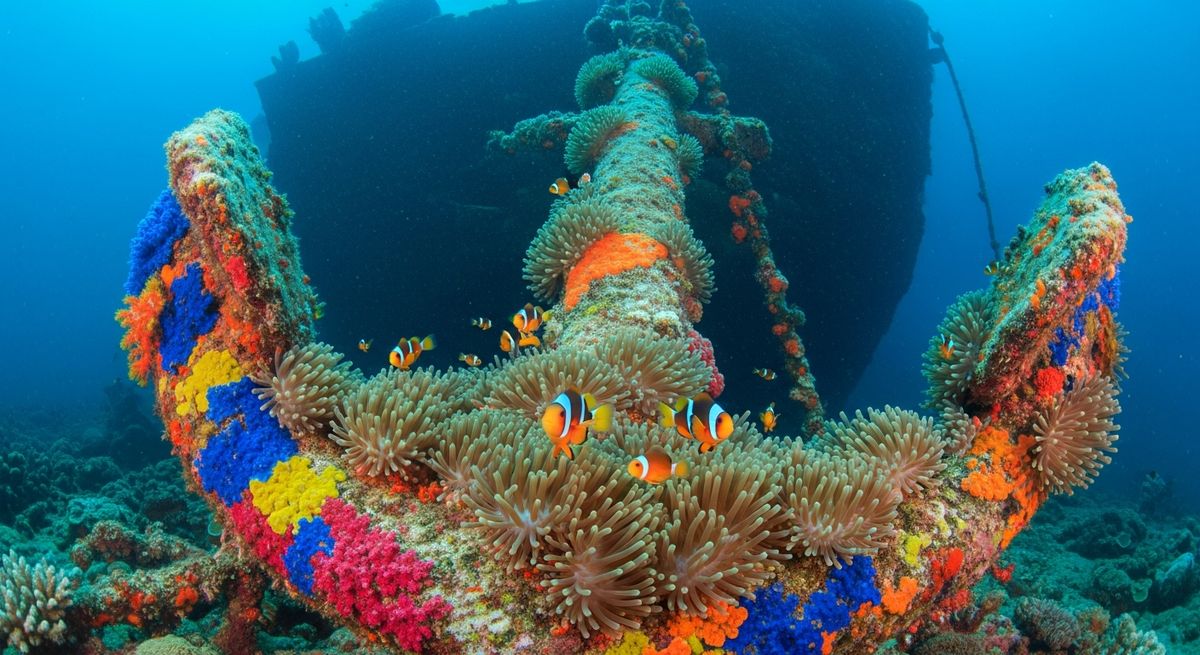
BLACK HAWK (AFT SECTION)
Protected Area
South of Portland
Why dive here
With 176+ marine species recorded in the area - including blue sharks, dolphins, dwarf minke whales, humpback whales and ocean sunfish (mola mola) - BLACK HAWK (AFT SECTION) offers some of Cornwall & Devon's richest wreck diving. Water ranges 10-18°C, warmest July, August, September.
The Black Hawk’s stern section is a real beast of a wreck, sitting upright and imposing at 45 metres. We love dropping onto the massive propellers, still attached and looking ready to spin, giving you a real sense of the ship’s scale. She was torpedoed in 1944, split in two, and this half went down fast, so there’s a lovely sense of an intact moment frozen in time. The hold is open for penetration, if you’re comfortable and properly trained. Inside, the gloom is often broken by torch beams picking out huge conger eels coiled amongst the twisted metal, their eyes reflecting the light. Outside, massive bib schools drift over the deck, sometimes so thick you can barely see the structure beneath. Visibility can be decent here, but it’s a deep dive in UK waters, so always go prepared for low light and a chill. Our tip: look for the elusive scorpion fish camouflaged on the hull plates. It’s a challenging dive, best suited for experienced wreck divers comfortable with depth and overhead environments.
Typical BLACK HAWK (AFT SECTION) Dive Profile
Illustrative profile based on site depth and type. Actual dive profiles vary - always follow your dive computer and training.
Safety Notes
Maximum depth 45m exceeds recreational limits (40m). Technical diving certification and equipment required.
Wreck site - avoid penetration without wreck diving certification. Watch for sharp metal and entanglement hazards.
Always perform a 3-minute safety stop at 5m before surfacing.
BLACK HAWK (AFT SECTION) Wreck History
Year Sunk
1944
Vessel Type
cargo ship
Cause
torpedo
Tonnage
7,176 GRT
The SS Black Hawk was a Liberty ship, a mass-produced American cargo vessel vital to the Allied war effort in WWII. Built in 1943, her career was cut short on December 29th, 1944, while on passage from Cherbourg. She was struck by a torpedo from the German submarine U-772, a direct hit that broke the ship's back. The vessel split in two, and the aft (stern) section sank almost immediately, taking the engine room and rear cargo holds with it.
Today, the stern section of the Black Hawk rests upright on the seabed at a depth of 45 metres. This is a challenging dive reserved for experienced technical or deep-air divers. The reward is a dramatic and imposing wreck, largely intact despite the violent nature of its sinking. Divers can explore the superstructure, peer into the cavernous engine room, and see the deck gun still pointing skyward. The depth has helped preserve the wreck, making it one of the most impressive deep dives in the region, a poignant memorial to the Battle of the Atlantic.
Nearest Dive Centres to BLACK HAWK (AFT SECTION)
Dive shops near BLACK HAWK (AFT SECTION)
Dive Beyond Limited
Old Harbour Dive Centre
Divers Down
Mayim Mermaid Academy
Dorset Diving Services
Reviews for BLACK HAWK (AFT SECTION)
Conditions
Ocean conditions, forecast and tides for BLACK HAWK (AFT SECTION)
BLACK HAWK (AFT SECTION) Ocean Conditions
Monthly averages for BLACK HAWK (AFT SECTION), sourced from Open-Meteo marine data - nearest station: Open-Meteo marine grid (50.44, -2.73) (3km away)
October Averages
Sea Temperature
17°C
62°F · Range: 15.1–17.5°C
Air Temperature
13°C
56°F
Wind Speed
8.14 m/s
15.8 knots
Atmospheric Pressure
1011 hPa
Based on 4 years of monitoring data · Data sources: Open-Meteo marine data
Plan & book
Ways to dive Cornwall & Devon, from day trips to liveaboards.
Day trips & courses
via GetYourGuideGuided dives, courses and snorkel trips with instant booking.
Find dive trips in Cornwall & DevonPlaces to stay
via Booking.comHotels and dive resorts near Cornwall & Devon.
Search stays in Cornwall & DevonDive insurance
Most travel insurance excludes or limits scuba. Check what you need before you go.
Dive insurance explainedPartner links: we may earn a commission if you book, at no extra cost to you. How we make money
Where to Stay near BLACK HAWK (AFT SECTION)
Prices from Booking.com. We may earn a commission at no extra cost to you.