BLACK HAWK (FWD SECTION)
Protected Area
Studland to Portland
Why dive here
With 176+ marine species recorded in the area - including blue sharks, dolphins, dwarf minke whales, humpback whales and ocean sunfish (mola mola) - BLACK HAWK (FWD SECTION) offers some of Cornwall & Devon's richest wreck diving. Water ranges 10-18°C, warmest July, August, September.
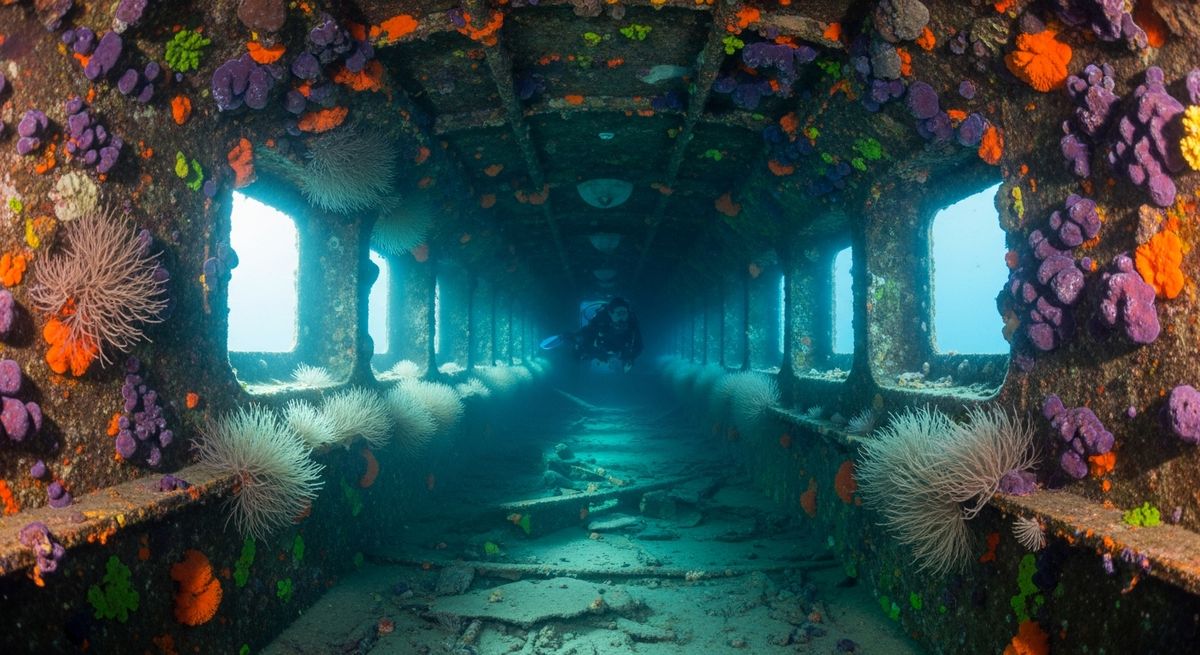
The Black Hawk’s forward section, just 15 metres down, is our absolute favourite kind of wreck dive – a relatively shallow, accessible piece of history that always delivers. We’ve found ourselves lingering here, often with a slight current nudging us along, just soaking in the sheer scale of it. The intact bow, surprisingly robust despite its age, points defiantly upwards, feeling almost majestic as you approach through the green water. What makes this a standout for us? It’s the swim-throughs and the sheer volume of metal to explore. We love drifting through the hold, imagining cargo long gone, now replaced by thick clusters of dead man's fingers and colourful jewel anemones that look like scattered gemstones. Keep an eye out for the resident conger eels; they’re often peeking out from behind plating or coiled up in the darker recesses. This part of the wreck suits divers who appreciate a good rummage and aren't afraid of a bit of an adventure. It’s a proper dive, offering just enough challenge and always something new to spot.
Typical BLACK HAWK (FWD SECTION) Dive Profile
Illustrative profile based on site depth and type. Actual dive profiles vary - always follow your dive computer and training.
Safety Notes
Wreck site - avoid penetration without wreck diving certification. Watch for sharp metal and entanglement hazards.
Always perform a 3-minute safety stop at 5m before surfacing.
BLACK HAWK (FWD SECTION) Wreck History
Year Sunk
1944
Vessel Type
cargo ship
Cause
torpedo
Tonnage
7,176 GRT
When the Liberty ship SS Black Hawk was torpedoed by U-772 on December 29th, 1944, the vessel broke clean in two. While the stern section plunged to the depths, the forward section remained stubbornly afloat. A salvage operation was mounted, and the bow was taken under tow with the aim of beaching it in Worbarrow Bay. However, the damaged section proved too difficult to handle and was eventually lost, sinking in much shallower waters than its other half.
Resting at a depth of 15 metres, the forward section of the Black Hawk offers a completely different diving experience to the deep stern. Its accessible depth makes it a popular site for divers of all levels. The wreckage is more broken up and scattered, a result of the salvage attempt and over 70 years of winter storms. Divers can explore a large debris field of twisted steel plates, winches, and other machinery. It's a fantastic rummage dive, where the ship's immense scale can be appreciated by swimming over the vast sections of its hull, now home to a vibrant ecosystem of fish and invertebrates.
Nearest Dive Centres to BLACK HAWK (FWD SECTION)
Dive shops near BLACK HAWK (FWD SECTION)
Old Harbour Dive Centre
Dive Beyond Limited
Divers Down
Mayim Mermaid Academy
Dorset Diving Services
TAL Scuba Ltd.
Reviews for BLACK HAWK (FWD SECTION)
Conditions
Ocean conditions, forecast and tides for BLACK HAWK (FWD SECTION)
BLACK HAWK (FWD SECTION) Ocean Conditions
Monthly averages for BLACK HAWK (FWD SECTION), sourced from Open-Meteo marine data - nearest station: Open-Meteo marine grid (50.44, -2.73) (3km away)
October Averages
Sea Temperature
17°C
62°F · Range: 15.1–17.5°C
Air Temperature
13°C
56°F
Wind Speed
8.14 m/s
15.8 knots
Atmospheric Pressure
1011 hPa
Based on 4 years of monitoring data · Data sources: Open-Meteo marine data
Plan & book
Ways to dive Cornwall & Devon, from day trips to liveaboards.
Day trips & courses
via GetYourGuideGuided dives, courses and snorkel trips with instant booking.
Find dive trips in Cornwall & DevonPlaces to stay
via Booking.comHotels and dive resorts near Cornwall & Devon.
Search stays in Cornwall & DevonDive insurance
Most travel insurance excludes or limits scuba. Check what you need before you go.
Dive insurance explainedPartner links: we may earn a commission if you book, at no extra cost to you. How we make money
Where to Stay near BLACK HAWK (FWD SECTION)
Prices from Booking.com. We may earn a commission at no extra cost to you.