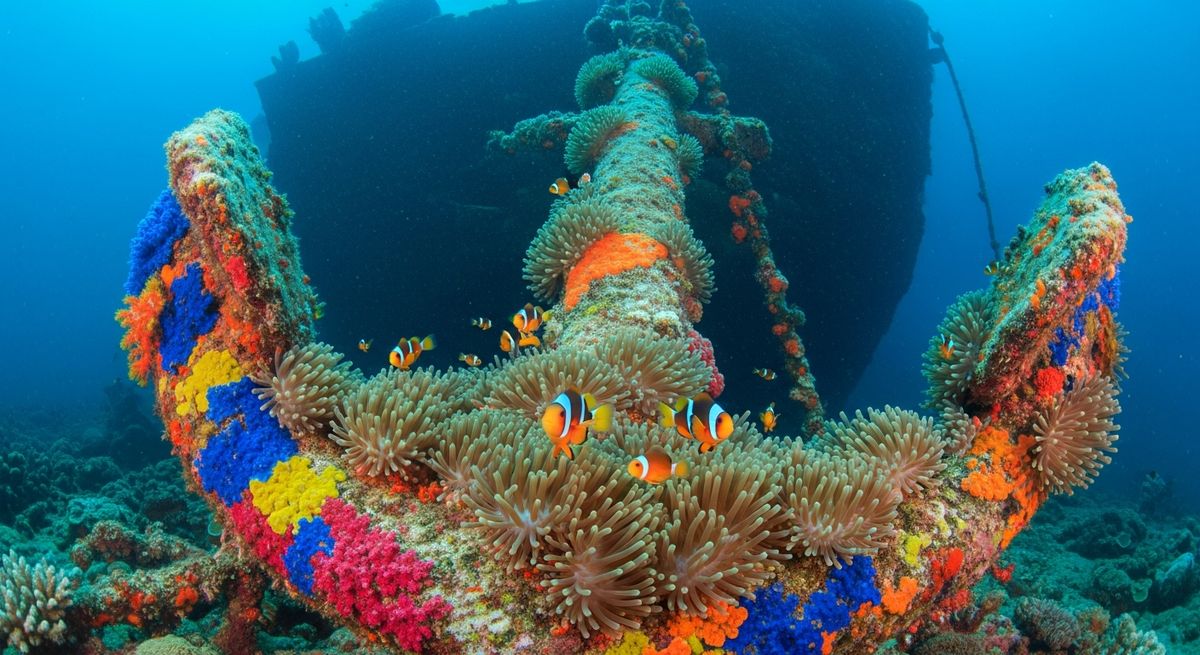
BLEAMOOR (PROBABLY)
Protected Area
Berry Head to Sharkham Point
Why dive here
With 176+ marine species recorded in the area - including blue sharks, dolphins, dwarf minke whales, humpback whales and ocean sunfish (mola mola) - BLEAMOOR (PROBABLY) offers some of Cornwall & Devon's richest wreck diving. Water ranges 10-18°C, warmest July, August, September.
Bleamoor, or what we’re pretty sure is Bleamoor, is a serious wreck dive. She sits upright, pretty much intact, at 48 metres. Dropping down, you hit the bow first, then glide along the deck towards the bridge, which is usually where we hang out, spotting big conger eels tucked into every crevice. We love the scale of her, a proper steamship from 1902, three boilers still very much present, and the triple-expansion engine a looming silhouette in the gloom. This isn’t a beginner’s playground; you'll want solid deep wreck experience and a good head for navigation in potentially low visibility. But for those who love a bit of history and a challenging dive, Bleamoor delivers. There are always dogfish resting on the plates, and the resident pollack often swim right up to your mask, curious about the bubbles. Our best advice? Pick a day with minimal swell and slack tide for the best chance of decent light penetration and an easier ascent.
Typical BLEAMOOR (PROBABLY) Dive Profile
Illustrative profile based on site depth and type. Actual dive profiles vary - always follow your dive computer and training.
Safety Notes
Maximum depth 48m exceeds recreational limits (40m). Technical diving certification and equipment required.
Wreck site - avoid penetration without wreck diving certification. Watch for sharp metal and entanglement hazards.
Always perform a 3-minute safety stop at 5m before surfacing.
BLEAMOOR (PROBABLY) Wreck History
Year Sunk
1917
Vessel Type
cargo ship
Cause
torpedo
Tonnage
3,755 GRT
The SS Bleamoor was a 3,755-ton steamship built in 1902 by the famous Sunderland shipbuilders, William Doxford & Sons. As part of the Moor Line fleet, she was a typical British tramp steamer of the era, transporting vital goods across the globe. With the outbreak of the First World War, her routine voyages became fraught with peril as German U-boats began to stalk the Allied shipping lanes.
On November 27, 1917, the Bleamoor was on a critical wartime passage from Barry, Wales, to Gibraltar, carrying a full cargo of coal. Her journey was violently interrupted when she was targeted by the German submarine U-96. A single torpedo struck the vessel, sealing her fate. The Bleamoor sank beneath the waves, becoming another casualty of the relentless war at sea.
Today, the wreck of the Bleamoor lies at a depth of 48 meters. This is a challenging dive reserved for experienced, certified technical divers. Those who make the descent are rewarded with the sight of a substantial WWI-era wreck, a sombre monument to the merchant mariners who risked their lives to supply the war effort. The vessel is largely intact, and divers can explore its decaying superstructure, boilers, and triple-expansion engine, paying their respects to a ship lost in conflict.
Nearest Dive Centres to BLEAMOOR (PROBABLY)
Dive shops near BLEAMOOR (PROBABLY)
Teign Diving Centre
Edge Watersports
Sound Diving Limited
Reviews for BLEAMOOR (PROBABLY)
Conditions
Ocean conditions, forecast and tides for BLEAMOOR (PROBABLY)
BLEAMOOR (PROBABLY) Ocean Conditions
Monthly averages for BLEAMOOR (PROBABLY), sourced from Open-Meteo marine data - nearest station: Open-Meteo marine grid (50.44, -2.73) (3km away)
October Averages
Sea Temperature
17°C
62°F · Range: 15.1–17.5°C
Air Temperature
13°C
56°F
Wind Speed
8.14 m/s
15.8 knots
Atmospheric Pressure
1011 hPa
Based on 4 years of monitoring data · Data sources: Open-Meteo marine data
Plan & book
Ways to dive Cornwall & Devon, from day trips to liveaboards.
Day trips & courses
via GetYourGuideGuided dives, courses and snorkel trips with instant booking.
Find dive trips in Cornwall & DevonPlaces to stay
via Booking.comHotels and dive resorts near Cornwall & Devon.
Search stays in Cornwall & DevonDive insurance
Most travel insurance excludes or limits scuba. Check what you need before you go.
Dive insurance explainedPartner links: we may earn a commission if you book, at no extra cost to you. How we make money
Where to Stay near BLEAMOOR (PROBABLY)
Prices from Booking.com. We may earn a commission at no extra cost to you.