BLUMENTHAL
Protected Area
Les Ecrehous
Why dive here
With 176+ marine species recorded in the area - including blue sharks, dolphins, dwarf minke whales, humpback whales and ocean sunfish (mola mola) - BLUMENTHAL offers some of Cornwall & Devon's richest wreck diving. Water ranges 10-18°C, warmest July, August, September.
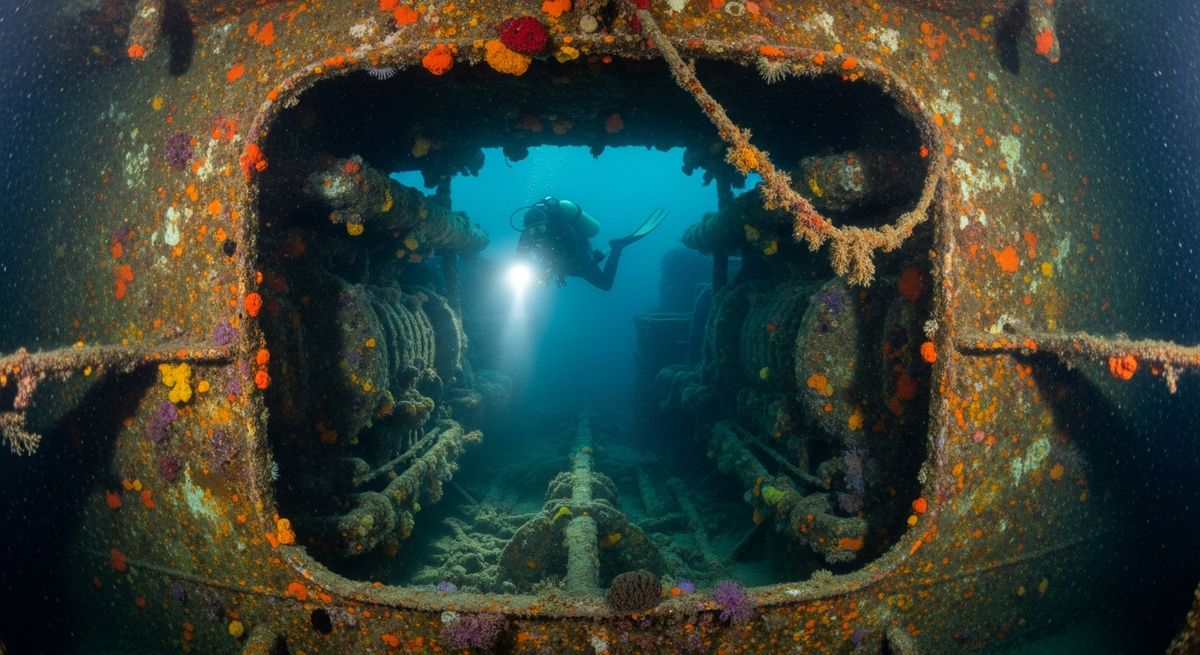
Blumenthal, off the Cornish coast, is a wreck dive that always delivers, especially for those who appreciate history with their bubbles. She’s shallow, only 11 metres, which means plenty of bottom time to explore the broken hull. What we love about her is how accessible the structure is. You can follow the lines of the old ship, imagining the cargo, and the marine life has really moved in. Visibility can be a bit of a lottery, as it often is in British waters, but on a good day, you'll see schools of pollack darting through the ribs of the ship, conger eels peeking from beneath plates, and dogfish often resting on the sandy seabed nearby. The wreck itself is quite broken up now, but you still get a real sense of its size, and the engine room area is always our favourite spot for a good poke around. It’s a cracking site for newer wreck divers or those wanting a relaxed bimble with a bit of character. Aim for slack tide for the easiest dive.
Typical BLUMENTHAL Dive Profile
Illustrative profile based on site depth and type. Actual dive profiles vary - always follow your dive computer and training.
Safety Notes
Wreck site - avoid penetration without wreck diving certification. Watch for sharp metal and entanglement hazards.
Always perform a 3-minute safety stop at 5m before surfacing.
BLUMENTHAL Wreck History
Year Sunk
1917
Vessel Type
cargo ship
Cause
torpedo
Tonnage
2,593 GRT
The SS Blumenthal began her life as a German steamship but was seized by Britain in 1914 at the outbreak of the First World War. Renamed the SS Polvarth and pressed into service for the Allied war effort, she spent three years ferrying vital supplies. Her final voyage was in November 1917, carrying a cargo of coal from Barry, Wales, destined for France.
While traversing the waters off the Cornish coast, she was spotted by the German submarine UB-51. A single torpedo struck the Polvarth, sealing her fate. In a valiant effort to save his ship and crew, the captain attempted to beach her in St. Ives Bay. However, the damage was too severe, and she foundered and sank before reaching the safety of the shore.
Today, the wreck of the Polvarth lies in just 11 meters of water, making it an accessible dive for all levels. Years of exposure to the powerful Cornish swells have flattened the hull, but the site is a fascinating scatter of steel plates, ribs, and machinery. The ship's large boilers and triple-expansion engine are the most recognizable features, providing a home for crabs and lobsters. Its classification as a 'Dangerous Wreck' is a reminder to dive with caution, as sharp metal is prevalent across the debris field.
Reviews for BLUMENTHAL
Conditions
Ocean conditions, forecast and tides for BLUMENTHAL
BLUMENTHAL Ocean Conditions
Monthly averages for BLUMENTHAL, sourced from Open-Meteo marine data - nearest station: Open-Meteo marine grid (50.44, -2.73) (3km away)
October Averages
Sea Temperature
17°C
62°F · Range: 15.1–17.5°C
Air Temperature
13°C
56°F
Wind Speed
8.14 m/s
15.8 knots
Atmospheric Pressure
1011 hPa
Based on 4 years of monitoring data · Data sources: Open-Meteo marine data
Plan & book
Ways to dive Cornwall & Devon, from day trips to liveaboards.
Day trips & courses
via GetYourGuideGuided dives, courses and snorkel trips with instant booking.
Find dive trips in Cornwall & DevonPlaces to stay
via Booking.comHotels and dive resorts near Cornwall & Devon.
Search stays in Cornwall & DevonDive insurance
Most travel insurance excludes or limits scuba. Check what you need before you go.
Dive insurance explainedPartner links: we may earn a commission if you book, at no extra cost to you. How we make money
Where to Stay near BLUMENTHAL
Prices from Booking.com. We may earn a commission at no extra cost to you.