BOGSTAD
Protected Area
Bristol Channel Approaches / Dynesfeydd Môr Hafren
Why dive here
With 176+ marine species recorded in the area - including blue sharks, dolphins, dwarf minke whales, humpback whales and ocean sunfish (mola mola) - BOGSTAD offers some of Cornwall & Devon's richest wreck diving. Water ranges 10-18°C, warmest July, August, September.
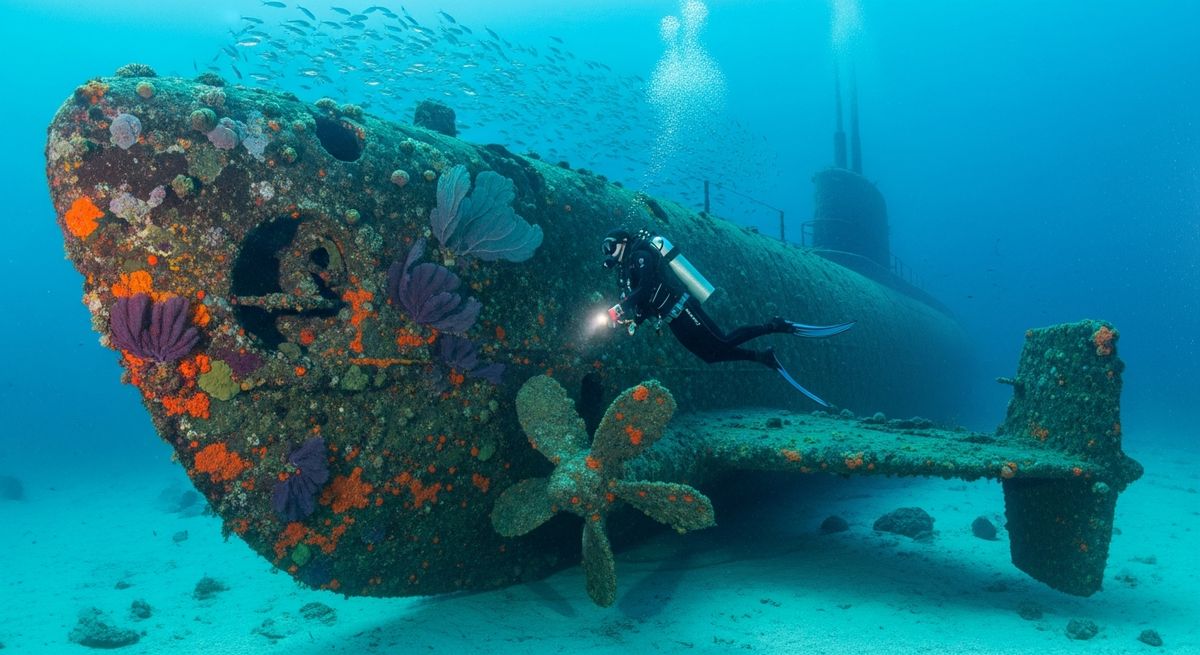
The Bogstad sits deep, a proper expedition dive at 49 metres. We love this wreck for its sheer scale and the sense of history that hangs heavy in the water, a ghost from the final days of World War I. Dropping onto the deck, you’re greeted by the skeletal remains of her triple-expansion engine, huge and impressive, now home to plump conger eels that peer out from every dark crevice. Our favourite part is exploring the intact bow section, a real navigational challenge in the often-murky Cornish waters. Expect to find squat lobsters tucked into the plating and schools of bib darting through the superstructure. This is a dive for experienced wreck enthusiasts, divers comfortable with decompression stops and who appreciate the cold, dark beauty of a deep steel ship. Best dived on slack water, obviously, and bring a good torch – it gets dim down there.
Typical BOGSTAD Dive Profile
Illustrative profile based on site depth and type. Actual dive profiles vary - always follow your dive computer and training.
Safety Notes
Maximum depth 49m exceeds recreational limits (40m). Technical diving certification and equipment required.
Wreck site - avoid penetration without wreck diving certification. Watch for sharp metal and entanglement hazards.
Always perform a 3-minute safety stop at 5m before surfacing.
BOGSTAD Wreck History
Year Sunk
1918
Vessel Type
cargo ship
Cause
torpedo
Tonnage
1,589 GRT
The SS Bogstad was a Norwegian steam-powered cargo ship built in Sunderland, England, in 1910. During the final months of World War I, she was tasked with the critical role of transporting iron ore from Bilbao, Spain, to the industrial heartlands of the United Kingdom. On September 4, 1918, while navigating the Bristol Channel, her vital mission was cut tragically short. The German submarine SM UB-125 spotted the Bogstad, firing a torpedo that sealed her fate. The ship sank quickly, taking all 12 of her crew members with her to the seabed.
Today, the SS Bogstad lies 18 nautical miles south of Lundy Island at a depth of 49 meters. This depth places her firmly in the realm of technical diving, accessible only to experienced and properly equipped divers. Those who make the descent are rewarded with a poignant view of a wartime casualty. The wreck is a somber memorial to its lost crew and a tangible piece of maritime history, slowly being reclaimed by the sea and decorated with the marine life of the English Channel.
Nearest Dive Centres to BOGSTAD
Dive shops near BOGSTAD
Harlyn Dive School
Dive Newquay
Scuba 2000
Reviews for BOGSTAD
Conditions
Ocean conditions, forecast and tides for BOGSTAD
BOGSTAD Ocean Conditions
Monthly averages for BOGSTAD, sourced from Open-Meteo marine data - nearest station: Open-Meteo marine grid (50.44, -2.73) (3km away)
October Averages
Sea Temperature
17°C
62°F · Range: 15.1–17.5°C
Air Temperature
13°C
56°F
Wind Speed
8.14 m/s
15.8 knots
Atmospheric Pressure
1011 hPa
Based on 4 years of monitoring data · Data sources: Open-Meteo marine data
Plan & book
Ways to dive Cornwall & Devon, from day trips to liveaboards.
Day trips & courses
via GetYourGuideGuided dives, courses and snorkel trips with instant booking.
Find dive trips in Cornwall & DevonPlaces to stay
via Booking.comHotels and dive resorts near Cornwall & Devon.
Search stays in Cornwall & DevonDive insurance
Most travel insurance excludes or limits scuba. Check what you need before you go.
Dive insurance explainedPartner links: we may earn a commission if you book, at no extra cost to you. How we make money
Where to Stay near BOGSTAD
Prices from Booking.com. We may earn a commission at no extra cost to you.