BOKN (POSSIBLY)
Protected Area
East of Start Point
Why dive here
With 176+ marine species recorded in the area - including blue sharks, dolphins, dwarf minke whales, humpback whales and ocean sunfish (mola mola) - BOKN (POSSIBLY) offers some of Cornwall & Devon's richest wreck diving. Water ranges 10-18°C, warmest July, August, September.
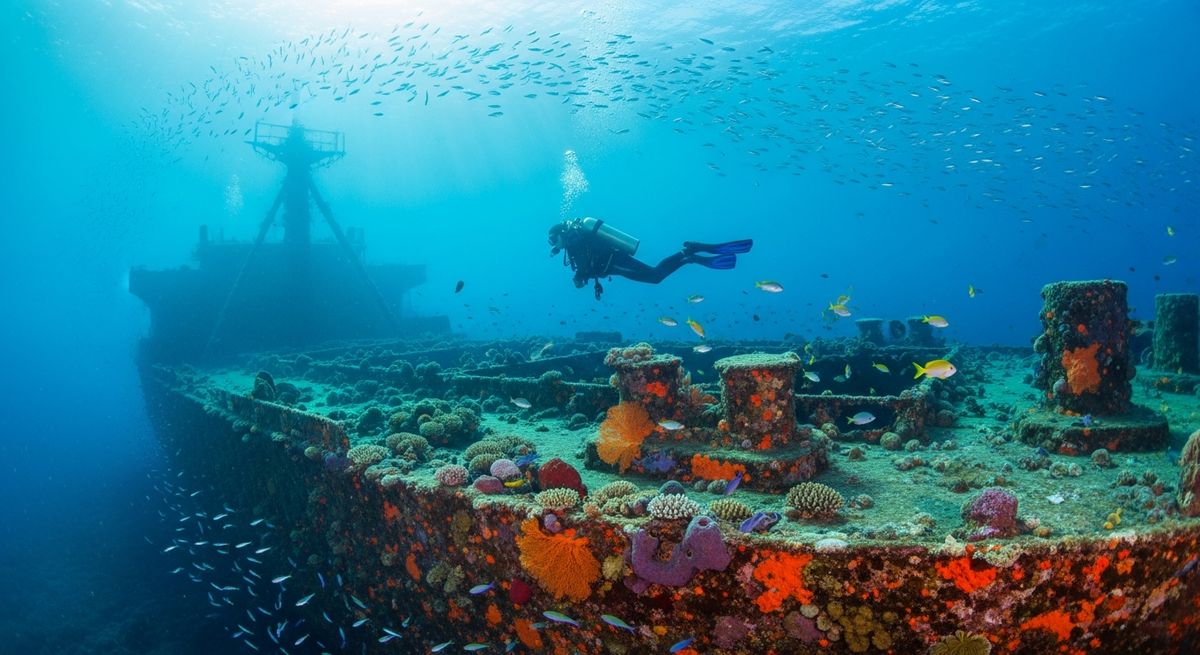
The *Bokn* might be deep, but for us, it's one of Cornwall's more rewarding wrecks. Dropping onto the deck at 53 metres, you'll feel the chill of the thermocline give way to an almost still calm. Visibility down here often hits a decent 15 metres, which is a real bonus for a wreck this size. We love finding the bow, still fairly intact, with its anchor chain spilling into the seabed. Look for the triple-expansion engine midships, a beautiful piece of engineering now home to conger eels, their heads peeking from rusted pipework. This isn't a wreck for beginners; the depth and potential for current mean you'll want solid experience and gas planning. But if you’re comfortable with decompression, the *Bokn* offers a proper journey through history. Schools of bib and pollock swirl around the superstructure, and if you bring a good torch, you'll spot nudibranchs clinging to the metalwork. It’s a quiet, reflective dive, a true dive into the past.
Typical BOKN (POSSIBLY) Dive Profile
Illustrative profile based on site depth and type. Actual dive profiles vary - always follow your dive computer and training.
Safety Notes
Maximum depth 53m exceeds recreational limits (40m). Technical diving certification and equipment required.
Wreck site - avoid penetration without wreck diving certification. Watch for sharp metal and entanglement hazards.
Always perform a 3-minute safety stop at 5m before surfacing.
BOKN (POSSIBLY) Wreck History
Year Sunk
1942
Vessel Type
cargo ship
Cause
torpedo
Tonnage
1,377 GRT
The SS Bokn had a long and storied career before its violent end in the English Channel. Launched in 1890 in Bergen, Norway, this steamship sailed for over five decades under various names, including Grenheim, Blindensol, and Urda. By the time of the Second World War, the aging vessel was pressed into the perilous service of the Allied convoys, a lifeline for wartime Britain.
On July 9th, 1942, while steaming as part of a coastal convoy, the Bokn's long life came to an abrupt end. It was attacked and torpedoed by a German E-boat (fast attack craft), sinking to the seabed. The attack was swift and devastating, a common fate for merchant ships braving the heavily patrolled waters off the English coast during the war.
Today, the Bokn rests at 53 meters, making it a challenging dive reserved for experienced technical divers. The wreck is largely intact, sitting upright on the seabed. Divers can explore its classic steamship features, including the prominent triple-expansion engine and boiler located amidships. The depth and conditions mean visibility can be variable, but for those qualified to make the descent, the Bokn is an atmospheric and historic time capsule from one of history's greatest conflicts.
Nearest Dive Centres to BOKN (POSSIBLY)
Dive shops near BOKN (POSSIBLY)
Edge Watersports
Teign Diving Centre
Dive Beyond Limited
Old Harbour Dive Centre
Reviews for BOKN (POSSIBLY)
Conditions
Ocean conditions, forecast and tides for BOKN (POSSIBLY)
BOKN (POSSIBLY) Ocean Conditions
Monthly averages for BOKN (POSSIBLY), sourced from Open-Meteo marine data - nearest station: Open-Meteo marine grid (50.44, -2.73) (3km away)
October Averages
Sea Temperature
17°C
62°F · Range: 15.1–17.5°C
Air Temperature
13°C
56°F
Wind Speed
8.14 m/s
15.8 knots
Atmospheric Pressure
1011 hPa
Based on 4 years of monitoring data · Data sources: Open-Meteo marine data
Plan & book
Ways to dive Cornwall & Devon, from day trips to liveaboards.
Day trips & courses
via GetYourGuideGuided dives, courses and snorkel trips with instant booking.
Find dive trips in Cornwall & DevonPlaces to stay
via Booking.comHotels and dive resorts near Cornwall & Devon.
Search stays in Cornwall & DevonDive insurance
Most travel insurance excludes or limits scuba. Check what you need before you go.
Dive insurance explainedPartner links: we may earn a commission if you book, at no extra cost to you. How we make money
Where to Stay near BOKN (POSSIBLY)
Prices from Booking.com. We may earn a commission at no extra cost to you.