BORDER KNIGHT
Protected Area
Coverack Cove & Dolor Point
Why dive here
With 176+ marine species recorded in the area - including blue sharks, dolphins, dwarf minke whales, humpback whales and ocean sunfish (mola mola) - BORDER KNIGHT offers some of Cornwall & Devon's richest wreck diving. Water ranges 10-18°C, warmest July, August, September.
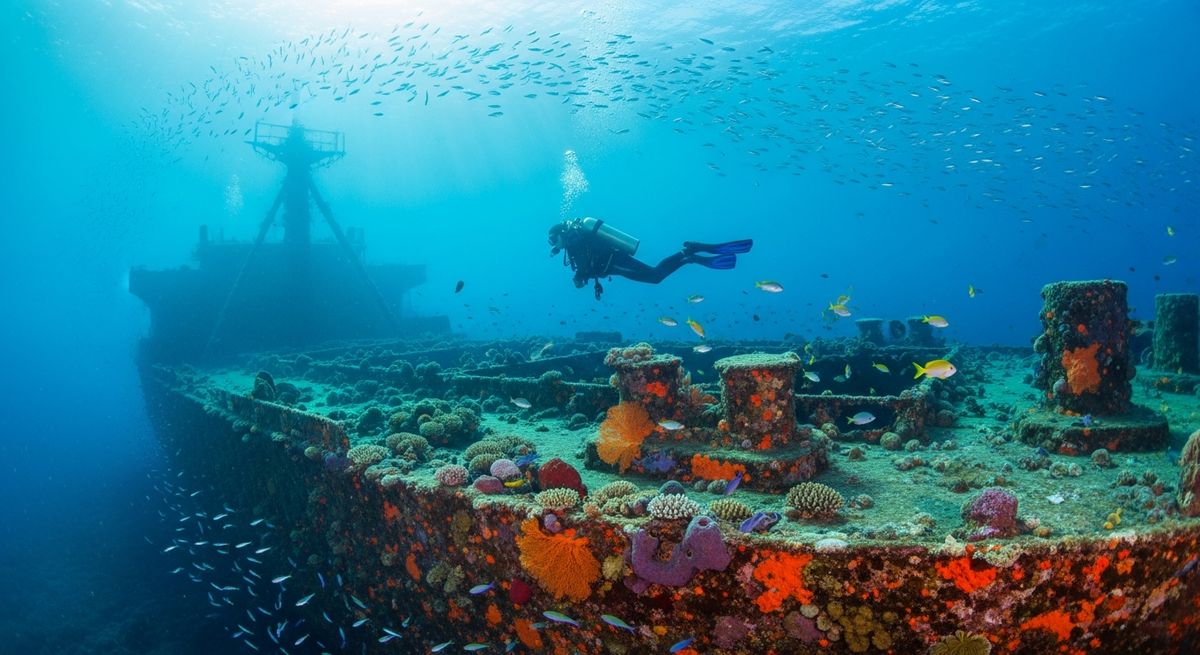
We’ll say it: the Border Knight isn’t an easy dive, but it’s definitely one for the logbook if you’re into proper wreck exploration. Dropping onto the deck at around 55 metres, you really feel the history of this steamship, torpedoed in 1917. She’s largely intact, lying upright, which we love because it gives you a real sense of scale. You can still make out the superstructure, and the bow section, in particular, is captivating – often shrouded in schooling bib and pollack that swirl around you, a living curtain. Our favourite part has to be the chance to peer into the holds. With a decent torch, you can illuminate the dark spaces where cargo once sat, imagining the journey from London to Barry. The visibility here can be superb on a good day, allowing the light to penetrate surprisingly deep. Keep an eye out for resident conger eels, tucked into any crevice they can find, and the odd lobster clinging to the plating. It’s a dive that rewards careful planning and respect for its depth. We’d suggest saving this one for calmer days; strong currents can make the descent and ascent a real challenge. This is a dive for experienced technical divers who appreciate historical wrecks and aren't afraid of a bit of depth.
Typical BORDER KNIGHT Dive Profile
Illustrative profile based on site depth and type. Actual dive profiles vary - always follow your dive computer and training.
Safety Notes
Maximum depth 55m exceeds recreational limits (40m). Technical diving certification and equipment required.
Wreck site - avoid penetration without wreck diving certification. Watch for sharp metal and entanglement hazards.
Always perform a 3-minute safety stop at 5m before surfacing.
BORDER KNIGHT Wreck History
Year Sunk
1917
Vessel Type
cargo ship
Cause
torpedo
Tonnage
3,723 GRT
Built in 1899 by D. and W. Henderson and Co. in Glasgow, the SS Border Knight was a British steam cargo ship of 3,723 GRT. For nearly two decades, she was a typical workhorse vessel of her era, serving the commercial trade routes of the British Empire. The outbreak of the First World War thrust her into a far more perilous environment, where merchant ships became prime targets in the escalating conflict at sea.
On November 4th, 1917, her luck ran out. While en route from London to Barry and sailing in ballast, she was spotted by the German submarine UB-40. Three miles off Black Head, Cornwall, a single torpedo struck the vessel, sealing her fate. The Border Knight sank quickly, becoming another casualty of the unrestricted submarine warfare that defined the war at sea.
Today, the Border Knight lies at a depth of 55 meters, making her a challenging dive reserved for experienced technical and rebreather divers. The wreck is significantly broken up due to the torpedo's impact and over a century of deterioration, but her impressive boilers and engine stand proud of the seabed. In good visibility, divers can explore the scattered remains, which have become a thriving habitat for marine life, including large conger eels, lobsters, and dense shoals of bib.
Nearest Dive Centres to BORDER KNIGHT
Dive shops near BORDER KNIGHT
Porthkerris Divers
DiveUK
Seaways Diving
Karleyth Diving Ltd.
Wavecrest Scuba
Viewpoint Diving Centre
Reviews for BORDER KNIGHT
Conditions
Ocean conditions, forecast and tides for BORDER KNIGHT
BORDER KNIGHT Ocean Conditions
Monthly averages for BORDER KNIGHT, sourced from Open-Meteo marine data - nearest station: Open-Meteo marine grid (50.44, -2.73) (3km away)
October Averages
Sea Temperature
17°C
62°F · Range: 15.1–17.5°C
Air Temperature
13°C
56°F
Wind Speed
8.14 m/s
15.8 knots
Atmospheric Pressure
1011 hPa
Based on 4 years of monitoring data · Data sources: Open-Meteo marine data
Plan & book
Ways to dive Cornwall & Devon, from day trips to liveaboards.
Day trips & courses
via GetYourGuideGuided dives, courses and snorkel trips with instant booking.
Find dive trips in Cornwall & DevonPlaces to stay
via Booking.comHotels and dive resorts near Cornwall & Devon.
Search stays in Cornwall & DevonDive insurance
Most travel insurance excludes or limits scuba. Check what you need before you go.
Dive insurance explainedPartner links: we may earn a commission if you book, at no extra cost to you. How we make money
Where to Stay near BORDER KNIGHT
Prices from Booking.com. We may earn a commission at no extra cost to you.