BRETAGNE
Protected Area
Lyme Bay and Torbay
Why dive here
With 176+ marine species recorded in the area - including blue sharks, dolphins, dwarf minke whales, humpback whales and ocean sunfish (mola mola) - BRETAGNE offers some of Cornwall & Devon's richest wreck diving. Water ranges 10-18°C, warmest July, August, September.
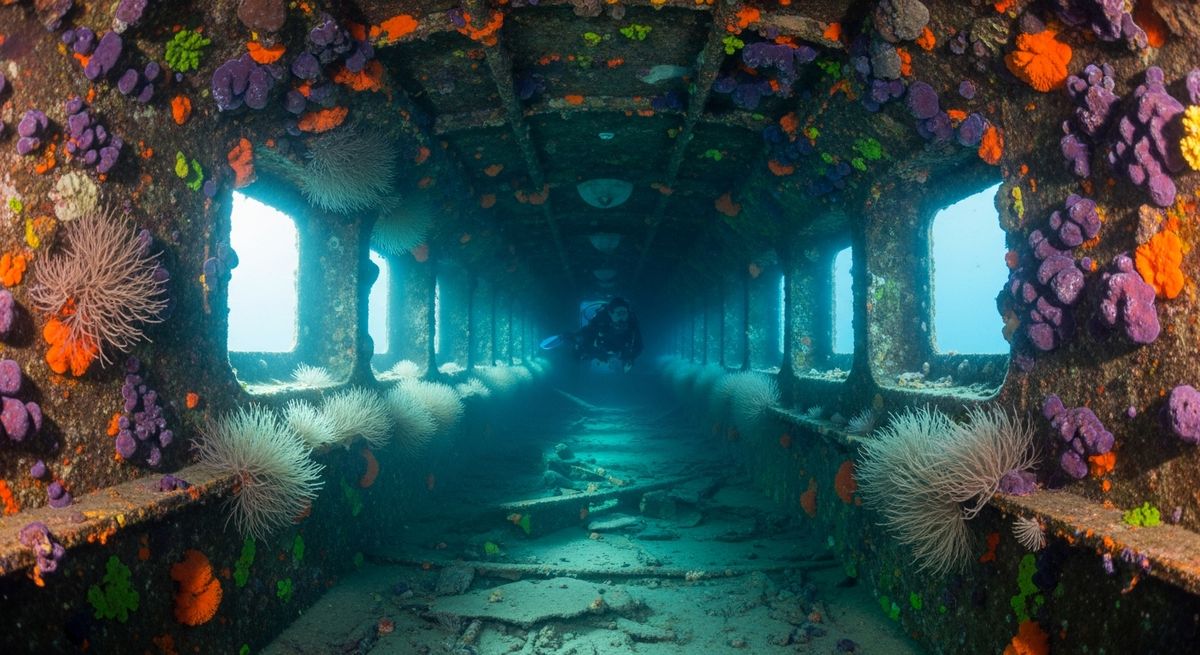
The Bretagne, lying in 24 metres, feels like a proper deep dive, even if the depth isn't extreme. We love this wreck for its accessibility and the sense of history it holds. She’s a steamship, sunk in 1918, and despite being classed as ‘dangerous’ by some, we find her wonderfully explorable. You’ll drop onto a good-sized cargo vessel, 70 metres long, with two boilers standing proud and a triple-expansion engine still largely intact. The stern is often our favourite part, with a distinctive propeller shaft that’s easy to follow. Visibility can be changeable, but when it’s good, the light penetrating the holds is quite something. Look out for the resident conger eels, tucked into every available crevice, and the shoals of pollock and bib that swirl around the structure. It’s a great wreck for divers who want to get a real feel for an early 20th-century steamship without venturing too deep. We suggest aiming for slack water, as currents can pick up.
Typical BRETAGNE Dive Profile
Illustrative profile based on site depth and type. Actual dive profiles vary - always follow your dive computer and training.
Safety Notes
Depth of 24m - Advanced Open Water certification recommended.
Wreck site - avoid penetration without wreck diving certification. Watch for sharp metal and entanglement hazards.
Always perform a 3-minute safety stop at 5m before surfacing.
BRETAGNE Wreck History
Year Sunk
1918
Vessel Type
cargo ship
Cause
torpedo
Tonnage
1,440 GRT
The SS Bretagne was a Norwegian steamship built in 1903. As a neutral vessel, she continued to trade throughout much of World War I, but by 1918, Germany's policy of unrestricted submarine warfare meant no ship in the English Channel was truly safe. On August 10, 1918, just three months before the war's end, the Bretagne was steaming off the coast of Cornwall with a vital cargo of coal.
Her journey was intercepted by the German submarine UB-125. The U-boat commander targeted the merchant ship, and a single torpedo was enough to cripple her. The Bretagne foundered and sank, becoming one of the last victims of the U-boat campaign in these waters. Fortunately, reports indicate that her crew were able to escape before she went down.
Lying at a depth of 24 meters, the Bretagne is now a superb and popular wreck dive. She is well broken, but her two large boilers and impressive triple-expansion engine stand proud of the seabed, providing a fantastic centerpiece for the dive. The wreckage acts as a thriving artificial reef, completely covered in a vibrant carpet of jewel anemones, plumose anemones, and dead man's fingers. It's a beautiful, colourful dive that offers a perfect blend of history and marine life.
Nearest Dive Centres to BRETAGNE
Dive shops near BRETAGNE
View all dive centres in Cornwall & DevonReviews for BRETAGNE
Conditions
Ocean conditions, forecast and tides for BRETAGNE
BRETAGNE Ocean Conditions
Monthly averages for BRETAGNE, sourced from Open-Meteo marine data - nearest station: Open-Meteo marine grid (50.44, -2.73) (3km away)
October Averages
Sea Temperature
17°C
62°F · Range: 15.1–17.5°C
Air Temperature
13°C
56°F
Wind Speed
8.14 m/s
15.8 knots
Atmospheric Pressure
1011 hPa
Based on 4 years of monitoring data · Data sources: Open-Meteo marine data
Plan & book
Ways to dive Cornwall & Devon, from day trips to liveaboards.
Day trips & courses
via GetYourGuideGuided dives, courses and snorkel trips with instant booking.
Find dive trips in Cornwall & DevonPlaces to stay
via Booking.comHotels and dive resorts near Cornwall & Devon.
Search stays in Cornwall & DevonDive insurance
Most travel insurance excludes or limits scuba. Check what you need before you go.
Dive insurance explainedPartner links: we may earn a commission if you book, at no extra cost to you. How we make money
Where to Stay near BRETAGNE
Prices from Booking.com. We may earn a commission at no extra cost to you.