BRETONNE (PROBABLY)
Protected Area
The Manacles
Why dive here
With 176+ marine species recorded in the area - including blue sharks, dolphins, dwarf minke whales, humpback whales and ocean sunfish (mola mola) - BRETONNE (PROBABLY) offers some of Cornwall & Devon's richest wreck diving. Water ranges 10-18°C, warmest July, August, September.
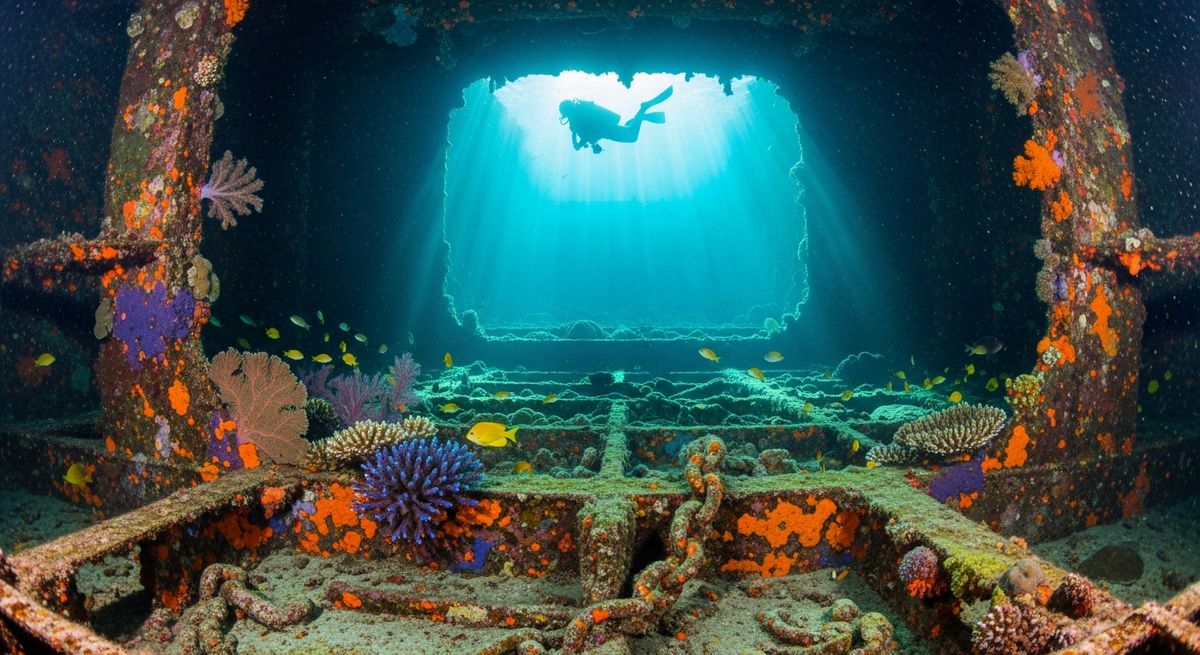
The Bretonne (Probably) is exactly what it sounds like – a wreck that most people are pretty sure is the Bretonne. It’s a deep dive, sitting at 56 metres, so this one is strictly for the experienced technical divers among us. We love it because it’s got that classic cargo steamer feel, upright and relatively intact for a wreck from 1920. Dropping down, the first thing you notice is how the boilers stand proud. They’re usually draped in dead man’s fingers, swaying gently in the current, creating this eerie, organic shroud. The triple expansion engine is a fantastic exploration point; you can still trace the huge cranks and connecting rods, imagining the sheer power of it. Our favourite part is the stern. It's often home to monstrous conger eels, tucked deep into the plating, their heads like grizzled old men peering out. You’ll also find plenty of decent-sized lobsters tucked away, and the hull itself is a canvas for jewel anemones and sponges. Visibility can be a bit hit or miss, as with most deeper UK sites, but on a good day, the low light filtering down gives it a properly dramatic atmosphere. This isn’t a quick jaunt; it’s a planned, methodical dive for those who appreciate maritime history and the slow creep of nature reclaiming steel.
Typical BRETONNE (PROBABLY) Dive Profile
Illustrative profile based on site depth and type. Actual dive profiles vary - always follow your dive computer and training.
Safety Notes
Maximum depth 56m exceeds recreational limits (40m). Technical diving certification and equipment required.
Wreck site - avoid penetration without wreck diving certification. Watch for sharp metal and entanglement hazards.
Always perform a 3-minute safety stop at 5m before surfacing.
BRETONNE (PROBABLY) Wreck History
Year Sunk
1923
Vessel Type
cargo ship
Cause
collision
Tonnage
1,510 GRT
The SS Bretonne was a French steamship, relatively new having been built in 1920. Her career was cut short on September 29, 1923, during a routine voyage carrying coal from Newport, Wales, to Caen, France. As she navigated the waters off Cornwall, a dense fog descended, dramatically reducing visibility and turning the busy shipping lane into a perilous gauntlet.
Near the notoriously treacherous Manacles reef, the Bretonne collided with another steamer, the SS Birville. The force of the impact tore a fatal gash in the Bretonne's hull, and she began to sink rapidly. Her crew had just enough time to abandon ship and were all safely picked up by the Birville, ensuring there was no loss of life in the incident. The Bretonne slipped beneath the waves and came to rest on the seabed, where she would lie forgotten for decades.
Rediscovered by divers, the Bretonne is now a premier technical dive. Sitting upright and remarkably intact at a depth of 56 meters, she is a spectacular sight. The depth often provides excellent, clear water, revealing a wreck that looks almost ready to sail. Divers with the requisite training can explore her superstructure, peer into the cargo holds, and admire the large, proud triple-expansion engine. Adorned with jewel anemones and patrolled by large fish, the Bretonne is a truly rewarding deep dive for those equipped to make the journey.
Nearest Dive Centres to BRETONNE (PROBABLY)
Dive shops near BRETONNE (PROBABLY)
Porthkerris Divers
DiveUK
Seaways Diving
Karleyth Diving Ltd.
Viewpoint Diving Centre
Wavecrest Scuba
Reviews for BRETONNE (PROBABLY)
Conditions
Ocean conditions, forecast and tides for BRETONNE (PROBABLY)
BRETONNE (PROBABLY) Ocean Conditions
Monthly averages for BRETONNE (PROBABLY), sourced from Open-Meteo marine data - nearest station: Open-Meteo marine grid (50.44, -2.73) (3km away)
October Averages
Sea Temperature
17°C
62°F · Range: 15.1–17.5°C
Air Temperature
13°C
56°F
Wind Speed
8.14 m/s
15.8 knots
Atmospheric Pressure
1011 hPa
Based on 4 years of monitoring data · Data sources: Open-Meteo marine data
Plan & book
Ways to dive Cornwall & Devon, from day trips to liveaboards.
Day trips & courses
via GetYourGuideGuided dives, courses and snorkel trips with instant booking.
Find dive trips in Cornwall & DevonPlaces to stay
via Booking.comHotels and dive resorts near Cornwall & Devon.
Search stays in Cornwall & DevonDive insurance
Most travel insurance excludes or limits scuba. Check what you need before you go.
Dive insurance explainedPartner links: we may earn a commission if you book, at no extra cost to you. How we make money
Where to Stay near BRETONNE (PROBABLY)
Prices from Booking.com. We may earn a commission at no extra cost to you.