BRISEIS
Protected Area
Gouliot Caves and Headland, Sark
Why dive here
With 176+ marine species recorded in the area - including blue sharks, dolphins, dwarf minke whales, humpback whales and ocean sunfish (mola mola) - BRISEIS offers some of Cornwall & Devon's richest wreck diving. Water ranges 10-18°C, warmest July, August, September.
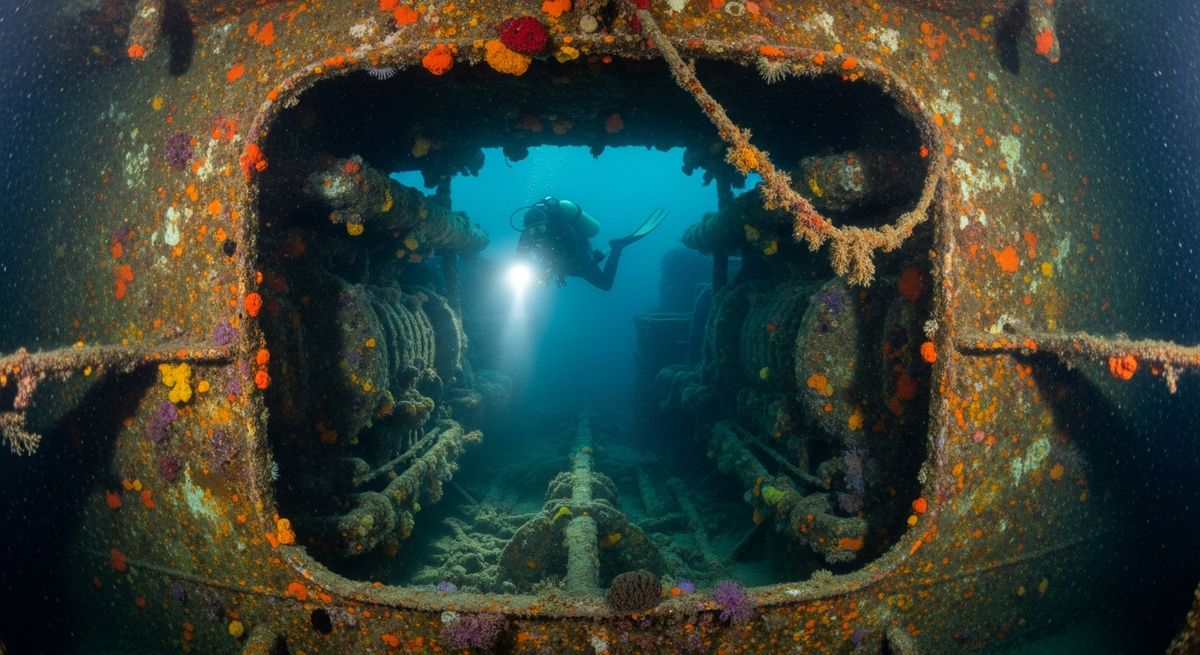
The Briseis, a steamship that went down in 1937, isn’t just another bit of metal on the seabed. She’s a proper wreck dive, sitting upright and surprisingly intact at just 14 metres. We love that you can really get a sense of her scale, with her bows rising impressively from the sand. Swim along the deck, and you’ll find cracks and openings everywhere, perfect for peering inside, though we’d suggest leaving serious penetration to those with specialist training. What makes the Briseis a standout for us is the way the marine life has claimed her. You'll spot jewel anemones plastered all over the metalwork, their tiny tentacles shimmering in the torchlight. Dogfish often rest in the sand nearby, and the whole wreck is home to schools of pollack and bib, darting in and out of the superstructure. It’s a fantastic site for newer wreck divers looking to get a feel for a substantial wreck without the deeper depths or fierce currents you sometimes find further offshore. Visibility can be a bit hit-or-miss, so pick a calm day with good tides for the best experience. The sheer volume of life, combined with the Briseis's solid structure, always makes for a satisfying dive.
Typical BRISEIS Dive Profile
Illustrative profile based on site depth and type. Actual dive profiles vary - always follow your dive computer and training.
Safety Notes
Wreck site - avoid penetration without wreck diving certification. Watch for sharp metal and entanglement hazards.
Always perform a 3-minute safety stop at 5m before surfacing.
BRISEIS Wreck History
Year Sunk
1937
Vessel Type
cargo ship
Cause
unknown
Originally launched as the GENUA from a Rostock shipyard in 1909, this German-built steamship was renamed BRISEIS in 1920. For nearly three decades, she plied the seas under the ownership of the Campagnie Auxillaire de Navigations, powered by her triple-expansion steam engine. Her long career came to an end on the first of October, 1937, when she sank for reasons that remain undocumented.
Lying at just 14 meters, the BRISEIS is a fantastic and highly accessible wreck dive suitable for divers of all experience levels. Its shallow depth allows for long, relaxed bottom times with excellent natural light. Having been on the seabed for over 80 years, the wreck is thoroughly colonized with vibrant marine life, transforming the old steamer into a bustling artificial reef. Divers can easily explore the scattered remains, including the ship's boilers and engine block, making it a perfect site for underwater photography and an introduction to the rich maritime history of the English Channel.
Nearest Dive Centres to BRISEIS
Dive shops near BRISEIS
View all dive centres in Cornwall & DevonReviews for BRISEIS
Conditions
Ocean conditions, forecast and tides for BRISEIS
BRISEIS Ocean Conditions
Monthly averages for BRISEIS, sourced from Open-Meteo marine data - nearest station: Open-Meteo marine grid (50.44, -2.73) (3km away)
October Averages
Sea Temperature
17°C
62°F · Range: 15.1–17.5°C
Air Temperature
13°C
56°F
Wind Speed
8.14 m/s
15.8 knots
Atmospheric Pressure
1011 hPa
Based on 4 years of monitoring data · Data sources: Open-Meteo marine data
Plan & book
Ways to dive Cornwall & Devon, from day trips to liveaboards.
Day trips & courses
via GetYourGuideGuided dives, courses and snorkel trips with instant booking.
Find dive trips in Cornwall & DevonPlaces to stay
via Booking.comHotels and dive resorts near Cornwall & Devon.
Search stays in Cornwall & DevonDive insurance
Most travel insurance excludes or limits scuba. Check what you need before you go.
Dive insurance explainedPartner links: we may earn a commission if you book, at no extra cost to you. How we make money
Where to Stay near BRISEIS
Prices from Booking.com. We may earn a commission at no extra cost to you.