BRITANNIA (PROBABLY)
Protected Area
Albert Field
Why dive here
With 176+ marine species recorded in the area - including blue sharks, dolphins, dwarf minke whales, humpback whales and ocean sunfish (mola mola) - BRITANNIA (PROBABLY) offers some of Cornwall & Devon's richest wreck diving. Water ranges 10-18°C, warmest July, August, September.
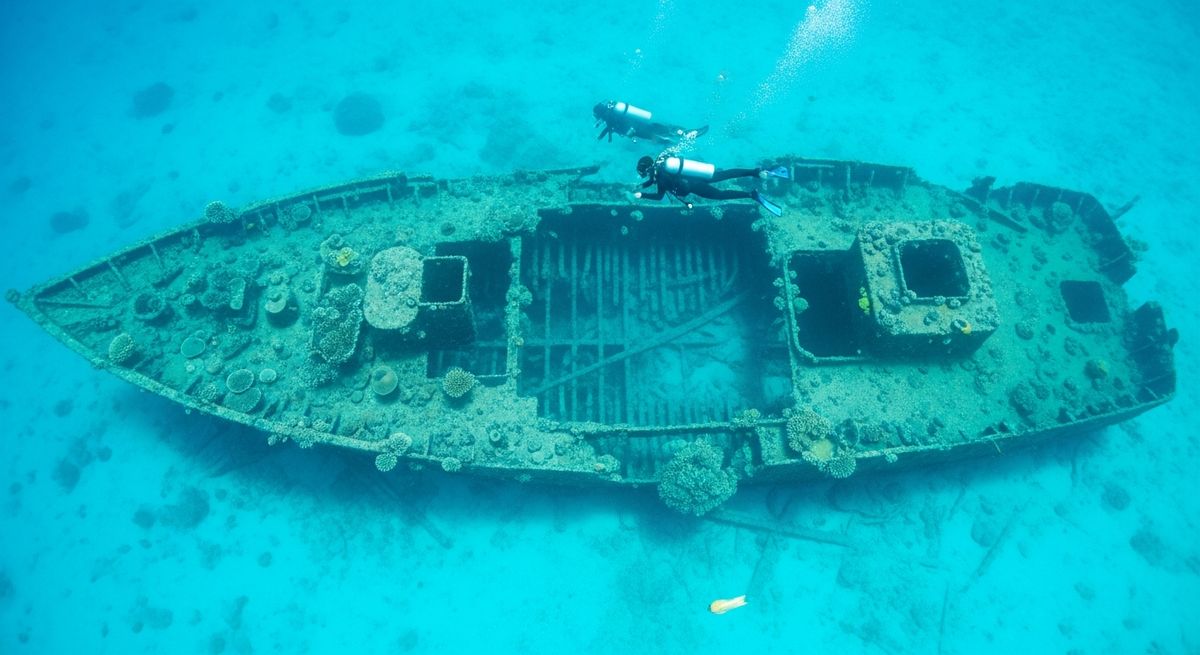
Let's talk about the Britannia. She’s often called "Probably the Britannia" for a reason – positive ID has been a bit of a saga, but frankly, when you’re down there, you don't care much about the paperwork. This wreck, a steamship sunk in 1917, lies at a solid 37 metres, making it one for divers comfortable with a bit of depth and colder water. What we love about her is the sheer scale. At 64 metres long, she’s substantial, and despite the years, much of her structure is still recognisable. You’ll fin along her decks, spotting the huge boilers, and often, the prop shaft stretching towards the stern. The wreck has become a fantastic artificial reef. Our last visit saw huge schools of pollack swirling in and out of the hold openings, and we always find conger eels tucked into shadowy corners. Look closely at the deck plating, too; it’s usually covered in jewel anemones, tiny bursts of colour in the ambient light. Visibility can be hit or miss in the English Channel, so pick your day – slack water on a neap tide is always our preference to avoid a wild ride. The currents here can be fierce, making a drift across the wreck a possibility if you misjudge it, but equally, they bring in plenty of food for the resident fish. She’s a proper wreck dive, full of history and marine life, perfect for those who appreciate the chill of a good British dive.
Typical BRITANNIA (PROBABLY) Dive Profile
Illustrative profile based on site depth and type. Actual dive profiles vary - always follow your dive computer and training.
Safety Notes
Deep dive (37m) - monitor air consumption closely. Advanced certification recommended.
Wreck site - avoid penetration without wreck diving certification. Watch for sharp metal and entanglement hazards.
Always perform a 3-minute safety stop at 5m before surfacing.
BRITANNIA (PROBABLY) Wreck History
Year Sunk
1917
Vessel Type
cargo ship
Cause
torpedo
Tonnage
1,114 GRT
The SS Britannia was a steamship built in 1885 by S & H Morton & Co. in Leith for the Leith, Hull & Hamburg Steam Packet Co. For over 30 years, she served as a reliable cargo vessel, plying the trade routes between the UK and continental Europe, a typical workhorse of her time.
Her peaceful career came to an end during the height of World War I. On October 19, 1917, while on a voyage from Middlesbrough to Italy carrying a vital cargo of steel, she entered a mined area. The Britannia struck a mine laid by the German submarine UC-75 and sank quickly, becoming another casualty of the unrestricted naval warfare that defined the era.
Today, the wreck of the Britannia rests at a depth of 37 metres. As is common for a vessel of its age that sank violently, it is substantially broken up. Divers can still easily identify the most robust parts of the ship, including the large boilers and the compound engine, which stand proud of the seabed. Sections of hull plating and the scattered steel cargo provide further points of interest on a dive that connects directly with the maritime history of WWI.
Nearest Dive Centres to BRITANNIA (PROBABLY)
Dive shops near BRITANNIA (PROBABLY)
Divers Down
Mayim Mermaid Academy
TAL Scuba Ltd.
Dorset Diving Services
Reviews for BRITANNIA (PROBABLY)
Conditions
Ocean conditions, forecast and tides for BRITANNIA (PROBABLY)
BRITANNIA (PROBABLY) Ocean Conditions
Monthly averages for BRITANNIA (PROBABLY), sourced from Open-Meteo marine data - nearest station: Open-Meteo marine grid (50.44, -2.73) (3km away)
October Averages
Sea Temperature
17°C
62°F · Range: 15.1–17.5°C
Air Temperature
13°C
56°F
Wind Speed
8.14 m/s
15.8 knots
Atmospheric Pressure
1011 hPa
Based on 4 years of monitoring data · Data sources: Open-Meteo marine data
Plan & book
Ways to dive Cornwall & Devon, from day trips to liveaboards.
Day trips & courses
via GetYourGuideGuided dives, courses and snorkel trips with instant booking.
Find dive trips in Cornwall & DevonPlaces to stay
via Booking.comHotels and dive resorts near Cornwall & Devon.
Search stays in Cornwall & DevonDive insurance
Most travel insurance excludes or limits scuba. Check what you need before you go.
Dive insurance explainedPartner links: we may earn a commission if you book, at no extra cost to you. How we make money
Where to Stay near BRITANNIA (PROBABLY)
Prices from Booking.com. We may earn a commission at no extra cost to you.