BRITISH INVENTOR (BOW SECTION)
Protected Area
Studland to Portland
Why dive here
With 176+ marine species recorded in the area - including blue sharks, dolphins, dwarf minke whales, humpback whales and ocean sunfish (mola mola) - BRITISH INVENTOR (BOW SECTION) offers some of Cornwall & Devon's richest wreck diving. Water ranges 10-18°C, warmest July, August, September.
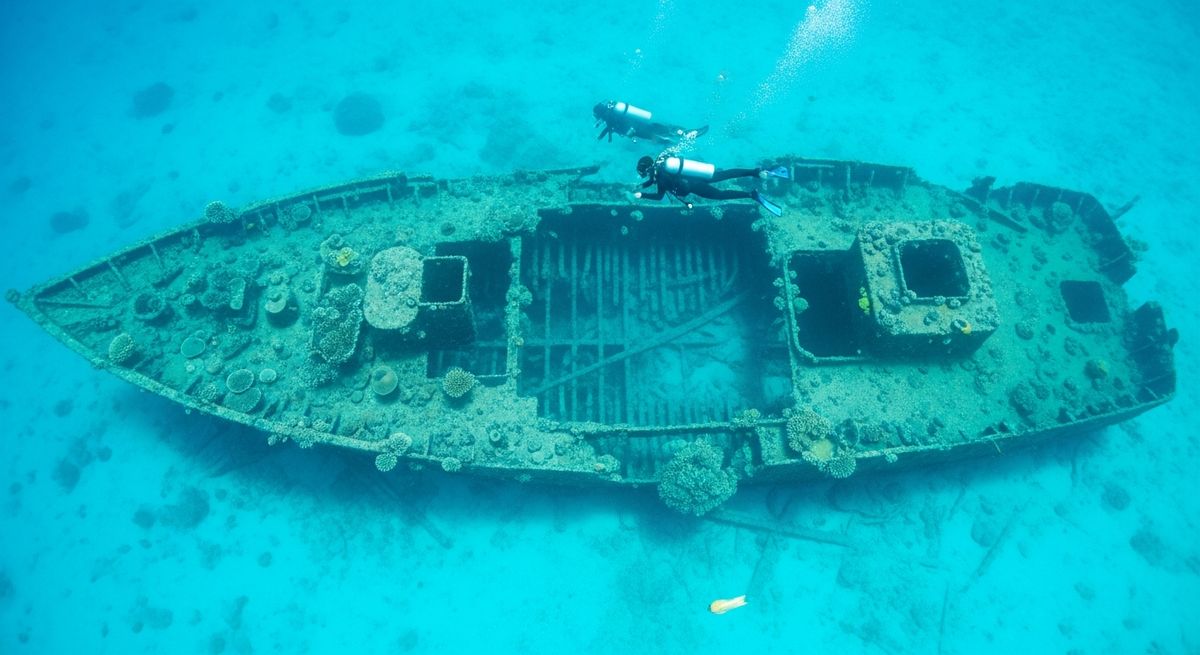
The *British Inventor* bow section is our favourite of the two halves. It’s sitting upright, around 19 metres, giving it a much more intact feel than the stern. We love how the bow points north, almost as if still trying to make its journey up the coast. Dropping down, you’ll quickly see the sheer scale of the tanker, especially those massive anchor chains still draped over the bow. The wreck itself is home to some seriously chunky conger eels tucked into every nook and cranny. Keep an eye out for them peering from collapsed sections. Dead man’s fingers coral grows in thick, white clumps, contrasting with the dark steel, and the shoals of pollock are often so dense they make the surface light ripple. We’d suggest a slack water dive here, as the currents can pick up, making it a bit of a workout. It’s a great dive for anyone keen on exploring a substantial piece of maritime history, not just another pile of scattered metal.
Typical BRITISH INVENTOR (BOW SECTION) Dive Profile
Illustrative profile based on site depth and type. Actual dive profiles vary - always follow your dive computer and training.
Safety Notes
Depth of 19m - Advanced Open Water certification recommended.
Wreck site - avoid penetration without wreck diving certification. Watch for sharp metal and entanglement hazards.
Always perform a 3-minute safety stop at 5m before surfacing.
BRITISH INVENTOR (BOW SECTION) Wreck History
Year Sunk
1940
Vessel Type
tanker
Cause
torpedo
Tonnage
7,006 GRT
The MV British Inventor was a motor tanker built in 1926 for the British Tanker Company, a key part of Britain's merchant navy. When World War II began, she was tasked with the perilous duty of transporting vital fuel supplies across hostile seas to keep the war effort going.
On June 13, 1940, while en route from Abadan, Persia, to the Hamble with a full cargo of fuel oil, she struck a German mine off St. Alban's Head. The powerful explosion tore a huge hole in her forward section. In a desperate attempt to save the ship and her valuable cargo, she was beached on Lulworth Banks. The damage was too great, however, and the vessel broke in two. In a remarkable feat of wartime salvage, the entire stern section was refloated and towed to port, where it was later fitted with a brand new bow and re-entered service as the 'British Vindicator'. The original, severed bow was abandoned.
This wreck site is that original bow section, which now rests in just 19 metres of water. It's an excellent and highly accessible dive, perfect for all levels of diver. The bow lies on its side, and its sheer size is impressive up close. Divers can explore the foredeck, peer into the chain locker, and examine the twisted, torn metal where the mine detonated, a fascinating and tangible piece of WWII history.
Nearest Dive Centres to BRITISH INVENTOR (BOW SECTION)
Dive shops near BRITISH INVENTOR (BOW SECTION)
Dive Beyond Limited
Old Harbour Dive Centre
Divers Down
Dorset Diving Services
Mayim Mermaid Academy
TAL Scuba Ltd.
Reviews for BRITISH INVENTOR (BOW SECTION)
Conditions
Ocean conditions, forecast and tides for BRITISH INVENTOR (BOW SECTION)
BRITISH INVENTOR (BOW SECTION) Ocean Conditions
Monthly averages for BRITISH INVENTOR (BOW SECTION), sourced from Open-Meteo marine data - nearest station: Open-Meteo marine grid (50.44, -2.73) (3km away)
October Averages
Sea Temperature
17°C
62°F · Range: 15.1–17.5°C
Air Temperature
13°C
56°F
Wind Speed
8.14 m/s
15.8 knots
Atmospheric Pressure
1011 hPa
Based on 4 years of monitoring data · Data sources: Open-Meteo marine data
Plan & book
Ways to dive Cornwall & Devon, from day trips to liveaboards.
Day trips & courses
via GetYourGuideGuided dives, courses and snorkel trips with instant booking.
Find dive trips in Cornwall & DevonPlaces to stay
via Booking.comHotels and dive resorts near Cornwall & Devon.
Search stays in Cornwall & DevonDive insurance
Most travel insurance excludes or limits scuba. Check what you need before you go.
Dive insurance explainedPartner links: we may earn a commission if you book, at no extra cost to you. How we make money
Where to Stay near BRITISH INVENTOR (BOW SECTION)
Prices from Booking.com. We may earn a commission at no extra cost to you.