BROOMHILL
Protected Area
South of Portland
Why dive here
With 176+ marine species recorded in the area - including blue sharks, dolphins, dwarf minke whales, humpback whales and ocean sunfish (mola mola) - BROOMHILL offers some of Cornwall & Devon's richest wreck diving. Water ranges 10-18°C, warmest July, August, September.
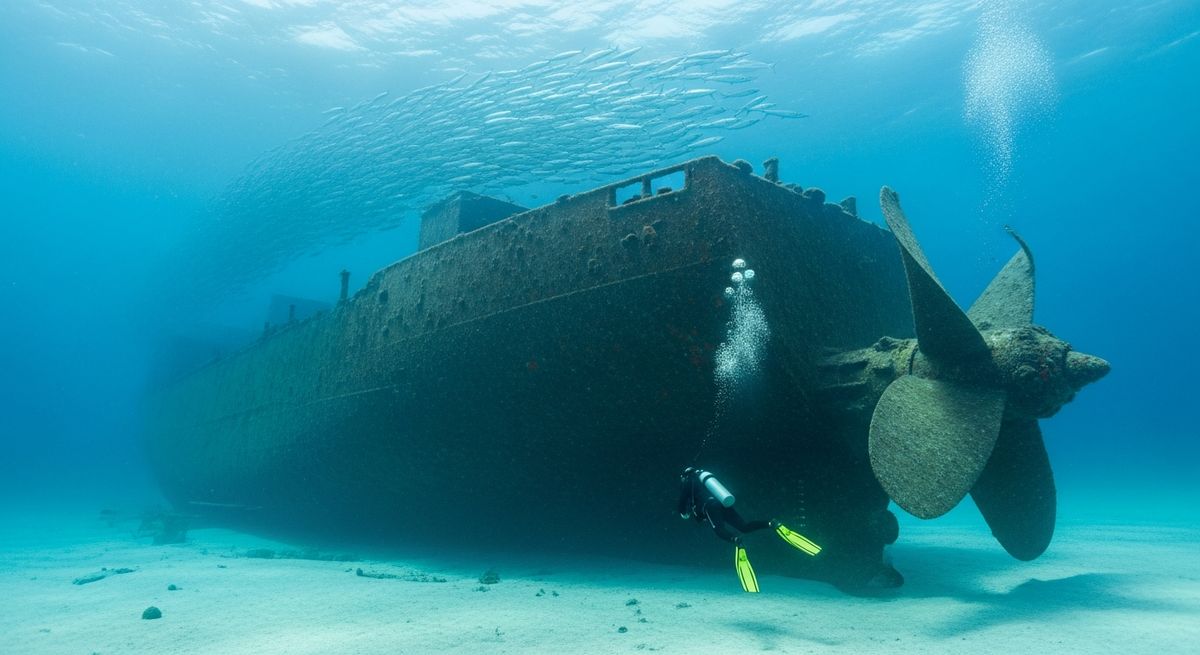
Broomhill is one of those deeper wrecks that really rewards the effort. Dropping down, the visibility in this part of Lyme Bay can be fickle, but when it’s good, the sheer size of the Broomhill emerges from the gloom. She’s a collier, sunk by a mine in 1917, and you can still feel the history – the deck plates are often encrusted with dead man's fingers, and huge plumose anemones sway from any upward-facing surface. We love the penetration into the engine room, if you’re properly trained and equipped for it; the triple-expansion engine is still largely intact. Even if you stay outside, there are so many nooks and crannies to poke your head into. Look out for conger eels peering from pipes and the occasional anglerfish nestled amongst the kelp that grows on the higher sections. This is a dive for experienced wreck enthusiasts, no question. The depth means you need to be mindful of your bottom time, and the currents can pick up, so we always plan our dive for slack water. It’s a proper expedition, and you’ll often have the whole wreck to yourself, which is a rare treat.
Typical BROOMHILL Dive Profile
Illustrative profile based on site depth and type. Actual dive profiles vary - always follow your dive computer and training.
Safety Notes
Maximum depth 50m exceeds recreational limits (40m). Technical diving certification and equipment required.
Wreck site - avoid penetration without wreck diving certification. Watch for sharp metal and entanglement hazards.
Always perform a 3-minute safety stop at 5m before surfacing.
BROOMHILL Wreck History
Year Sunk
1917
Vessel Type
cargo ship
Cause
unknown
The SS Broomhill was a modern collier, built in 1909 to transport coal for the Broomhill Collieries Ltd. For eight years, she faithfully plied the coastal routes, a workhorse of British industry. Her service was cut short on May 10, 1917, during the height of the First World War's submarine campaign against British shipping. While the official records are sparse on the cause, her sinking in the active waters between Cornwall and Devon strongly suggests she was another casualty of a U-boat attack, sent to the bottom without warning.
Today, the Broomhill is a classic deep wreck dive, lying at a depth of 50 meters. This site is for experienced divers who are comfortable with depth and decompression. The reward is a substantial and fascinating wreck to explore. Key features for divers are the ship's two large boilers and the impressive triple-expansion engine, all of which stand proud of the seabed. After more than a century underwater, these powerful pieces of engineering are now beautifully encrusted with marine life, creating a stunning artificial reef.
Nearest Dive Centres to BROOMHILL
Dive shops near BROOMHILL
View all dive centres in Cornwall & DevonReviews for BROOMHILL
Conditions
Ocean conditions, forecast and tides for BROOMHILL
BROOMHILL Ocean Conditions
Monthly averages for BROOMHILL, sourced from Open-Meteo marine data - nearest station: Open-Meteo marine grid (50.44, -2.73) (3km away)
October Averages
Sea Temperature
17°C
62°F · Range: 15.1–17.5°C
Air Temperature
13°C
56°F
Wind Speed
8.14 m/s
15.8 knots
Atmospheric Pressure
1011 hPa
Based on 4 years of monitoring data · Data sources: Open-Meteo marine data
Plan & book
Ways to dive Cornwall & Devon, from day trips to liveaboards.
Day trips & courses
via GetYourGuideGuided dives, courses and snorkel trips with instant booking.
Find dive trips in Cornwall & DevonPlaces to stay
via Booking.comHotels and dive resorts near Cornwall & Devon.
Search stays in Cornwall & DevonDive insurance
Most travel insurance excludes or limits scuba. Check what you need before you go.
Dive insurance explainedPartner links: we may earn a commission if you book, at no extra cost to you. How we make money
Where to Stay near BROOMHILL
Prices from Booking.com. We may earn a commission at no extra cost to you.