BRUNHILDA
Protected Area
Skerries Bank and Surrounds
Why dive here
With 176+ marine species recorded in the area - including blue sharks, dolphins, dwarf minke whales, humpback whales and ocean sunfish (mola mola) - BRUNHILDA offers some of Cornwall & Devon's richest wreck diving. Water ranges 10-18°C, warmest July, August, September.
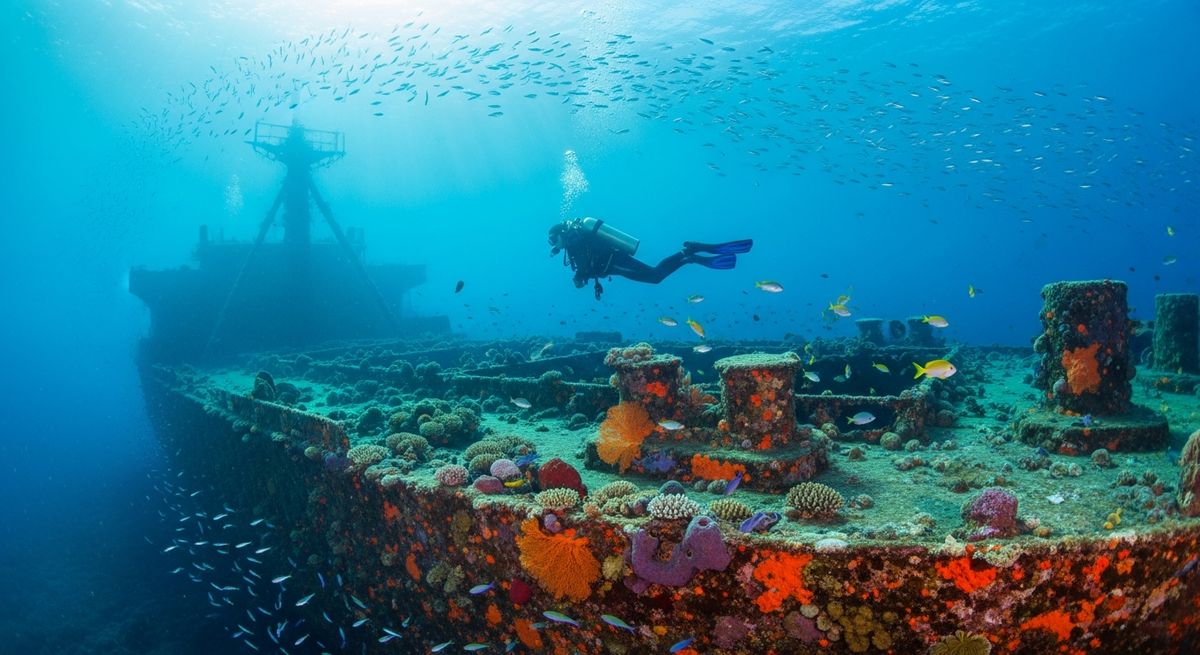
The Brunhilda is a proper diver's wreck, a chunky steamship that sits upright and intact on the seabed, around 56 meters down. When we say intact, we mean it. You can follow her deck from bow to stern, spotting the giant boilers and the triple expansion engine still standing proud amidships. It’s the sheer scale and level of preservation that really hits you. Dropping down through the gloom, the wreck slowly resolves itself, an enormous shadow emerging from the deep blue. We've spent dives just navigating her length, poking around the holds where crabs scuttle in the sediment. The stern is our favourite spot, often shrouded in schooling bib and pollack, with conger eels peering out from gaps in the plating. This is a technical dive, absolutely, but for those with the training, it’s a genuinely rewarding experience. Dive her on a calm day, slack water, and you’ll get to appreciate the history she holds without battling a current.
Typical BRUNHILDA Dive Profile
Illustrative profile based on site depth and type. Actual dive profiles vary - always follow your dive computer and training.
Safety Notes
Maximum depth 56m exceeds recreational limits (40m). Technical diving certification and equipment required.
Wreck site - avoid penetration without wreck diving certification. Watch for sharp metal and entanglement hazards.
Always perform a 3-minute safety stop at 5m before surfacing.
BRUNHILDA Wreck History
Year Sunk
1917
Vessel Type
cargo ship
Cause
torpedo
The SS Brunhilda was a British steamship built in 1901 by the renowned William Gray & Co. shipyard in West Hartlepool. For over a decade, she served as a typical merchant freighter of her time, powered by a triple-expansion steam engine and transporting goods across the seas. When World War I broke out, she, like thousands of other civilian vessels, was pressed into the vital service of keeping Britain supplied, operating under the constant threat of German naval power.
Her service came to a violent end on July 11, 1917. While on passage from Falmouth, she was targeted by the German submarine UC-47. Struck by a torpedo, the Brunhilda sank beneath the waves, becoming another victim of Germany's unrestricted submarine warfare campaign which aimed to cripple the Allied war effort by starving them of resources.
Resting at a depth of 56 meters, the Brunhilda is now a classic deep wreck dive for experienced technical divers. She sits upright and is largely intact, offering a spectacular sight as she emerges from the gloom. Divers can explore her superstructure, peer into the cargo holds, and marvel at the two large boilers and the impressive triple-expansion engine, which stands proud amidships. The depth and conditions make this a challenging dive, but one that rewards with a perfectly preserved piece of World War I history.
Nearest Dive Centres to BRUNHILDA
Dive shops near BRUNHILDA
Teign Diving Centre
Edge Watersports
Sound Diving Limited
Plymouth Diving Centre
Reviews for BRUNHILDA
Conditions
Ocean conditions, forecast and tides for BRUNHILDA
BRUNHILDA Ocean Conditions
Monthly averages for BRUNHILDA, sourced from Open-Meteo marine data - nearest station: Open-Meteo marine grid (50.44, -2.73) (3km away)
October Averages
Sea Temperature
17°C
62°F · Range: 15.1–17.5°C
Air Temperature
13°C
56°F
Wind Speed
8.14 m/s
15.8 knots
Atmospheric Pressure
1011 hPa
Based on 4 years of monitoring data · Data sources: Open-Meteo marine data
Plan & book
Ways to dive Cornwall & Devon, from day trips to liveaboards.
Day trips & courses
via GetYourGuideGuided dives, courses and snorkel trips with instant booking.
Find dive trips in Cornwall & DevonPlaces to stay
via Booking.comHotels and dive resorts near Cornwall & Devon.
Search stays in Cornwall & DevonDive insurance
Most travel insurance excludes or limits scuba. Check what you need before you go.
Dive insurance explainedPartner links: we may earn a commission if you book, at no extra cost to you. How we make money
Where to Stay near BRUNHILDA
Prices from Booking.com. We may earn a commission at no extra cost to you.