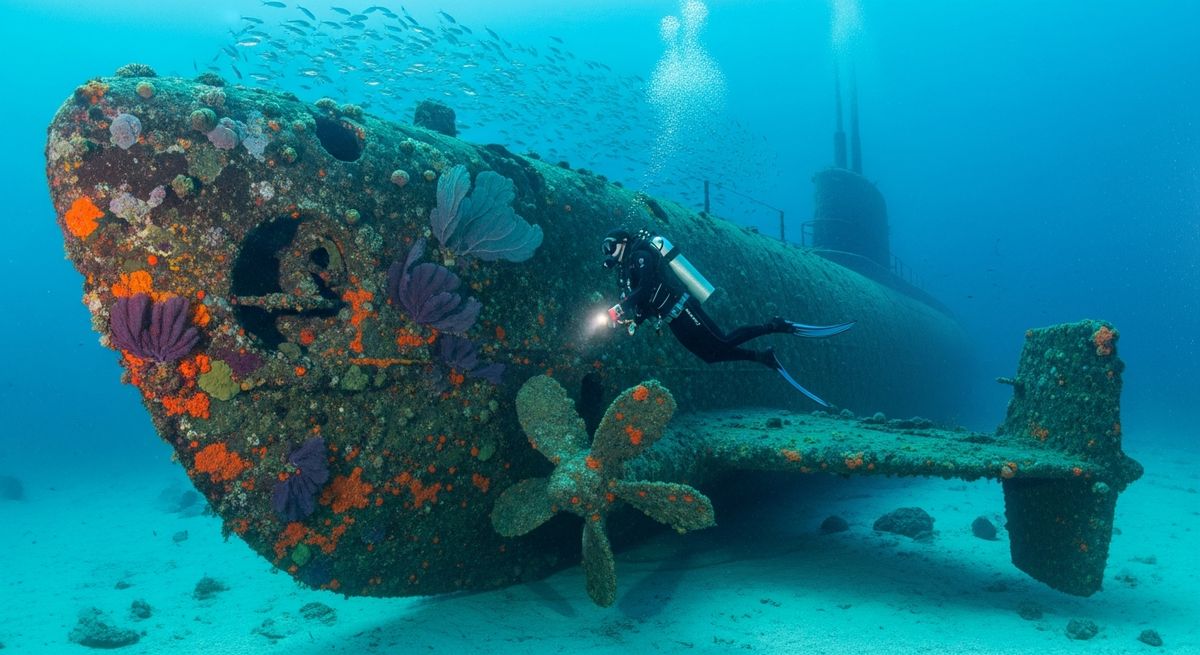
CABENDA
Protected Area
Crymlyn Burrows
Why dive here
With 176+ marine species recorded in the area - including blue sharks, dolphins, dwarf minke whales, humpback whales and ocean sunfish (mola mola) - CABENDA offers some of Cornwall & Devon's richest wreck diving. Water ranges 10-18°C, warmest July, August, September.
The Cabenda, a small motor vessel sunk by a mine in 1941, sits upright and largely intact at a very accessible 12 metres. We love how the shallow depth and relatively sheltered position make it an excellent introduction to wreck diving, particularly for those new to the game or divers who prefer longer bottom times. You’ll find the wreck itself is quite broken in parts, a testament to the wartime explosion, but the bow and stern sections are still clearly recognisable. Head towards the stern to find the propeller still in place, often cloaked in plumose anemones, their frilly tentacles swaying with the gentle surge. Inside the hold, if you peer carefully, we’ve often spotted conger eels tucked away in the shadows, their heads poking out from behind rusting metal plates. Look out for dogfish resting on the silty seabed just off the wreck’s perimeter; they’re often camouflaged surprisingly well. We’d suggest timing your dive with slack water, as even a gentle current can make navigating the interior a bit more challenging.
Typical CABENDA Dive Profile
Illustrative profile based on site depth and type. Actual dive profiles vary - always follow your dive computer and training.
Safety Notes
Wreck site - avoid penetration without wreck diving certification. Watch for sharp metal and entanglement hazards.
Always perform a 3-minute safety stop at 5m before surfacing.
CABENDA Wreck History
Year Sunk
1941
Vessel Type
cargo ship
Cause
mined
A small coastal motor vessel, the MV Cabenda was caught up in the immense conflict of the Second World War. In February 1941, while on a routine passage from Shoreham to Briton Ferry, it entered a section of the English Channel that had been secretly mined by enemy forces, a common tactic used to disrupt vital Allied shipping lanes.
The Cabenda's final moments were swift and violent. It struck a mine and sank quickly, becoming another maritime casualty of the war. Its remains came to rest in the relatively shallow waters off the coast of Cornwall and Devon, a silent memorial to the dangers faced by civilian mariners during the war.
Today, lying at a depth of just 12 meters, the Cabenda is an accessible dive for many. However, its official classification as a 'Dangerous Wreck' is a reminder of its traumatic end. Divers can explore the 45-meter-long structure, which is now an artificial reef for local marine life, but must do so with caution, aware of potential hazards like sharp, corroded metal and the unpredictable currents of the channel.
Nearest Dive Centres to CABENDA
Dive shops near CABENDA
View all dive centres in Cornwall & DevonReviews for CABENDA
Conditions
Ocean conditions, forecast and tides for CABENDA
CABENDA Ocean Conditions
Monthly averages for CABENDA, sourced from Open-Meteo marine data - nearest station: Open-Meteo marine grid (50.44, -2.73) (3km away)
October Averages
Sea Temperature
17°C
62°F · Range: 15.1–17.5°C
Air Temperature
13°C
56°F
Wind Speed
8.14 m/s
15.8 knots
Atmospheric Pressure
1011 hPa
Based on 4 years of monitoring data · Data sources: Open-Meteo marine data
Plan & book
Ways to dive Cornwall & Devon, from day trips to liveaboards.
Day trips & courses
via GetYourGuideGuided dives, courses and snorkel trips with instant booking.
Find dive trips in Cornwall & DevonPlaces to stay
via Booking.comHotels and dive resorts near Cornwall & Devon.
Search stays in Cornwall & DevonDive insurance
Most travel insurance excludes or limits scuba. Check what you need before you go.
Dive insurance explainedPartner links: we may earn a commission if you book, at no extra cost to you. How we make money
Where to Stay near CABENDA
Prices from Booking.com. We may earn a commission at no extra cost to you.