CADUCEUS
Protected Area
Sinah Common
Why dive here
With 176+ marine species recorded in the area - including blue sharks, dolphins, dwarf minke whales, humpback whales and ocean sunfish (mola mola) - CADUCEUS offers some of Cornwall & Devon's richest wreck diving. Water ranges 10-18°C, warmest July, August, September.
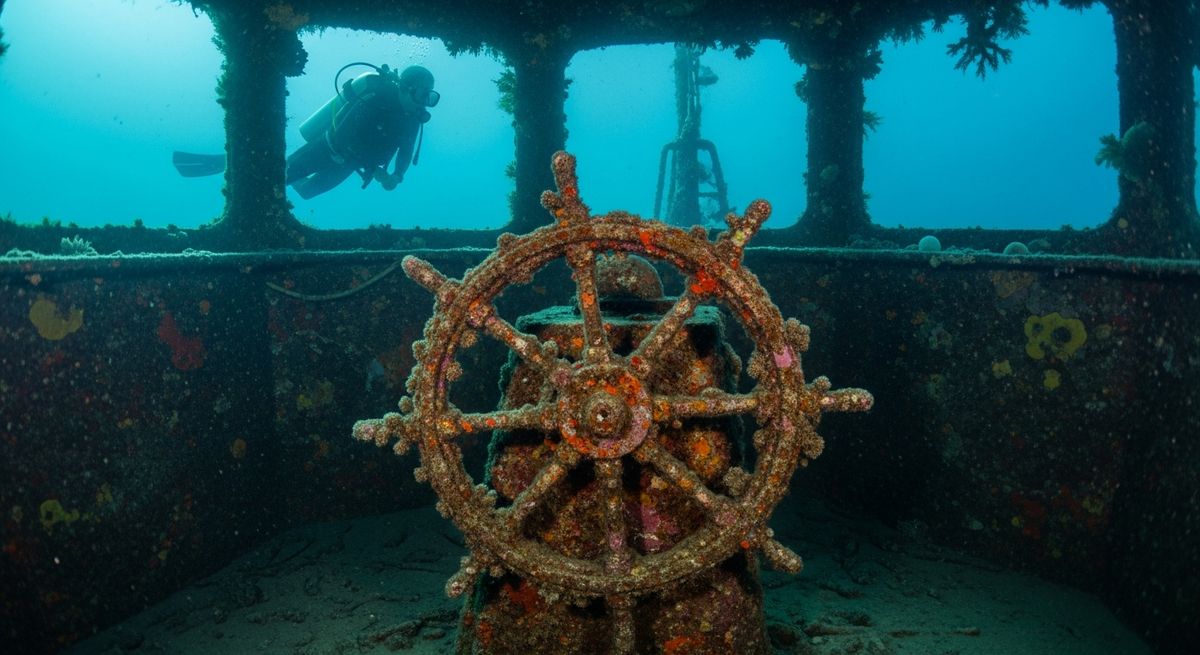
The Caduceus, she’s a proper old girl, and one we find ourselves gravitating to when the weather’s a bit lively. Forget your deep, dark wrecks; this one’s right there at 3 metres, often exposed at low tide. It’s a fantastic shore dive from Mill Bay, but you’ll want to time it perfectly with slack water on a rising tide. We’ve spent hours here, poking around the ribs and timbers, still quite substantial in places, especially towards the stern where the hull plates curve up. You get a real sense of her scale. What we love about the Caduceus is how the light plays on the kelp-draped timbers. It’s a shallow dive, so visibility is often excellent, letting you make out the ghostly shapes of the frames. Look closely amongst the weed and you’ll spot shannies peering out from crevices, blennies scooting across the wood, and tiny spider crabs clinging on. It’s not about big pelagics here; it's about the small, intricate world that has made this shipwreck home. Our favourite time to dive it is mid-morning, when the sun is high and filters down through the surface chop, illuminating every barnacle-covered beam. It’s perfect for new divers or those looking for a relaxed, shallow exploration with a bit of history thrown in.
Typical CADUCEUS Dive Profile
Illustrative profile based on site depth and type. Actual dive profiles vary - always follow your dive computer and training.
Safety Notes
Wreck site - avoid penetration without wreck diving certification. Watch for sharp metal and entanglement hazards.
CADUCEUS Wreck History
Year Sunk
1881
Vessel Type
sailing vessel
Cause
grounding
The Caduceus was a wooden sailing vessel built in Sunderland in 1857. In October 1881, while on a passage from Newcastle-upon-Tyne bound for Italy, she encountered treacherous conditions off the coast of Cornwall. The ship went ashore and was relentlessly battered by the waves until it broke apart. Fortunately, the entire crew was recovered safely, but the vessel was a total loss, its cargo and timbers scattered by the sea.
Today, the remains of the Caduceus lie in just three meters of water, making it an ideal dive for beginners or a fascinating snorkel on a calm day. Over 140 years of immersion have taken their toll on the wooden structure, and what remains is a scattered field of timbers, iron fittings, and other remnants of a bygone era of sail. Divers can explore the flattened wreckage, searching for clues to its past while enjoying the vibrant marine life that now calls this historic site home.
Nearest Dive Centres to CADUCEUS
Dive shops near CADUCEUS
In2 Diving
Sussex Diving & Leisure
Mulberry Marine Experiences CIC
Andark Diving
Abyss Scuba School
Sunken Dreams Scuba Diving Academy
Reviews for CADUCEUS
Conditions
Ocean conditions, forecast and tides for CADUCEUS
CADUCEUS Ocean Conditions
Monthly averages for CADUCEUS, sourced from Open-Meteo marine data - nearest station: Open-Meteo marine grid (50.44, -2.73) (3km away)
October Averages
Sea Temperature
17°C
62°F · Range: 15.1–17.5°C
Air Temperature
13°C
56°F
Wind Speed
8.14 m/s
15.8 knots
Atmospheric Pressure
1011 hPa
Based on 4 years of monitoring data · Data sources: Open-Meteo marine data
Plan & book
Ways to dive Cornwall & Devon, from day trips to liveaboards.
Day trips & courses
via GetYourGuideGuided dives, courses and snorkel trips with instant booking.
Find dive trips in Cornwall & DevonPlaces to stay
via Booking.comHotels and dive resorts near Cornwall & Devon.
Search stays in Cornwall & DevonDive insurance
Most travel insurance excludes or limits scuba. Check what you need before you go.
Dive insurance explainedPartner links: we may earn a commission if you book, at no extra cost to you. How we make money
Where to Stay near CADUCEUS
Prices from Booking.com. We may earn a commission at no extra cost to you.