CAIRNDHU
Protected Area
Kingmere
Why dive here
With 176+ marine species recorded in the area - including blue sharks, dolphins, dwarf minke whales, humpback whales and ocean sunfish (mola mola) - CAIRNDHU offers some of Cornwall & Devon's richest wreck diving. Water ranges 10-18°C, warmest July, August, September.
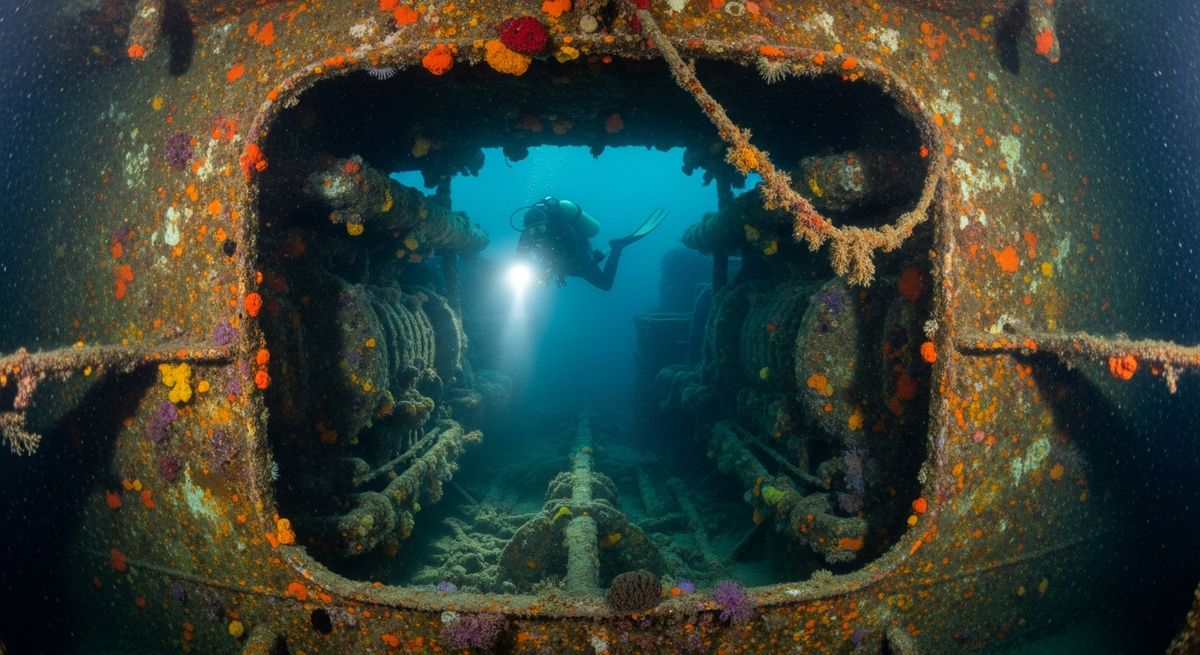
The Cairndhu, a substantial steamship, lies broken but still impressive at 23 metres. We often hit this one when the weather pushes us away from the exposed coast, and it rarely disappoints. She went down fast in 1917, torpedoed, and the impact left her in two main sections, but there’s enough structure to keep you busy. Our favourite part is poking around the stern, where the prop shaft leads you towards the impressive triple expansion engine. You’ll find conger eels tucked into every dark crevice, sometimes a foot thick. Visibility can be hit or miss, typical for the English Channel, but even in murkier conditions, the sheer scale of the wreck emerges slowly, dramatically. Bring a good torch and take your time; the cargo holds are full of brass and porcelain, reminders of her final journey. It’s a proper historical dive, perfect for those who like their wrecks with a bit of mystery and plenty of nooks to explore.
Typical CAIRNDHU Dive Profile
Illustrative profile based on site depth and type. Actual dive profiles vary - always follow your dive computer and training.
Safety Notes
Depth of 23m - Advanced Open Water certification recommended.
Wreck site - avoid penetration without wreck diving certification. Watch for sharp metal and entanglement hazards.
Always perform a 3-minute safety stop at 5m before surfacing.
CAIRNDHU Wreck History
Year Sunk
1917
Vessel Type
cargo ship
Cause
torpedo
The SS Cairndhu was a British steamship built in 1911 for the Cairn Line. Like so many other merchant vessels, it was pressed into service during the First World War, braving the perilous, U-boat-infested waters to transport essential supplies. On April 15, 1917, while on a voyage from South Shields to Gibraltar carrying a cargo of coal, its luck ran out. The Cairndhu was spotted by the German submarine SM UB-40, commanded by Oberleutnant zur See Hans Howaldt. A single torpedo sealed the ship's fate, sending it to the bottom of the English Channel.
Located in 23 meters of water, the Cairndhu is now a popular and fascinating wreck dive off the coast of Cornwall. The wreck is significantly broken up, a testament to the force of the torpedo and over a century spent on the seabed. Despite this, its main features, including the boilers and the triple-expansion engine, are still clearly visible and provide a focal point for the dive. The scattered plates and ribs of the hull have created an ideal artificial reef, attracting an abundance of marine life. Divers can expect to see schools of bib, pollack, and wrasse, as well as conger eels and lobsters seeking shelter in the wreckage.
Nearest Dive Centres to CAIRNDHU
Dive shops near CAIRNDHU
Abyss Scuba School
Ocean View
Mulberry Marine Experiences CIC
Sussex Diving & Leisure
In2 Diving
Reviews for CAIRNDHU
Conditions
Ocean conditions, forecast and tides for CAIRNDHU
CAIRNDHU Ocean Conditions
Monthly averages for CAIRNDHU, sourced from Open-Meteo marine data - nearest station: Open-Meteo marine grid (50.44, -2.73) (3km away)
October Averages
Sea Temperature
17°C
62°F · Range: 15.1–17.5°C
Air Temperature
13°C
56°F
Wind Speed
8.14 m/s
15.8 knots
Atmospheric Pressure
1011 hPa
Based on 4 years of monitoring data · Data sources: Open-Meteo marine data
Plan & book
Ways to dive Cornwall & Devon, from day trips to liveaboards.
Day trips & courses
via GetYourGuideGuided dives, courses and snorkel trips with instant booking.
Find dive trips in Cornwall & DevonPlaces to stay
via Booking.comHotels and dive resorts near Cornwall & Devon.
Search stays in Cornwall & DevonDive insurance
Most travel insurance excludes or limits scuba. Check what you need before you go.
Dive insurance explainedPartner links: we may earn a commission if you book, at no extra cost to you. How we make money
Where to Stay near CAIRNDHU
Prices from Booking.com. We may earn a commission at no extra cost to you.