CAMBRIAN PRINCESS (PROBABLY)
Protected Area
Utopia
Why dive here
With 176+ marine species recorded in the area - including blue sharks, dolphins, dwarf minke whales, humpback whales and ocean sunfish (mola mola) - CAMBRIAN PRINCESS (PROBABLY) offers some of Cornwall & Devon's richest wreck diving. Water ranges 10-18°C, warmest July, August, September.
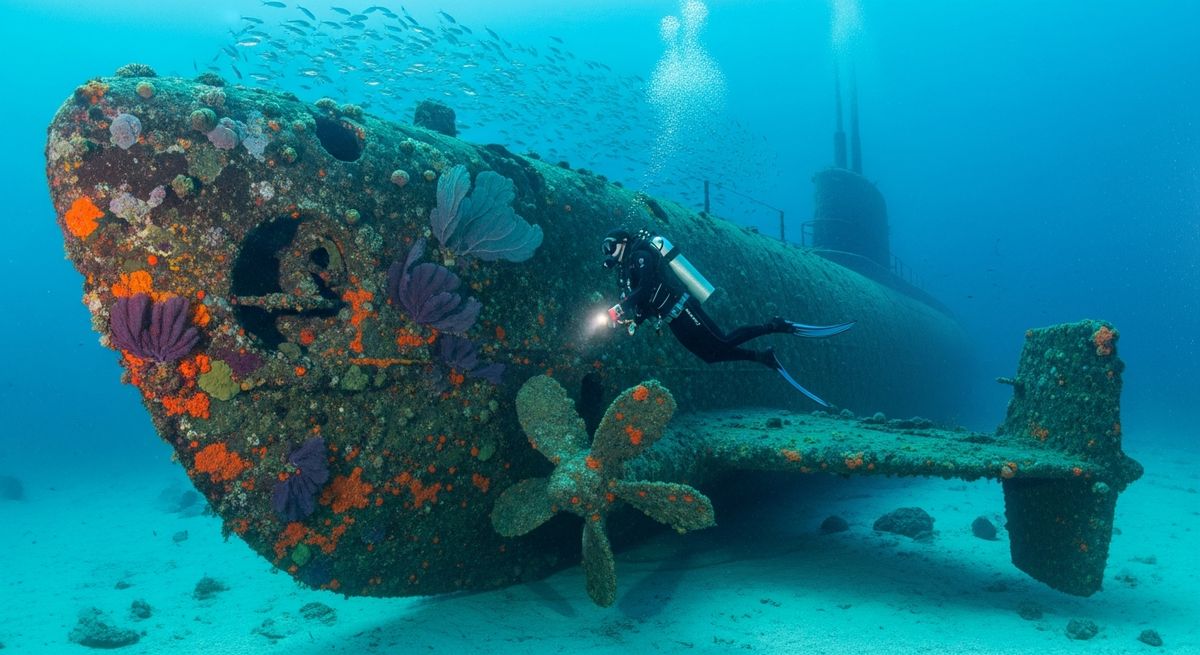
The Cambrian Princess, or at least what we’re pretty sure is the Cambrian Princess, is a proper chunk of history on the seabed off Devon. She’s an iron sailing vessel, lost in 1902 after a collision, and what's left is spread across the sand at 29 metres. We love dropping down onto the bow section first; it’s largely intact and feels quite imposing, even after all these years. You can often see conger eels tucked into the deeper recesses here, their heads poking out from between the plates. Our favourite part, though, is exploring the debris field. The stern is more broken up, but it means you get to pick through scattered ribs and plates, imagining the chaos of her final moments. You’ll find squat lobsters in every nook and cranny, and if you’re patient, even a few shy anglerfish camouflaged against the rust. It’s a dive for those who appreciate the ghost of a ship and don’t mind a bit of a rummage. Visibility can be hit or miss, typical for the channel, but on a good day, the scale of her is really impressive. We always suggest bringing a good torch; it brings out the colours on the encrusting sponges and helps spot the smaller critters hiding within the structure.
Typical CAMBRIAN PRINCESS (PROBABLY) Dive Profile
Illustrative profile based on site depth and type. Actual dive profiles vary - always follow your dive computer and training.
Safety Notes
Depth of 29m - Advanced Open Water certification recommended.
Wreck site - avoid penetration without wreck diving certification. Watch for sharp metal and entanglement hazards.
Always perform a 3-minute safety stop at 5m before surfacing.
CAMBRIAN PRINCESS (PROBABLY) Wreck History
Year Sunk
1902
Vessel Type
sailing vessel
Cause
storm
The Cambrian Princess was a three-masted, iron-hulled sailing barque built in 1877. A true workhorse of the final days of sail, she spent her career on demanding long-haul trade routes, connecting industrial Europe with the raw materials of the wider world. At the turn of the 20th century, ships like the Cambrian Princess were a common sight, but their era was rapidly coming to a close with the dominance of steam power.
In early 1902, the Cambrian Princess was nearing the end of a gruelling multi-month voyage from Lobos de Afuera, Peru, bound for Antwerp, Belgium. Her holds were filled with a valuable cargo of guano for use as fertilizer. As she navigated the English Channel, she was caught in a violent gale. After a long battle with the storm, the ship was overwhelmed and foundered off the Cornish coast on April 1st, 1902.
Resting at a depth of 29 metres, the Cambrian Princess is a classic dive into the age of sail. The iron hull has largely collapsed, but the wreck's outline is still clearly visible on the seabed. Divers can explore the flattened hull plates and see the unique cargo of guano, which has solidified over the century into a rock-like substance. The wreckage provides a home for abundant marine life, including conger eels, lobsters, and schools of bib, making for a scenic and atmospheric dive.
Nearest Dive Centres to CAMBRIAN PRINCESS (PROBABLY)
Dive shops near CAMBRIAN PRINCESS (PROBABLY)
Sussex Diving & Leisure
Mulberry Marine Experiences CIC
In2 Diving
Abyss Scuba School
Andark Diving
Ocean View
Reviews for CAMBRIAN PRINCESS (PROBABLY)
Conditions
Ocean conditions, forecast and tides for CAMBRIAN PRINCESS (PROBABLY)
CAMBRIAN PRINCESS (PROBABLY) Ocean Conditions
Monthly averages for CAMBRIAN PRINCESS (PROBABLY), sourced from Open-Meteo marine data - nearest station: Open-Meteo marine grid (50.44, -2.73) (3km away)
October Averages
Sea Temperature
17°C
62°F · Range: 15.1–17.5°C
Air Temperature
13°C
56°F
Wind Speed
8.14 m/s
15.8 knots
Atmospheric Pressure
1011 hPa
Based on 4 years of monitoring data · Data sources: Open-Meteo marine data
Plan & book
Ways to dive Cornwall & Devon, from day trips to liveaboards.
Day trips & courses
via GetYourGuideGuided dives, courses and snorkel trips with instant booking.
Find dive trips in Cornwall & DevonPlaces to stay
via Booking.comHotels and dive resorts near Cornwall & Devon.
Search stays in Cornwall & DevonDive insurance
Most travel insurance excludes or limits scuba. Check what you need before you go.
Dive insurance explainedPartner links: we may earn a commission if you book, at no extra cost to you. How we make money
Where to Stay near CAMBRIAN PRINCESS (PROBABLY)
Prices from Booking.com. We may earn a commission at no extra cost to you.