CAMPEADOR 5 (BOW SECTION)(PROBABLY)
Protected Area
Whitecliff Bay and Bembridge Ledges
Why dive here
With 176+ marine species recorded in the area - including blue sharks, dolphins, dwarf minke whales, humpback whales and ocean sunfish (mola mola) - CAMPEADOR 5 (BOW SECTION)(PROBABLY) offers some of Cornwall & Devon's richest wreck diving. Water ranges 10-18°C, warmest July, August, September.
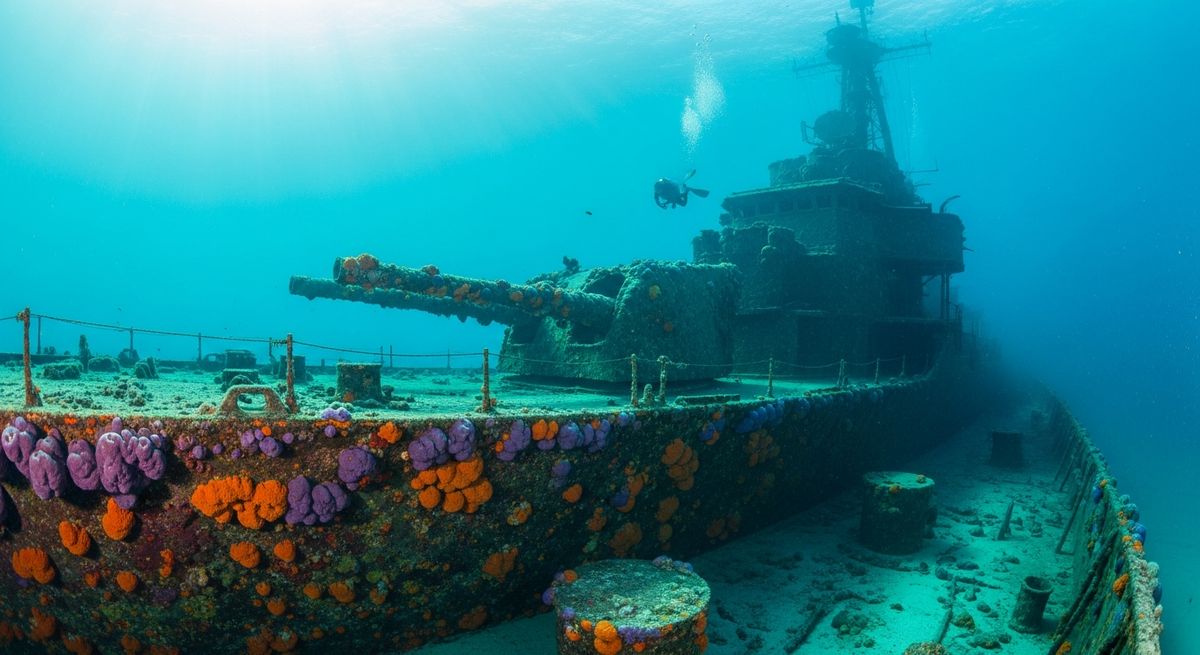
The Campeador 5's bow section is, quite simply, a fantastic little dive. We know, "probably" a Campeador, but whatever its origins, this wreck is a real window into wartime history, even if it feels more like a playground now. Sitting upright at a comfortable 9 metres, it’s a brilliant site for newer wreck divers or those looking for a relaxed bimble. You’re not going to find grand swim-throughs here, but the jagged metal plates and twisted beams tell a story. Look for the way the light filters through the gaps in the hull, illuminating schools of pollock darting in and out. Ballan wrasse are everywhere, bold and curious, picking at the anemones that coat every surface. Our favourite detail? The sheer density of plumose anemones on the deeper sections, brilliant white against the dark steel. We always suggest hitting this one on a slack tide, otherwise, you'll be fighting the current instead of enjoying the history. It's an easy entry from a RIB, and often paired with other nearby wrecks for a double dive.
Typical CAMPEADOR 5 (BOW SECTION)(PROBABLY) Dive Profile
Illustrative profile based on site depth and type. Actual dive profiles vary - always follow your dive computer and training.
Safety Notes
Wreck site - avoid penetration without wreck diving certification. Watch for sharp metal and entanglement hazards.
CAMPEADOR 5 (BOW SECTION)(PROBABLY) Wreck History
Year Sunk
1940
Vessel Type
yacht
Cause
mined
The vessel known as Campeador 5 was originally a private yacht, enjoying a life of leisure before its story took a dramatic turn with the outbreak of World War II. Like many private vessels, it was requisitioned for military service, pressed into the war effort to patrol the vital coastal waters of the United Kingdom. These 'little ships' played a crucial role in coastal defense, submarine spotting, and rescue operations.
On June 22, 1940, during the intense early stages of the war, Campeador 5's service came to an abrupt and violent end. While on patrol in the English Channel, the converted yacht struck a German mine. The explosion tore the vessel apart, sending it to the bottom. This site is believed to be the bow section of the unfortunate yacht.
Lying at a shallow depth of just 9 meters, this wreck is an incredibly accessible dive for all certification levels. Divers can explore the scattered remains of the yacht's bow, a poignant reminder of the civilian sacrifice during the war. Its 'Dangerous Wreck' classification is a warning of sharp, twisted metal, but for the cautious diver, it offers a fascinating look at a piece of WWII history, now encrusted with kelp and home to crabs and wrasse.
Nearest Dive Centres to CAMPEADOR 5 (BOW SECTION)(PROBABLY)
Dive shops near CAMPEADOR 5 (BOW SECTION)(PROBABLY)
In2 Diving
Sussex Diving & Leisure
Mulberry Marine Experiences CIC
Andark Diving
Abyss Scuba School
Ocean View
Reviews for CAMPEADOR 5 (BOW SECTION)(PROBABLY)
Conditions
Ocean conditions, forecast and tides for CAMPEADOR 5 (BOW SECTION)(PROBABLY)
CAMPEADOR 5 (BOW SECTION)(PROBABLY) Ocean Conditions
Monthly averages for CAMPEADOR 5 (BOW SECTION)(PROBABLY), sourced from Open-Meteo marine data - nearest station: Open-Meteo marine grid (50.44, -2.73) (3km away)
October Averages
Sea Temperature
17°C
62°F · Range: 15.1–17.5°C
Air Temperature
13°C
56°F
Wind Speed
8.14 m/s
15.8 knots
Atmospheric Pressure
1011 hPa
Based on 4 years of monitoring data · Data sources: Open-Meteo marine data
Plan & book
Ways to dive Cornwall & Devon, from day trips to liveaboards.
Day trips & courses
via GetYourGuideGuided dives, courses and snorkel trips with instant booking.
Find dive trips in Cornwall & DevonPlaces to stay
via Booking.comHotels and dive resorts near Cornwall & Devon.
Search stays in Cornwall & DevonDive insurance
Most travel insurance excludes or limits scuba. Check what you need before you go.
Dive insurance explainedPartner links: we may earn a commission if you book, at no extra cost to you. How we make money
Where to Stay near CAMPEADOR 5 (BOW SECTION)(PROBABLY)
Prices from Booking.com. We may earn a commission at no extra cost to you.