CAMPEN
Protected Area
The Needles
Why dive here
With 176+ marine species recorded in the area - including blue sharks, dolphins, dwarf minke whales, humpback whales and ocean sunfish (mola mola) - CAMPEN offers some of Cornwall & Devon's richest wreck diving. Water ranges 10-18°C, warmest July, August, September.
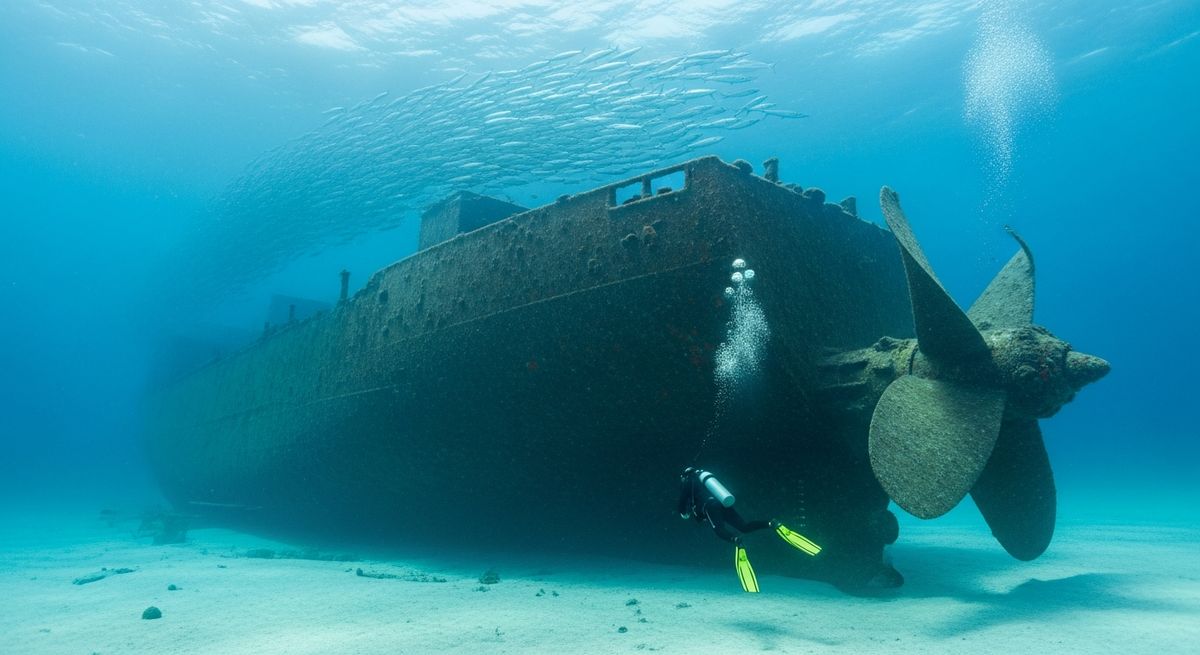
Campen isn't your typical neat wreck, and that's exactly what we love about it. This East Indiaman, wrecked on the Needles, is a scattering of history across the seabed, rather than an intact hull. You won't be penetrating cabins here, but you will be sifting through what feels like an archaeological dig. The distributed remains mean you're constantly discovering, a piece of timber here, a copper fitting there. It’s the kind of dive where you need to slow down, really look, and let your imagination piece together the story. We’ve had some fantastic encounters with lobsters tucked into the debris and surprisingly large conger eels making homes in the larger sections of wreckage. Visibility can be a bit hit or miss, so we’d suggest timing your dive for slack water on a neap tide for the best chance of a clear view. It suits divers who appreciate history and enjoy the thrill of discovery more than the perfect wreck selfie. It’s a proper treasure hunt, just without the gold.
Safety Notes
Wreck site - avoid penetration without wreck diving certification. Watch for sharp metal and entanglement hazards.
CAMPEN Wreck History
Vessel Type
cargo ship
Cause
grounding
The Campen was a Dutch East Indiaman, a formidable vessel from the golden age of sail in the 17th century. These ships undertook epic, perilous voyages to the Far East, returning laden with spices, silks, and other exotic goods. Some historical records suggest the Campen may have been part of the hired Dutch fleet that fought alongside the Swedes against the Danes in the 1644 Battle of Fehmarn, giving this merchant vessel a storied military past.
Its final voyage, however, did not end in a blaze of cannon fire. Instead, the Campen met a more common fate for the sailing ships of its era. While navigating the treacherous waters of the English Channel, it ran aground on the infamous, chalk-stack rocks known as The Needles. Battered by relentless waves, the ship was broken apart and its cargo scattered across the seabed.
Resting at 0 meters, the site of the Campen is not a traditional wreck dive but a historical exploration in the shallows. Snorkelers and divers can explore the distributed remains scattered across the seafloor. Over the centuries, the wooden hull has disintegrated, but sharp-eyed explorers may still find cannons, anchors, ballast stones, and other artifacts, all heavily colonized by marine life, offering a tangible connection to the dramatic age of sail.
Nearest Dive Centres to CAMPEN
Dive shops near CAMPEN
TAL Scuba Ltd.
Mayim Mermaid Academy
Divers Down
Dorset Diving Services
Andark Diving
In2 Diving
Reviews for CAMPEN
Conditions
Ocean conditions, forecast and tides for CAMPEN
CAMPEN Ocean Conditions
Monthly averages for CAMPEN, sourced from Open-Meteo marine data - nearest station: Open-Meteo marine grid (50.44, -2.73) (3km away)
October Averages
Sea Temperature
17°C
62°F · Range: 15.1–17.5°C
Air Temperature
13°C
56°F
Wind Speed
8.14 m/s
15.8 knots
Atmospheric Pressure
1011 hPa
Based on 4 years of monitoring data · Data sources: Open-Meteo marine data
Plan & book
Ways to dive Cornwall & Devon, from day trips to liveaboards.
Day trips & courses
via GetYourGuideGuided dives, courses and snorkel trips with instant booking.
Find dive trips in Cornwall & DevonPlaces to stay
via Booking.comHotels and dive resorts near Cornwall & Devon.
Search stays in Cornwall & DevonDive insurance
Most travel insurance excludes or limits scuba. Check what you need before you go.
Dive insurance explainedPartner links: we may earn a commission if you book, at no extra cost to you. How we make money
Where to Stay near CAMPEN
Prices from Booking.com. We may earn a commission at no extra cost to you.