CAMSWAN
Protected Area
Bembridge Down
Why dive here
With 176+ marine species recorded in the area - including blue sharks, dolphins, dwarf minke whales, humpback whales and ocean sunfish (mola mola) - CAMSWAN offers some of Cornwall & Devon's richest wreck diving. Water ranges 10-18°C, warmest July, August, September.
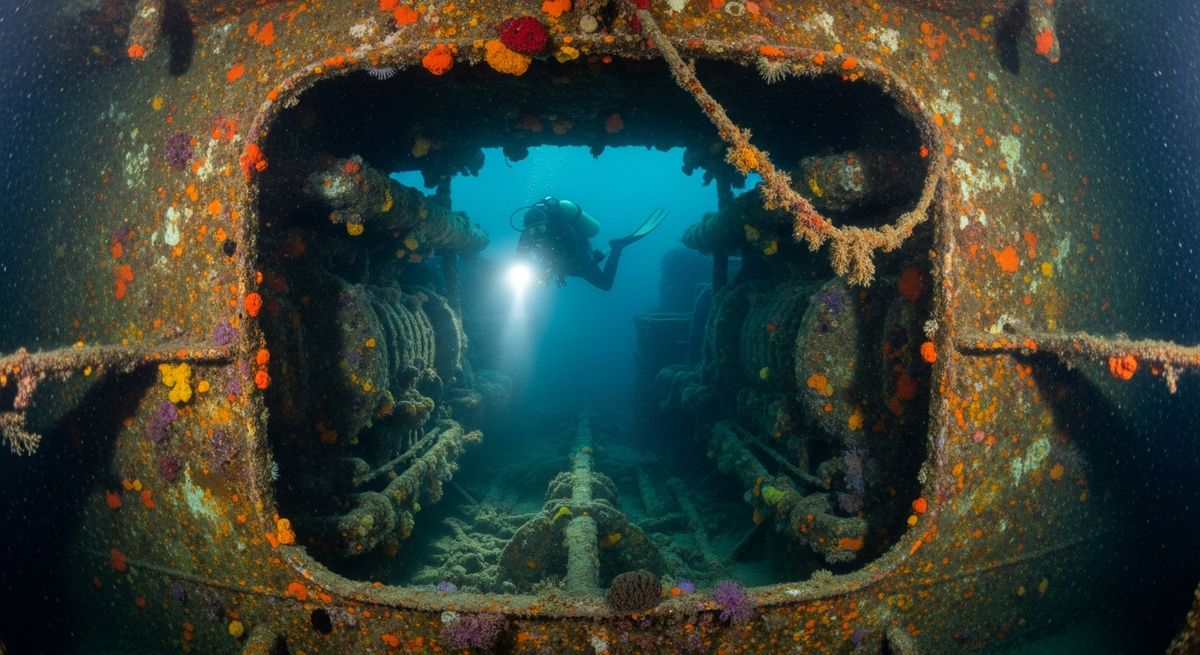
The *Camswan* is a wreck that truly tells a story, even if it’s a tragic one. Sunk on her maiden voyage in 1917 after a collision, this steamship lies in about 15 metres, which makes it accessible for most divers. We love how intact she is; you can still discern the bow and stern, and it feels like stepping back in time. The visibility here can be hit or miss, typical for the UK, but when it’s good, the sheer scale of the 102-metre vessel is impressive. Look for the huge boilers and engine block, which are now completely encrusted with plumose anemones and dead man's fingers. Our favourite thing is exploring the cargo holds, often filled with schools of juvenile pollock that shimmer in the ambient light. You'll often spot conger eels tucked into crevices, their heads peering out, making for some excellent photo opportunities. It’s a site that suits divers who appreciate historical wrecks and aren't afraid of cooler water and the occasional current.
Typical CAMSWAN Dive Profile
Illustrative profile based on site depth and type. Actual dive profiles vary - always follow your dive computer and training.
Safety Notes
Wreck site - avoid penetration without wreck diving certification. Watch for sharp metal and entanglement hazards.
Always perform a 3-minute safety stop at 5m before surfacing.
CAMSWAN Wreck History
Year Sunk
1917
Vessel Type
cargo ship
Cause
collision
The story of the SS Camswan is a short and tragic one. Built in 1917 by the Blyth Shipbuilding & Drydock Co., she was a brand-new steamship launched amidst the turmoil of the First World War. Owned by the Osborne Steamship Company, she was loaded with cargo and set off from Blyth, destined for Naples, Italy, on her highly anticipated maiden voyage.
Tragically, the Camswan would never complete its first journey. On October 19, 1917, while navigating the busy shipping lanes off the coast of Devon, she was involved in a catastrophic collision with another vessel. The damage was too severe for the new ship to withstand, and she quickly foundered and sank beneath the waves. It was a heartbreaking end for a vessel that had only just begun its life.
Lying at a shallow depth of just 15 meters, the remains of the Camswan are now a popular dive site for novice wreck divers and photographers. The vessel is significantly broken up after more than a century on the seabed, but its boilers and engine block are still clearly visible, providing a focal point for the dive. The scattered wreckage has created a rich habitat for marine life, with wrasse, pollack, and colorful anemones adorning the twisted steel plates.
Nearest Dive Centres to CAMSWAN
Dive shops near CAMSWAN
In2 Diving
Sussex Diving & Leisure
Mulberry Marine Experiences CIC
Andark Diving
Abyss Scuba School
Reviews for CAMSWAN
Conditions
Ocean conditions, forecast and tides for CAMSWAN
CAMSWAN Ocean Conditions
Monthly averages for CAMSWAN, sourced from Open-Meteo marine data - nearest station: Open-Meteo marine grid (50.44, -2.73) (3km away)
October Averages
Sea Temperature
17°C
62°F · Range: 15.1–17.5°C
Air Temperature
13°C
56°F
Wind Speed
8.14 m/s
15.8 knots
Atmospheric Pressure
1011 hPa
Based on 4 years of monitoring data · Data sources: Open-Meteo marine data
Plan & book
Ways to dive Cornwall & Devon, from day trips to liveaboards.
Day trips & courses
via GetYourGuideGuided dives, courses and snorkel trips with instant booking.
Find dive trips in Cornwall & DevonPlaces to stay
via Booking.comHotels and dive resorts near Cornwall & Devon.
Search stays in Cornwall & DevonDive insurance
Most travel insurance excludes or limits scuba. Check what you need before you go.
Dive insurance explainedPartner links: we may earn a commission if you book, at no extra cost to you. How we make money
Where to Stay near CAMSWAN
Prices from Booking.com. We may earn a commission at no extra cost to you.