CANTERBURY BELL
Protected Area
North West of Lundy
Why dive here
With 176+ marine species recorded in the area - including blue sharks, dolphins, dwarf minke whales, humpback whales and ocean sunfish (mola mola) - CANTERBURY BELL offers some of Cornwall & Devon's richest wreck diving. Water ranges 10-18°C, warmest July, August, September.
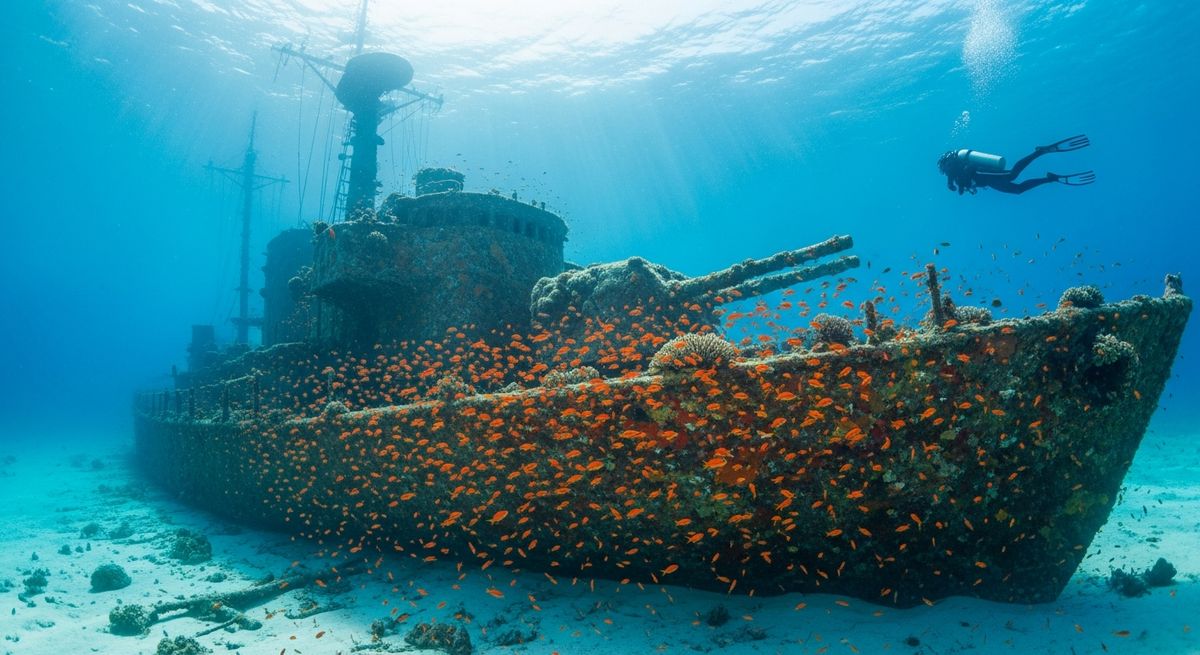
The *Canterbury Bell* is a cracking dive, a real time capsule sitting at 58 metres. We love how intact she is for her age, especially that triple-expansion engine. You can still pick out the two boilers and the single shaft, testament to the craftsmanship of Shields Engineering. Drop down and you're immediately in amongst schools of pollock that swirl around the superstructure, flashing silver in your torch beam. Look closer and the wreck is absolutely smothered in jewel anemones, creating these incredible, colourful carpets over the rusted metal. Our favourite moment is always finning through the open cargo holds, imagining the coal that once filled them, now home to cheeky conger eels peeking out from every crevice. She’s a dive best suited for experienced wreckies with the right training, given the depth. Pick a calm day with minimal swell for the best conditions, as the currents here can occasionally be tricky.
Typical CANTERBURY BELL Dive Profile
Illustrative profile based on site depth and type. Actual dive profiles vary - always follow your dive computer and training.
Safety Notes
Maximum depth 58m exceeds recreational limits (40m). Technical diving certification and equipment required.
Wreck site - avoid penetration without wreck diving certification. Watch for sharp metal and entanglement hazards.
Always perform a 3-minute safety stop at 5m before surfacing.
CANTERBURY BELL Wreck History
Year Sunk
1922
Vessel Type
cargo ship
Cause
storm
Tonnage
976 GRT
The SS Canterbury Bell was a British steamship built by Richardson & Co in North Shields. A vessel of modest size, she featured a 'machinery aft' design, typical for coastal colliers and cargo ships of the early 20th century. She served diligently in the post-WWI merchant fleet, transporting goods around the British Isles.
In January 1922, the Canterbury Bell set off from Llanelli, Wales, with a course set for Cork, Ireland. She sailed directly into the path of a ferocious storm that swept the region. Battered by mountainous seas and gale-force winds, the ship was overwhelmed. She foundered and sank on January 5th, tragically taking all hands with her.
Today, the wreck of the Canterbury Bell lies at a depth of 58 meters, making her a serious undertaking for experienced technical divers only. Those who make the descent are rewarded with the sight of a remarkably well-preserved vessel sitting upright on the seabed. In the often-clear offshore waters, divers can explore a complete shipwreck that serves as a poignant memorial to the sailors who lost their lives in the storm.
Nearest Dive Centres to CANTERBURY BELL
Dive shops near CANTERBURY BELL
View all dive centres in Cornwall & DevonReviews for CANTERBURY BELL
Conditions
Ocean conditions, forecast and tides for CANTERBURY BELL
CANTERBURY BELL Ocean Conditions
Monthly averages for CANTERBURY BELL, sourced from Open-Meteo marine data - nearest station: Open-Meteo marine grid (50.44, -2.73) (3km away)
October Averages
Sea Temperature
17°C
62°F · Range: 15.1–17.5°C
Air Temperature
13°C
56°F
Wind Speed
8.14 m/s
15.8 knots
Atmospheric Pressure
1011 hPa
Based on 4 years of monitoring data · Data sources: Open-Meteo marine data
Plan & book
Ways to dive Cornwall & Devon, from day trips to liveaboards.
Day trips & courses
via GetYourGuideGuided dives, courses and snorkel trips with instant booking.
Find dive trips in Cornwall & DevonPlaces to stay
via Booking.comHotels and dive resorts near Cornwall & Devon.
Search stays in Cornwall & DevonDive insurance
Most travel insurance excludes or limits scuba. Check what you need before you go.
Dive insurance explainedPartner links: we may earn a commission if you book, at no extra cost to you. How we make money
Where to Stay near CANTERBURY BELL
Prices from Booking.com. We may earn a commission at no extra cost to you.