CARASA (POSSIBLY)
Protected Area
Bedruthan Steps and Park Head
Why dive here
With 176+ marine species recorded in the area - including blue sharks, dolphins, dwarf minke whales, humpback whales and ocean sunfish (mola mola) - CARASA (POSSIBLY) offers some of Cornwall & Devon's richest wreck diving. Water ranges 10-18°C, warmest July, August, September.
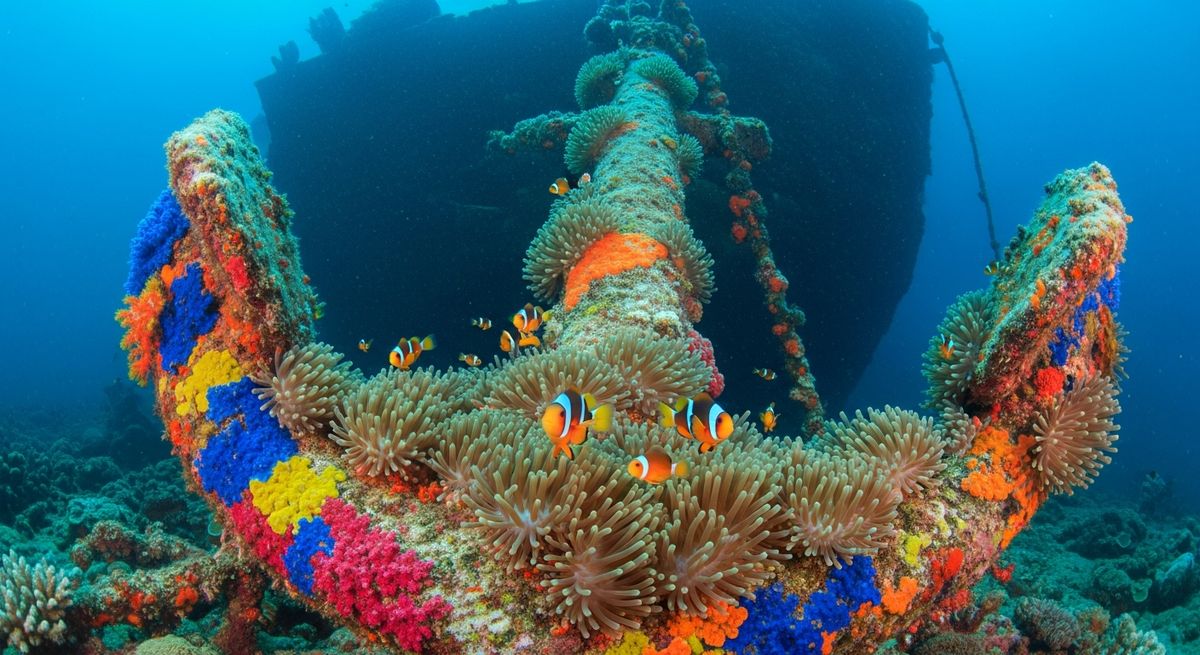
The SS Carasa, or what we believe is the Carasa, offers a moody, historical dive. Dropping down to 38 metres, you’re enveloped by the dim, green light of the English Channel. This steamship, torpedoed in 1918, lies largely intact, a testament to a bygone era. We love picking out the details, the massive boilers standing proud, the skeletal remains of her deck structures draped in kelp and anemones. It's a dive that rewards slow exploration, peering into cargo holds where conger eels lurk, their heads protruding from shadowy corners. The wreck itself hums with life: dense clouds of bib and pollack shimmer around the superstructure, while dogfish often snooze on the sand nearby. We’d suggest diving this one on a slack tide for the best visibility, which, on a good day, can stretch to 10 metres. It’s a site for those who appreciate history and the quiet drama of a wreck reclaimed by the sea.
Typical CARASA (POSSIBLY) Dive Profile
Illustrative profile based on site depth and type. Actual dive profiles vary - always follow your dive computer and training.
Safety Notes
Deep dive (38m) - monitor air consumption closely. Advanced certification recommended.
Wreck site - avoid penetration without wreck diving certification. Watch for sharp metal and entanglement hazards.
Always perform a 3-minute safety stop at 5m before surfacing.
CARASA (POSSIBLY) Wreck History
Year Sunk
1918
Vessel Type
cargo ship
Cause
torpedo
Tonnage
2,097 GRT
The SS Carasa was a Spanish steamship built in 1911 by William Pickersgill & Sons in Sunderland for the Cia Naviera Vascongada shipping company. For seven years, she plied the trade routes, a typical merchant vessel of her time powered by a triple-expansion steam engine. But her career was cut short by the escalating U-boat conflict of the First World War. On August 25th, 1918, while on passage from Bilbao, Spain, the Carasa was intercepted by the German submarine UB-92. A single torpedo struck the vessel, sealing her fate. She sank beneath the waves of the English Channel, becoming another maritime casualty of the Great War.
Today, the wreck of the Carasa lies at a depth of 38 metres off the coast of Cornwall. The years underwater have taken their toll, and the 86-metre-long hull is now broken and collapsing. However, key features like her two large boilers and the triple-expansion engine stand proud of the seabed, providing a focal point for the dive. The wreckage is often teeming with life; shoals of bib and pollack swarm the structure, while colourful cuckoo wrasse dart amongst the plates. Divers exploring the debris field may find conger eels peering from pipework and lobsters hiding in the shadows, making the Carasa a classic and rewarding UK wreck dive.
Nearest Dive Centres to CARASA (POSSIBLY)
Dive shops near CARASA (POSSIBLY)
Dive Newquay
Wavecrest Scuba
Harlyn Dive School
Scuba 2000
Karleyth Diving Ltd.
Viewpoint Diving Centre
Reviews for CARASA (POSSIBLY)
Conditions
Ocean conditions, forecast and tides for CARASA (POSSIBLY)
CARASA (POSSIBLY) Ocean Conditions
Monthly averages for CARASA (POSSIBLY), sourced from Open-Meteo marine data - nearest station: Open-Meteo marine grid (50.44, -2.73) (3km away)
October Averages
Sea Temperature
17°C
62°F · Range: 15.1–17.5°C
Air Temperature
13°C
56°F
Wind Speed
8.14 m/s
15.8 knots
Atmospheric Pressure
1011 hPa
Based on 4 years of monitoring data · Data sources: Open-Meteo marine data
Plan & book
Ways to dive Cornwall & Devon, from day trips to liveaboards.
Day trips & courses
via GetYourGuideGuided dives, courses and snorkel trips with instant booking.
Find dive trips in Cornwall & DevonPlaces to stay
via Booking.comHotels and dive resorts near Cornwall & Devon.
Search stays in Cornwall & DevonDive insurance
Most travel insurance excludes or limits scuba. Check what you need before you go.
Dive insurance explainedPartner links: we may earn a commission if you book, at no extra cost to you. How we make money
Where to Stay near CARASA (POSSIBLY)
Prices from Booking.com. We may earn a commission at no extra cost to you.