CARBINEER
Protected Area
Offshore Overfalls
Why dive here
With 176+ marine species recorded in the area - including blue sharks, dolphins, dwarf minke whales, humpback whales and ocean sunfish (mola mola) - CARBINEER offers some of Cornwall & Devon's richest wreck diving. Water ranges 10-18°C, warmest July, August, September.
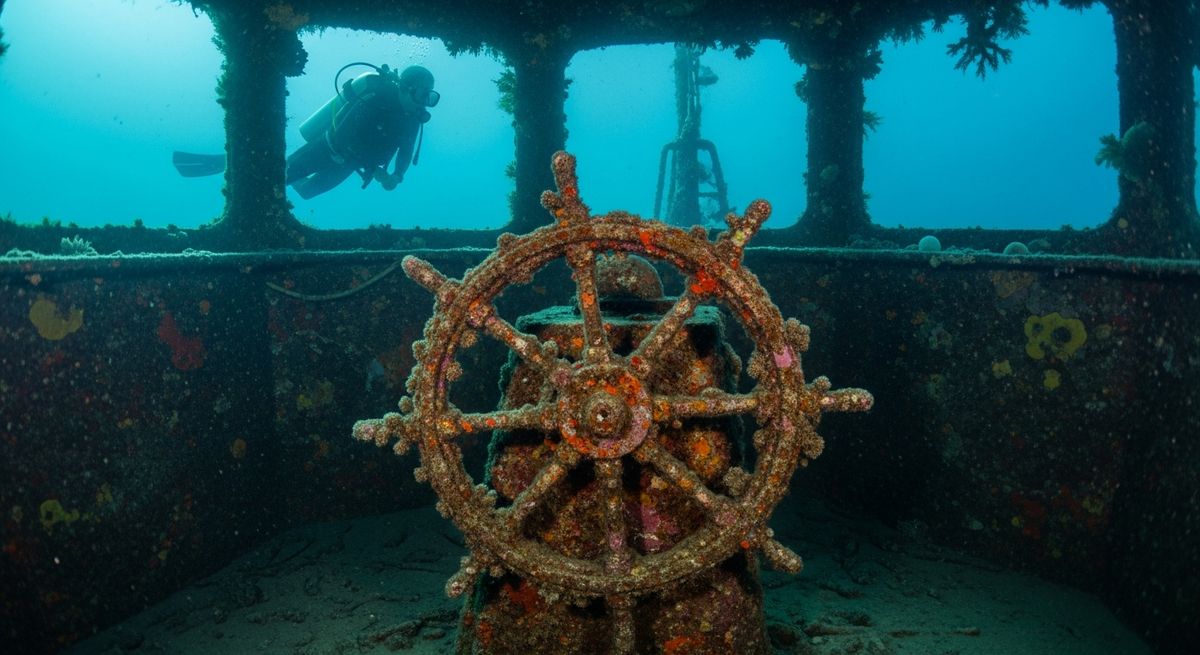
The Carbineer is one of our absolute favourite wrecks off the Cornish coast, particularly if you appreciate a good intact steamship. She went down in 1914 after a collision, settling upright in about 32 metres, which means even on a shorter bottom time, you get a real sense of her scale. We’ve always found the visibility here to be surprisingly good for the UK, often around 10-15 metres, which really lets you take in the bow and stern, often silhouetted against the emerald light filtering down. What we love most is how the Carbineer has become a living reef. Her hold is often packed with bib and pouting, swirling so thick you can barely see the bulkhead. Look closer, and you’ll spot dogfish tucked into crevices and plump conger eels peeking from beneath plates. The wheelhouse area is a personal highlight, still reasonably defined, and if you’re careful with your fin kicks, you can poke around some of the remaining structure. It’s a proper wreck dive, best for those comfortable in deeper water and with a bit of current, but the reward is a genuinely atmospheric exploration of a working steamship turned marine habitat.
Typical CARBINEER Dive Profile
Illustrative profile based on site depth and type. Actual dive profiles vary - always follow your dive computer and training.
Safety Notes
Deep dive (32m) - monitor air consumption closely. Advanced certification recommended.
Wreck site - avoid penetration without wreck diving certification. Watch for sharp metal and entanglement hazards.
Always perform a 3-minute safety stop at 5m before surfacing.
CARBINEER Wreck History
Year Sunk
1914
Vessel Type
cargo ship
Cause
collision
Tonnage
675 GRT
The SS Carbineer was a coastal cargo steamer built in 1907 in Newcastle-upon-Tyne for the Fisher-Renwick Manchester-London Steamship Company. Her career was brief, lasting only seven years before a fateful encounter in the English Channel. On April 22nd, 1914, while navigating through thick fog off Start Point, Devon, the Carbineer collided with the much larger SS Brika. The impact was catastrophic for the smaller vessel. While the Brika survived, the Carbineer was mortally wounded and quickly began to sink. Fortunately, the proximity of the other vessel allowed for a swift rescue, and all 14 members of her crew were saved before she slipped beneath the waves.
Resting upright on a sandy seabed at 32 metres, the Carbineer is a popular and accessible wreck for local divers. Though her wooden decks have long since rotted away, the hull remains largely intact, with the bow and stern still clearly defined. The single boiler and triple-expansion engine are prominent features midships, providing shelter for a variety of marine life. Divers can expect to see large shoals of bib, pollack, and poor cod swirling around the superstructure, while conger eels and lobsters have taken up residence within the decaying hull, making it a lively and picturesque dive.
Nearest Dive Centres to CARBINEER
Dive shops near CARBINEER
Sussex Diving & Leisure
Mulberry Marine Experiences CIC
Abyss Scuba School
In2 Diving
Ocean View
Reviews for CARBINEER
Conditions
Ocean conditions, forecast and tides for CARBINEER
CARBINEER Ocean Conditions
Monthly averages for CARBINEER, sourced from Open-Meteo marine data - nearest station: Open-Meteo marine grid (50.44, -2.73) (3km away)
October Averages
Sea Temperature
17°C
62°F · Range: 15.1–17.5°C
Air Temperature
13°C
56°F
Wind Speed
8.14 m/s
15.8 knots
Atmospheric Pressure
1011 hPa
Based on 4 years of monitoring data · Data sources: Open-Meteo marine data
Plan & book
Ways to dive Cornwall & Devon, from day trips to liveaboards.
Day trips & courses
via GetYourGuideGuided dives, courses and snorkel trips with instant booking.
Find dive trips in Cornwall & DevonPlaces to stay
via Booking.comHotels and dive resorts near Cornwall & Devon.
Search stays in Cornwall & DevonDive insurance
Most travel insurance excludes or limits scuba. Check what you need before you go.
Dive insurance explainedPartner links: we may earn a commission if you book, at no extra cost to you. How we make money
Where to Stay near CARBINEER
Prices from Booking.com. We may earn a commission at no extra cost to you.