CARBON
Protected Area
Severn Estuary
Why dive here
With 176+ marine species recorded in the area - including blue sharks, dolphins, dwarf minke whales, humpback whales and ocean sunfish (mola mola) - CARBON offers some of Cornwall & Devon's richest wreck diving. Water ranges 10-18°C, warmest July, August, September.
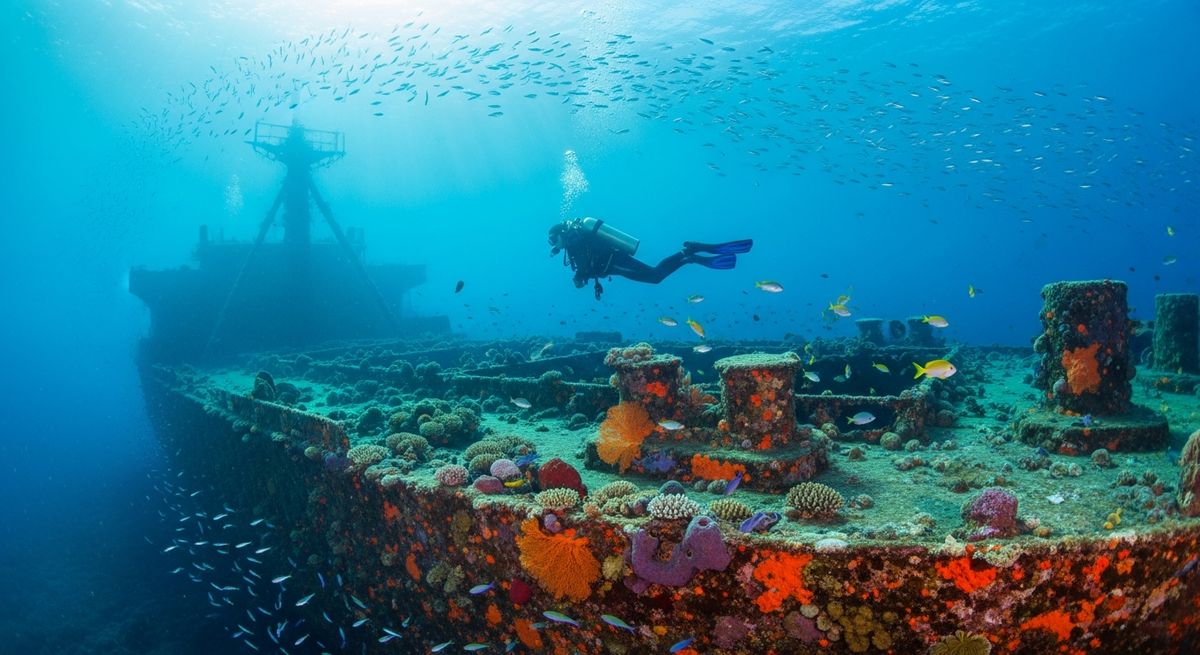
The Carbon is a proper little time capsule, a 30-metre steam barge sitting in just two metres of water near the entrance to Ely Harbour. We love how accessible it is, making it a brilliant spot for those days when you just want to get in the water without a huge production. Dropping down, you’re straight onto the wreck, its iron plates draped in a thick tapestry of green and brown algae, swaying gently with the tide. You can still make out the single boiler and the compound expansion engine, though they’re heavily encrusted now. The hull itself is a low-lying structure, but the gaps and crevices are perfect homes for small crabs and blennies. We’ve even seen small pollock darting through the remaining framework. It’s not a deep dive, obviously, so light penetrates everywhere, illuminating the rust colours and the odd splash of jewel anemones. It’s an ideal site for macro photography or simply a relaxed potter, letting you soak in a bit of history. Try to time it for slack water on a sunny day; the visibility really pops then.
Typical CARBON Dive Profile
Illustrative profile based on site depth and type. Actual dive profiles vary - always follow your dive computer and training.
Safety Notes
Wreck site - avoid penetration without wreck diving certification. Watch for sharp metal and entanglement hazards.
CARBON Wreck History
Year Sunk
1919
Vessel Type
barge
Cause
storm
Tonnage
126 GRT
The Carbon was a small steam barge built in Bristol in 1892. For nearly three decades, she worked the coastal routes, a reliable workhorse of her time. In 1919, while on a passage from Ely Harbour in Wales to her home port of Bristol with a cargo of stone, she was caught in a fierce gale in the Bristol Channel. The small vessel was no match for the storm's fury and foundered, sinking in the shallows. Today, the remains of the Carbon lie in just 2 metres of water. Due to the shallow depth and the powerful tidal currents of the area, the wreck is heavily broken up and scattered across the seabed. It is more of a debris field of metal plates and machinery than a recognizable ship, but on a calm day at high tide, it can be an interesting site for snorkelers or trainee divers to explore and observe the marine life that has colonized the wreckage.
Nearest Dive Centres to CARBON
Dive shops near CARBON
Welsh Diving
Extreme Marine
The Lake
Divexplore
Vobster Quay Dive Shop
InDepth
Reviews for CARBON
Conditions
Ocean conditions, forecast and tides for CARBON
CARBON Ocean Conditions
Monthly averages for CARBON, sourced from Open-Meteo marine data - nearest station: Open-Meteo marine grid (50.44, -2.73) (3km away)
October Averages
Sea Temperature
17°C
62°F · Range: 15.1–17.5°C
Air Temperature
13°C
56°F
Wind Speed
8.14 m/s
15.8 knots
Atmospheric Pressure
1011 hPa
Based on 4 years of monitoring data · Data sources: Open-Meteo marine data
Plan & book
Ways to dive Cornwall & Devon, from day trips to liveaboards.
Day trips & courses
via GetYourGuideGuided dives, courses and snorkel trips with instant booking.
Find dive trips in Cornwall & DevonPlaces to stay
via Booking.comHotels and dive resorts near Cornwall & Devon.
Search stays in Cornwall & DevonDive insurance
Most travel insurance excludes or limits scuba. Check what you need before you go.
Dive insurance explainedPartner links: we may earn a commission if you book, at no extra cost to you. How we make money
Where to Stay near CARBON
Prices from Booking.com. We may earn a commission at no extra cost to you.