CARENTAN
Protected Area
Studland Cliffs
Why dive here
With 176+ marine species recorded in the area - including blue sharks, dolphins, dwarf minke whales, humpback whales and ocean sunfish (mola mola) - CARENTAN offers some of Cornwall & Devon's richest wreck diving. Water ranges 10-18°C, warmest July, August, September.
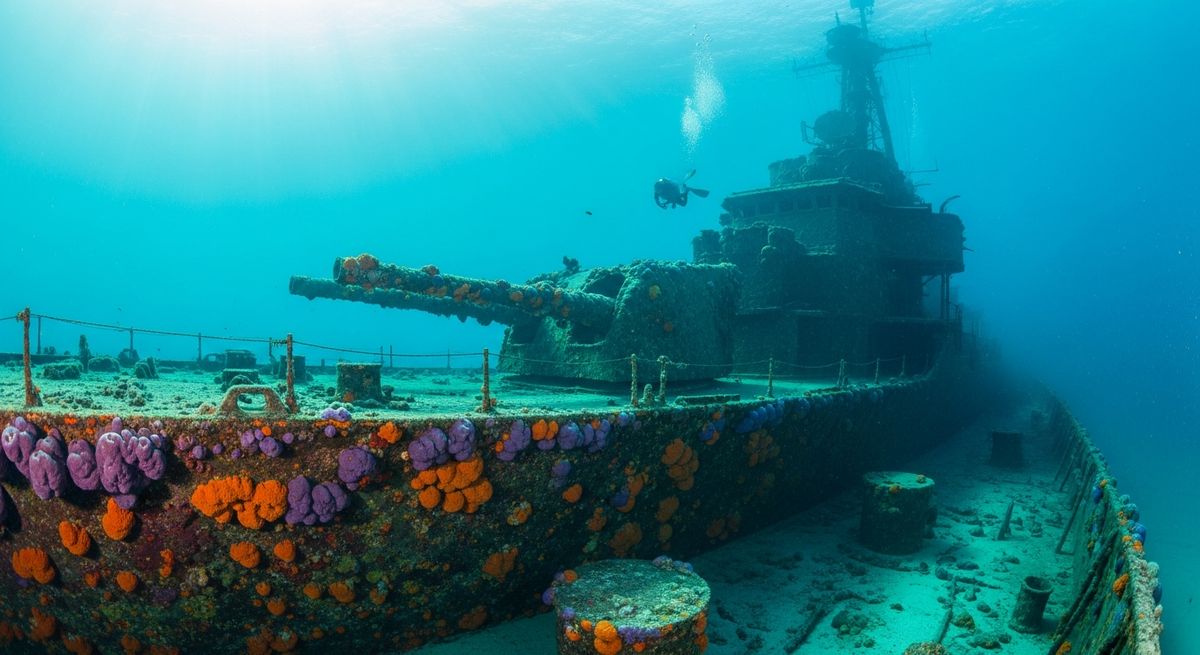
The Carentan. She’s not one of your grand, intact liners, but we love her for her history and the compact dive she offers. This French submarine chaser, sunk in 1943, sits upright at 35m, her 37-meter length a manageable circuit for a single dive. We often find the visibility here surprisingly good, especially on a neap tide, allowing you to really appreciate her lines. What you get is a solid, honest wreck dive. Her bow points west, often draped in long strands of kelp that sway with the surge. Descending onto her deck, you’ll see the main features like the forward gun platform and the remnants of her bridge structure. The stern is often a good spot for lobsters tucked into any crevice they can find, and we’ve seen some decent-sized pollack patrolling her perimeter. Given her manageable size and depth, she’s a brilliant wreck for those comfortable at 30-35m who want to explore a well-defined piece of wartime history without needing multiple dives to see it all. Just keep an eye on the current; it can pick up.
Typical CARENTAN Dive Profile
Illustrative profile based on site depth and type. Actual dive profiles vary - always follow your dive computer and training.
Safety Notes
Deep dive (35m) - monitor air consumption closely. Advanced certification recommended.
Wreck site - avoid penetration without wreck diving certification. Watch for sharp metal and entanglement hazards.
Always perform a 3-minute safety stop at 5m before surfacing.
CARENTAN Wreck History
Year Sunk
1943
Vessel Type
warship
Cause
grounding
The Carentan began its life in a French shipyard in 1940, built as a fast and agile submarine chaser. Following the fall of France, the vessel escaped to Britain and was quickly commissioned into the Royal Navy to help defend the vital Atlantic convoys. Armed and powered by two 1100 BHP engines, it became part of the front-line defence against the U-boat menace during the height of the Battle of the Atlantic.
The enemy that finally claimed the Carentan was not a submarine, but the sea itself. On December 21, 1943, while seeking shelter from a violent storm, the ship was overwhelmed by the conditions and driven hard onto the rocks near Fowey, Cornwall. The vessel was a total loss, breaking up under the relentless pounding of the waves.
Today, the wreckage of the Carentan is scattered across the seabed at a depth of around 35 metres. The force of its sinking has left the wreck heavily broken, but this creates a fascinating and extensive debris field for divers to explore. Sections of hull plating, engine components, and the ship's boilers are all identifiable. This site is an excellent dive for advanced recreational divers, offering a tangible connection to the naval history of the Second World War.
Nearest Dive Centres to CARENTAN
Dive shops near CARENTAN
Divers Down
Mayim Mermaid Academy
Dorset Diving Services
TAL Scuba Ltd.
Dive Beyond Limited
Old Harbour Dive Centre
Reviews for CARENTAN
Conditions
Ocean conditions, forecast and tides for CARENTAN
CARENTAN Ocean Conditions
Monthly averages for CARENTAN, sourced from Open-Meteo marine data - nearest station: Open-Meteo marine grid (50.44, -2.73) (3km away)
October Averages
Sea Temperature
17°C
62°F · Range: 15.1–17.5°C
Air Temperature
13°C
56°F
Wind Speed
8.14 m/s
15.8 knots
Atmospheric Pressure
1011 hPa
Based on 4 years of monitoring data · Data sources: Open-Meteo marine data
Plan & book
Ways to dive Cornwall & Devon, from day trips to liveaboards.
Day trips & courses
via GetYourGuideGuided dives, courses and snorkel trips with instant booking.
Find dive trips in Cornwall & DevonPlaces to stay
via Booking.comHotels and dive resorts near Cornwall & Devon.
Search stays in Cornwall & DevonDive insurance
Most travel insurance excludes or limits scuba. Check what you need before you go.
Dive insurance explainedPartner links: we may earn a commission if you book, at no extra cost to you. How we make money
Where to Stay near CARENTAN
Prices from Booking.com. We may earn a commission at no extra cost to you.