CARMARAND
Protected Area
Morte Platform
Why dive here
With 176+ marine species recorded in the area - including blue sharks, dolphins, dwarf minke whales, humpback whales and ocean sunfish (mola mola) - CARMARAND offers some of Cornwall & Devon's richest wreck diving. Water ranges 10-18°C, warmest July, August, September.
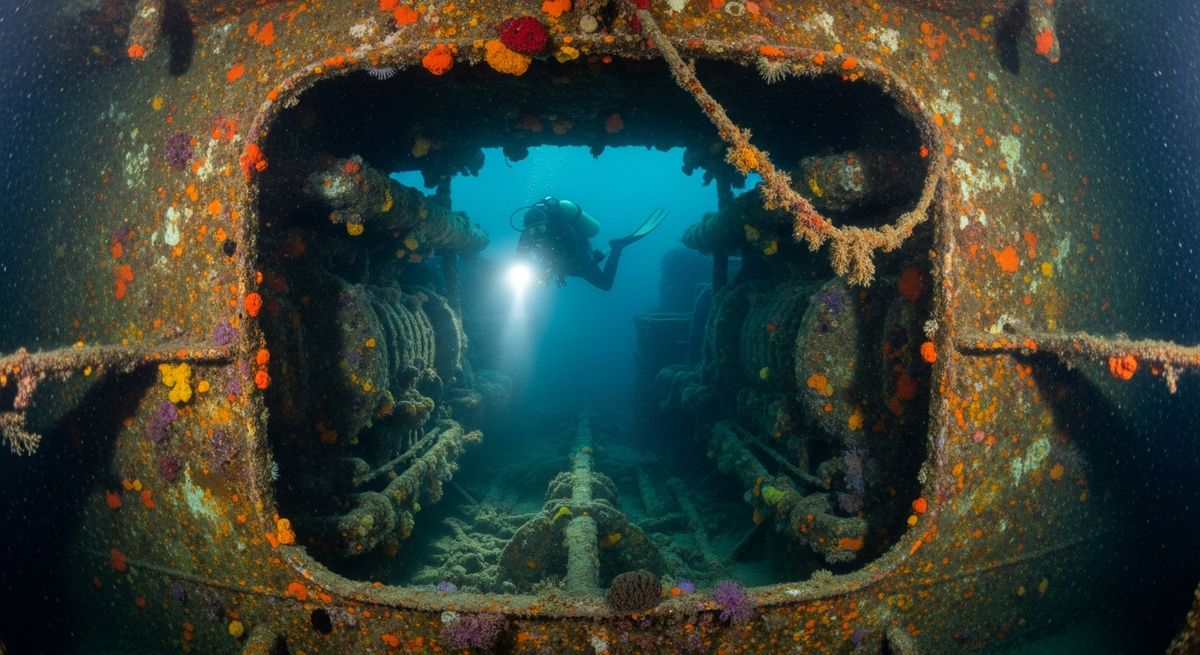
The Carmarand wreck, sunk in 1989 off the Cornish coast, is one of our favourite UK dives for a reason – it’s a proper little time capsule. We love how intact she is for her size, only 12.2 metres long, sitting upright at 40 metres. You can still make out the wheelhouse, the mast, even the gantry crane, all covered in a thick fuzz of plumose anemones. It’s a dive for those who appreciate history and macro life. Get in close, and you’ll find squat lobsters tucked into every nook, gobies peering from portholes, and jewel anemones sparkling on the deck. Our tip for this one: pick a day with minimal swell and dive it early. The visibility often drops later, and you want to be able to savour the detail. Don’t expect screaming pelagics, but for a classic Cornish wreck dive with character, the Carmarand delivers. It’s ideal for experienced divers comfortable with deeper wrecks and keen on exploring every crevice of a well-preserved vessel.
Typical CARMARAND Dive Profile
Illustrative profile based on site depth and type. Actual dive profiles vary - always follow your dive computer and training.
Safety Notes
Deep dive (40m) - monitor air consumption closely. Advanced certification recommended.
Wreck site - avoid penetration without wreck diving certification. Watch for sharp metal and entanglement hazards.
Always perform a 3-minute safety stop at 5m before surfacing.
CARMARAND Wreck History
Year Sunk
1989
Vessel Type
fishing vessel
Cause
flooding
The Carmarand was a small 12-meter fishing vessel whose career came to an abrupt end on July 15, 1989. While at sea off the coast of Cornwall, a pump failed, leading to uncontrollable flooding in the engine room. The small boat was quickly overwhelmed and sank, settling on the seabed 40 meters below. Unlike the historic wrecks that surround it, the Carmarand's demise was not the result of warfare or storm, but a simple, catastrophic mechanical failure.
Today, the Carmarand offers a compelling dive for those with advanced or technical qualifications. Its 40-meter depth means a shorter bottom time and requires careful planning, but the reward is a largely intact modern wreck. Given its small size, divers can easily circumnavigate the entire vessel in a single dive, exploring the wheelhouse, deck, and fishing gear that now provide a habitat for conger eels, lobsters, and dense shoals of bib. As a 'non-dangerous' wreck, it provides a fascinating and manageable deep dive experience in the rich waters of the English Channel.
Nearest Dive Centres to CARMARAND
Dive shops near CARMARAND
View all dive centres in Cornwall & DevonReviews for CARMARAND
Conditions
Ocean conditions, forecast and tides for CARMARAND
CARMARAND Ocean Conditions
Monthly averages for CARMARAND, sourced from Open-Meteo marine data - nearest station: Open-Meteo marine grid (50.44, -2.73) (3km away)
October Averages
Sea Temperature
17°C
62°F · Range: 15.1–17.5°C
Air Temperature
13°C
56°F
Wind Speed
8.14 m/s
15.8 knots
Atmospheric Pressure
1011 hPa
Based on 4 years of monitoring data · Data sources: Open-Meteo marine data
Plan & book
Ways to dive Cornwall & Devon, from day trips to liveaboards.
Day trips & courses
via GetYourGuideGuided dives, courses and snorkel trips with instant booking.
Find dive trips in Cornwall & DevonPlaces to stay
via Booking.comHotels and dive resorts near Cornwall & Devon.
Search stays in Cornwall & DevonDive insurance
Most travel insurance excludes or limits scuba. Check what you need before you go.
Dive insurance explainedPartner links: we may earn a commission if you book, at no extra cost to you. How we make money
Where to Stay near CARMARAND
Prices from Booking.com. We may earn a commission at no extra cost to you.