CAROLUS
Protected Area
Cuckoo Rock to Turbot Point
Why dive here
With 176+ marine species recorded in the area - including blue sharks, dolphins, dwarf minke whales, humpback whales and ocean sunfish (mola mola) - CAROLUS offers some of Cornwall & Devon's richest wreck diving. Water ranges 10-18°C, warmest July, August, September.
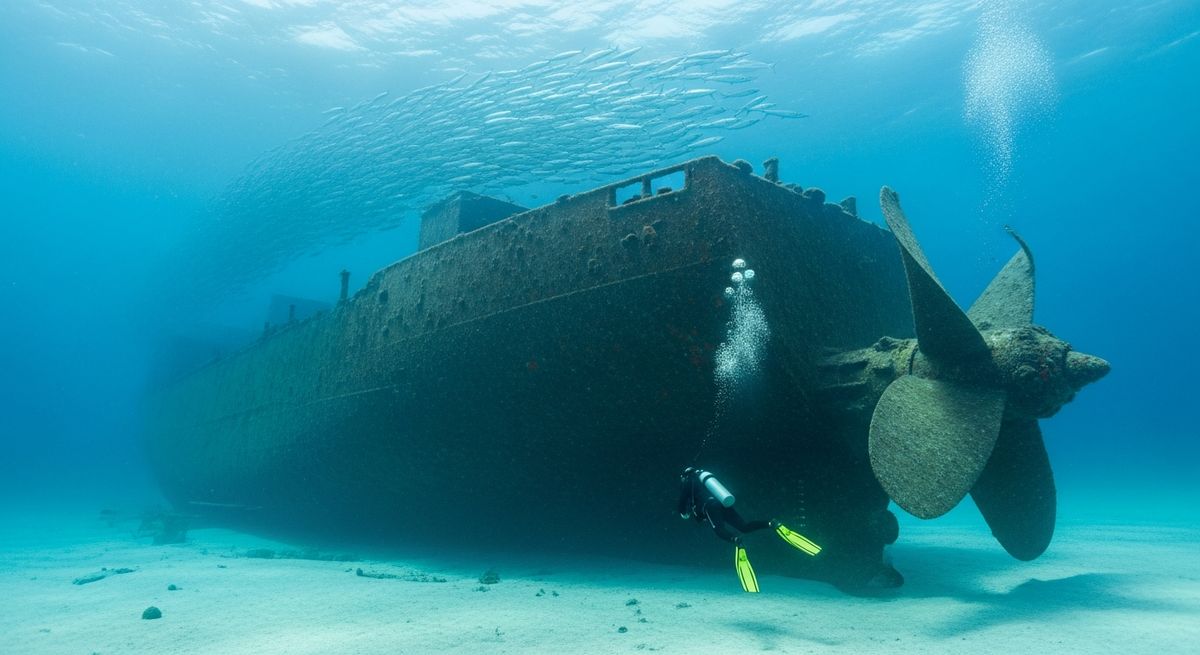
The Carolus, sitting at 56 metres, isn't a beginner's wreck, but for those with the training, she's a proper adventure. Dropping onto her deck, the first thing you notice is how intact she feels for a ship sunk in 1918. Her stern, especially, is a big draw for us, with the props still in place and usually covered in jewel anemones. We love finning over the cargo holds, imagining what she carried on her passage to Rouen, before pushing towards the impressive boilers. The sheer scale of them really hits you. Visibility can be hit or miss in the Channel, so picking a calm day with a strong tide is key here. That said, when it’s good, the light penetrating the wreck creates some dramatic scenes, illuminating the resident conger eels tucked into every dark corner. While there aren't specific "named" species, the general population of crabs, lobsters, and those surprisingly large pollack make her feel alive. She’s a satisfying deep wreck dive, perfect for technical divers who appreciate a relatively intact piece of maritime history and don't mind the chill.
Typical CAROLUS Dive Profile
Illustrative profile based on site depth and type. Actual dive profiles vary - always follow your dive computer and training.
Safety Notes
Maximum depth 56m exceeds recreational limits (40m). Technical diving certification and equipment required.
Wreck site - avoid penetration without wreck diving certification. Watch for sharp metal and entanglement hazards.
Always perform a 3-minute safety stop at 5m before surfacing.
CAROLUS Wreck History
Year Sunk
1918
Vessel Type
cargo ship
Cause
torpedo
Built in Bergen, Norway, at the turn of the 20th century, the CAROLUS was a typical steamship of her time, powered by a triple-expansion engine. For nearly two decades, she faithfully served her Norwegian owners, A/S Dampskibs Carolus, likely hauling cargo across the North Sea and Atlantic. Her career came to a sudden and violent end on January 27, 1918, during the final, brutal year of the First World War. While sailing off the coast of Cornwall, she fell victim to Germany's unrestricted submarine warfare, a fate shared by thousands of Allied and neutral merchant vessels.
Lying at a depth of 56 metres, the CAROLUS is now a challenging and rewarding dive reserved for experienced technical and decompression divers. The cold, deep water has preserved the wreck well. Those qualified to make the descent are greeted by the impressive sight of her two large boilers and the hulking triple-expansion engine standing proud amidst the wreckage. Exploring the CAROLUS is a sombre journey to a casualty of the Great War, a steel testament to a conflict that reached far beneath the waves.
Nearest Dive Centres to CAROLUS
Dive shops near CAROLUS
Viewpoint Diving Centre
Karleyth Diving Ltd.
Scuba 2000
DiveUK
Dive Looe
Seaways Diving
Reviews for CAROLUS
Conditions
Ocean conditions, forecast and tides for CAROLUS
CAROLUS Ocean Conditions
Monthly averages for CAROLUS, sourced from Open-Meteo marine data - nearest station: Open-Meteo marine grid (50.44, -2.73) (3km away)
October Averages
Sea Temperature
17°C
62°F · Range: 15.1–17.5°C
Air Temperature
13°C
56°F
Wind Speed
8.14 m/s
15.8 knots
Atmospheric Pressure
1011 hPa
Based on 4 years of monitoring data · Data sources: Open-Meteo marine data
Plan & book
Ways to dive Cornwall & Devon, from day trips to liveaboards.
Day trips & courses
via GetYourGuideGuided dives, courses and snorkel trips with instant booking.
Find dive trips in Cornwall & DevonPlaces to stay
via Booking.comHotels and dive resorts near Cornwall & Devon.
Search stays in Cornwall & DevonDive insurance
Most travel insurance excludes or limits scuba. Check what you need before you go.
Dive insurance explainedPartner links: we may earn a commission if you book, at no extra cost to you. How we make money
Where to Stay near CAROLUS
Prices from Booking.com. We may earn a commission at no extra cost to you.