CARONI RIVER (PART OF)
Protected Area
Swanpool
Why dive here
With 176+ marine species recorded in the area - including blue sharks, dolphins, dwarf minke whales, humpback whales and ocean sunfish (mola mola) - CARONI RIVER (PART OF) offers some of Cornwall & Devon's richest wreck diving. Water ranges 10-18°C, warmest July, August, September.
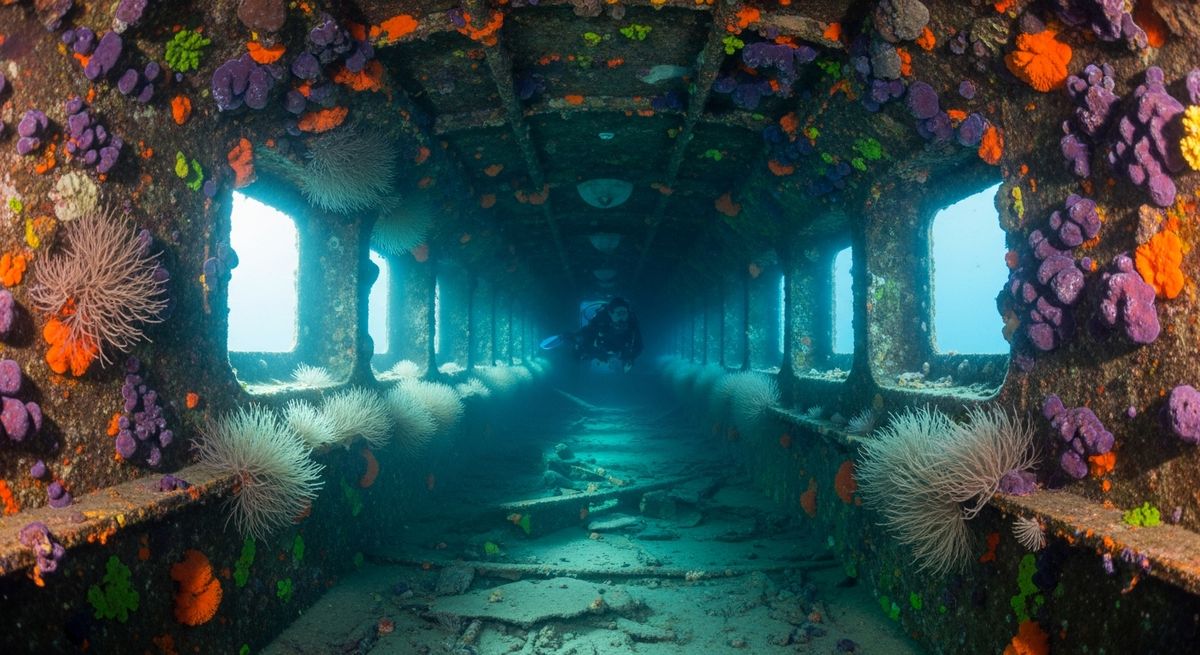
The Caroni River, what a moody old wreck. We love this site for its sheer, imposing scale, even if it is a bit of a grim reminder of wartime losses. Dropping down onto the bow, the first thing you notice is how the light changes, the superstructure just eats up the ambient glow. You’ll navigate around massive plates of corroded steel, often thick with dead man's fingers and anemones. Look for conger eels poking out from behind collapsed bulkheads – they’re everywhere here. Our favourite bit is exploring the forward holds; the sheer size of them feels cavernous, and you can really get a sense of the vessel's original purpose. It’s a site that suits divers who appreciate a substantial wreck, those who don’t mind a bit of a gloomier dive, and who are comfortable with potential strong currents that can sweep through, especially on bigger tides. This isn't a colourful coral reef, it’s a sombre, fascinating piece of history, reclaimed by the sea.
Typical CARONI RIVER (PART OF) Dive Profile
Illustrative profile based on site depth and type. Actual dive profiles vary - always follow your dive computer and training.
Safety Notes
Depth of 21m - Advanced Open Water certification recommended.
Wreck site - avoid penetration without wreck diving certification. Watch for sharp metal and entanglement hazards.
Always perform a 3-minute safety stop at 5m before surfacing.
CARONI RIVER (PART OF) Wreck History
Year Sunk
1940
Vessel Type
tanker
Cause
mine
The SS Caroni River, a 1928-built tanker, met its fate in the opening months of World War II. On January 20, 1940, the vessel was fatally wounded after striking a mine in the English Channel. The powerful explosion tore the ship apart, sending it to the seabed at a depth of 21 meters, where its remains are scattered today. At the time of its loss, the tanker was owned by the British Empire Steam Navigation Co., a component of the historic Royal Mail group.
The remains of the Caroni River are a somber relic of the war. The site is officially classified as a 'Dangerous Wreck,' a designation given to wrecks that pose a potential hazard to navigation or divers due to their condition, cargo, or unexploded ordnance. This status means that diving on the wreck is often restricted. For qualified divers exploring the maritime heritage of the UK's south coast, the scattered parts of the Caroni River serve as a powerful reminder of the conflict that took place just beneath the waves.
Nearest Dive Centres to CARONI RIVER (PART OF)
Dive shops near CARONI RIVER (PART OF)
DiveUK
Porthkerris Divers
Seaways Diving
Karleyth Diving Ltd.
Viewpoint Diving Centre
Wavecrest Scuba
Reviews for CARONI RIVER (PART OF)
Conditions
Ocean conditions, forecast and tides for CARONI RIVER (PART OF)
CARONI RIVER (PART OF) Ocean Conditions
Monthly averages for CARONI RIVER (PART OF), sourced from Open-Meteo marine data - nearest station: Open-Meteo marine grid (50.44, -2.73) (3km away)
October Averages
Sea Temperature
17°C
62°F · Range: 15.1–17.5°C
Air Temperature
13°C
56°F
Wind Speed
8.14 m/s
15.8 knots
Atmospheric Pressure
1011 hPa
Based on 4 years of monitoring data · Data sources: Open-Meteo marine data
Plan & book
Ways to dive Cornwall & Devon, from day trips to liveaboards.
Day trips & courses
via GetYourGuideGuided dives, courses and snorkel trips with instant booking.
Find dive trips in Cornwall & DevonPlaces to stay
via Booking.comHotels and dive resorts near Cornwall & Devon.
Search stays in Cornwall & DevonDive insurance
Most travel insurance excludes or limits scuba. Check what you need before you go.
Dive insurance explainedPartner links: we may earn a commission if you book, at no extra cost to you. How we make money
Where to Stay near CARONI RIVER (PART OF)
Prices from Booking.com. We may earn a commission at no extra cost to you.