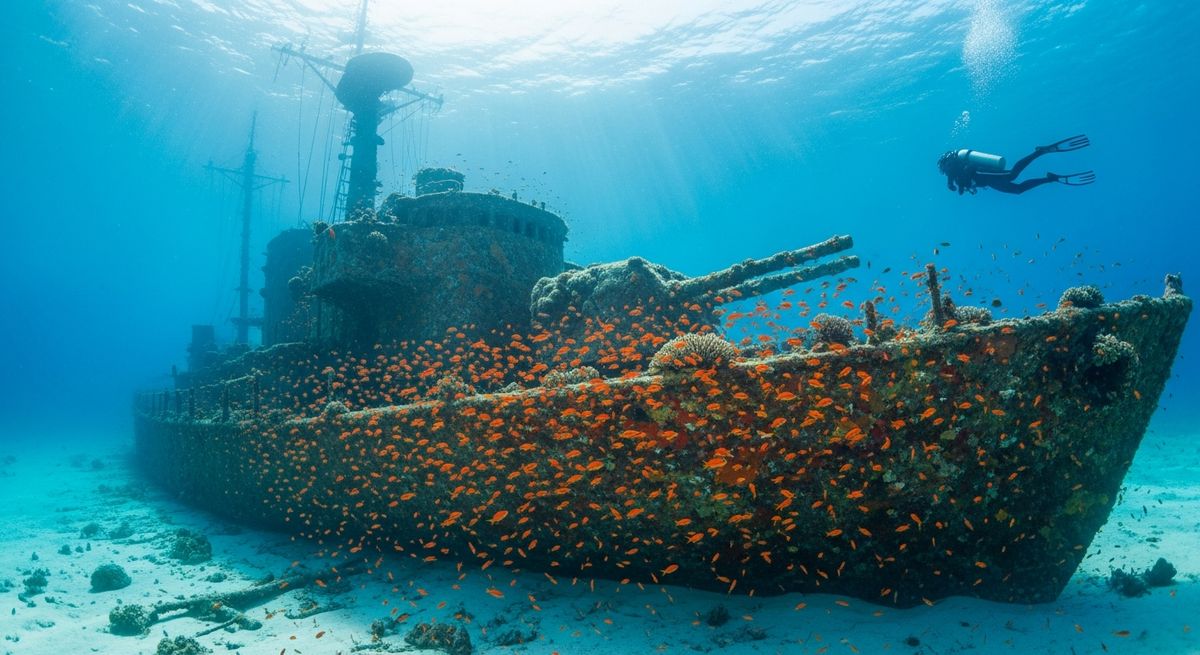
RFA GREEN RANGER - Cornwall & Devon

The RFA Green Ranger, well, it’s a bit of a story, isn't it? Lost in a brutal NNE Force 8 gale, she ended up beam-on against the rocks at Longpeak back in '62. What’s left isn't a deep plunge, which we actually appreciate sometimes. Instead, you get a sprawling, broken wreck, largely concentrated in the shallows. We love picking through the scattered plates and twisted metal, imagining the force that tore her apart. Visibility here can be a lottery, like much of the UK coast. On a calm day, though, when the sun penetrates the green water, the sight of the hull plates draped in kelp is something else. You'll often find conger eels tucked into the larger sections, their heads peeking out from shadows. Ballan wrasse are everywhere, darting between the rusty frames. It’s an ideal site for a relaxed poke-around, good for those who enjoy wreck diving but aren't chasing extreme depths. Our favourite time to dive it is on a slack tide, gives you more time to really explore the broken sections without fighting the current.

Location
Cornwall & Devon, United Kingdom, Mediterranean & Europe
Coordinates
50.978840, -4.536117
Type
wreck
Maximum Depth
0m

Marine Protected Area: Marsland to Clovelly Coast

Best Time to Dive in Cornwall & Devon

The warmest water temperatures in Cornwall & Devon occur in January, averaging 9.6°C. The coolest conditions are in December at 9.6°C.

Monthly Water Temperatures

  • January: 9.6°C (air: 7.3°C)
  • February: 9.6°C (air: 8.4°C)
  • March: 9.6°C (air: 8.6°C)
  • April: 9.6°C (air: 10.1°C)
  • May: 9.6°C (air: 12.6°C)
  • June: 9.6°C (air: 15.2°C)
  • July: 9.6°C (air: 16.6°C)
  • August: 9.6°C (air: 17.1°C)
  • September: 9.6°C (air: 15.9°C)
  • October: 9.6°C (air: 13.5°C)
  • November: 9.6°C (air: 10.7°C)
  • December: 9.6°C (air: 8.7°C)

Nearby Dive Sites in Cornwall & Devon

Nearest Dive Centres to RFA GREEN RANGER

Marine Life in Cornwall & Devon

Home to 192 recorded species including 93 reef fish, 18 sharks & rays, 13 whales & dolphins, 11 crabs & lobsters, 11 other, 10 seagrass & algae.

Notable Species

Recommended Packing List for RFA GREEN RANGER

Based on average water temperature of 9.6°C.

  • Drysuit - water at 10°C demands a drysuit with thermal undergarments
  • Hood & Gloves (7mm+) - critical to prevent heat loss
  • Mask - essential for every dive
  • Fins
  • BCD - buoyancy compensator
  • Regulator - your most safety-critical piece of gear
  • Dive Computer - tracks depth, time, and NDL
  • Surface Marker Buoy (SMB) - essential for boat pickups
  • Dive Torch - useful for crevices and colour at depth
  • Underwater Camera - capture your diving memories

Frequently Asked Questions

What is the maximum depth of the RFA Green Ranger wreck, and what are the typical diving depths encountered?
The RFA Green Ranger wreck is listed with a depth of 0m, indicating it is located at the surface or in the intertidal zone. This means divers would encounter very shallow conditions, potentially even exposed at low tide, making it accessible for snorkeling or very shallow diving. For more information on diving in the area, visit our Cornwall & Devon sub-region page.
What kind of marine life and wreck features can divers expect to see when exploring the RFA Green Ranger?
The RFA Green Ranger is a substantial tanker vessel, measuring 111.3m in length and 14.3m in width, offering extensive wreck features to explore. Divers can expect to see portions of its hull and superstructure, providing a fascinating glimpse into its past as a large ship. While specific marine life is not detailed in our records for this site, wrecks typically attract a variety of local species; you can learn more about common marine life in the region on our wildlife database.
How difficult is the RFA Green Ranger dive site, and is it suitable for divers with an Open Water certification?
The RFA Green Ranger dive site is classified as intermediate difficulty. This suggests it is suitable for divers who have some experience beyond their initial Open Water certification, perhaps with advanced training or a good number of logged dives. While an Open Water diver might be able to visit, additional experience or guidance is generally recommended for intermediate sites.
What are the best times of year or tidal conditions to dive the RFA Green Ranger for optimal visibility and calmer currents?
Our current data for the RFA Green Ranger does not specify the best times of year or particular tidal conditions for optimal visibility and calmer currents. Local dive operators or guides in the Cornwall & Devon area would be the best resource for up-to-date information on site-specific conditions. You can also explore general advice on our When to Dive page.
Are there any specific diving certifications or experience levels required or highly recommended to dive the RFA Green Ranger wreck?
Given its intermediate difficulty rating, the RFA Green Ranger wreck is highly recommended for divers with experience beyond an entry-level Open Water certification. An Advanced Open Water certification or equivalent experience with wreck diving or challenging conditions would be beneficial. Always ensure your skills and equipment are appropriate for the dive conditions; consider reviewing our equipment guide.
What are the typical current strengths and visibility conditions at the RFA Green Ranger dive site?
Our available data for the RFA Green Ranger does not provide specific details on typical current strengths or visibility conditions. As with any dive site, conditions can vary greatly, so it's always best to consult with local dive centers or guides in Cornwall & Devon for the most current information before planning your dive.