ORCHARD REEFER
Protected Area
Haramous
Why dive here
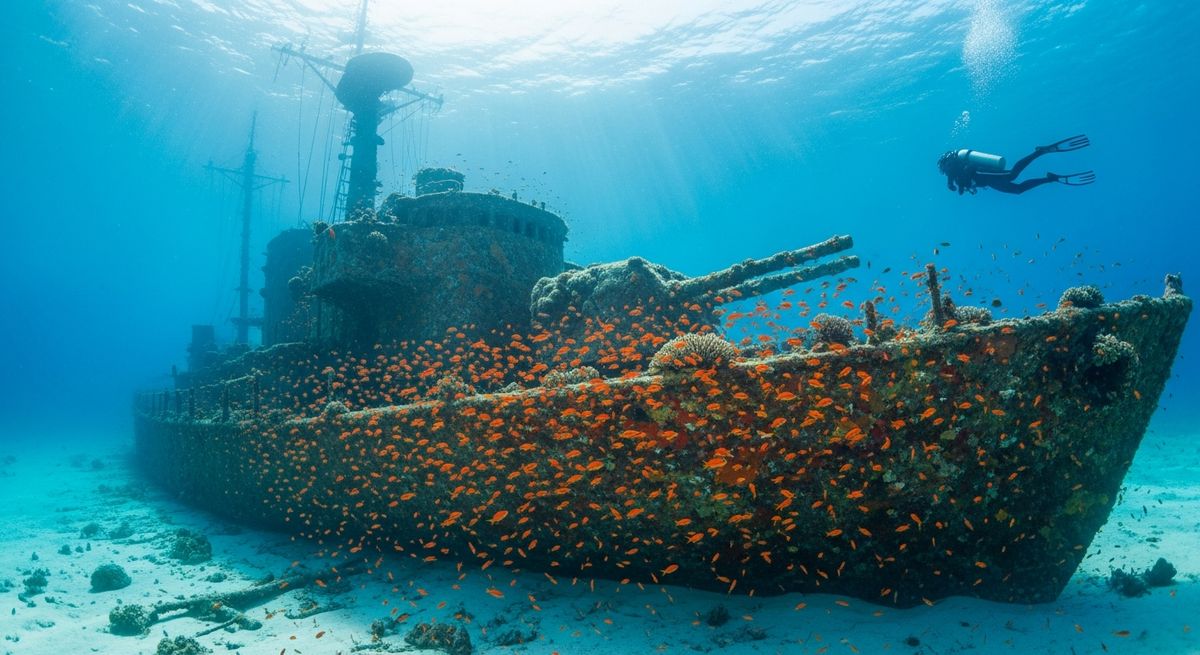
With 197+ marine species recorded in the area - including blacktip reef sharks, blue-spotted stingrays, dugongs, hammerhead sharks and sea turtles - ORCHARD REEFER offers some of Gulf of Tadjoura's richest wreck diving. Water ranges 27-32°C, warmest June, September, October.
The Orchard Reefer is a true historical heavyweight here in the Gulf of Tadjoura. This isn’t a quick swim-by; we always spend a solid hour just soaking it in. Sunk by fire back in ‘75, the sheer size of her, 126 metres long, is what grabs you first. You’re finning over this huge hull, just 13 metres down, and it feels like flying over a sunken city. We love how the superstructure has collapsed in on itself, creating these dark, shadowy swim-throughs. Sunlight filters in, catching the glint of thousands of glassfish that pulse in and out of the metalwork. Our favourite part is the bow section; there’s a real sense of scale there. Look for the resident potato groupers that hang around the deeper crevices. The visibility is usually excellent, letting you appreciate the whole outline. It's a proper wreck dive, ideal for those who love to explore and really get a feel for a ship's past.
Typical ORCHARD REEFER Dive Profile
Illustrative profile based on site depth and type. Actual dive profiles vary - always follow your dive computer and training.
Safety Notes
Wreck site - avoid penetration without wreck diving certification. Watch for sharp metal and entanglement hazards.
Always perform a 3-minute safety stop at 5m before surfacing.
Reviews for ORCHARD REEFER
Conditions
Ocean conditions, forecast and tides for ORCHARD REEFER
ORCHARD REEFER Ocean Conditions
Monthly averages for ORCHARD REEFER, sourced from Open-Meteo marine data - nearest station: Open-Meteo marine grid (11.95, 43.3) (19km away)
October Averages
Sea Temperature
32°C
89°F · Range: 29.6–33.4°C
Air Temperature
30°C
86°F
Wind Speed
4.2 m/s
8.2 knots
Atmospheric Pressure
1010.7 hPa
Based on 4 years of monitoring data · Data sources: Open-Meteo marine data
Plan & book
Ways to dive Gulf of Tadjoura, from day trips to liveaboards.
Day trips & courses
via GetYourGuideGuided dives, courses and snorkel trips with instant booking.
Find dive trips in Gulf of TadjouraPlaces to stay
via Booking.comHotels and dive resorts near Gulf of Tadjoura.
Search stays in Gulf of TadjouraDive insurance
Most travel insurance excludes or limits scuba. Check what you need before you go.
Dive insurance explainedPartner links: we may earn a commission if you book, at no extra cost to you. How we make money
Where to Stay near ORCHARD REEFER
Prices from Booking.com. We may earn a commission at no extra cost to you.