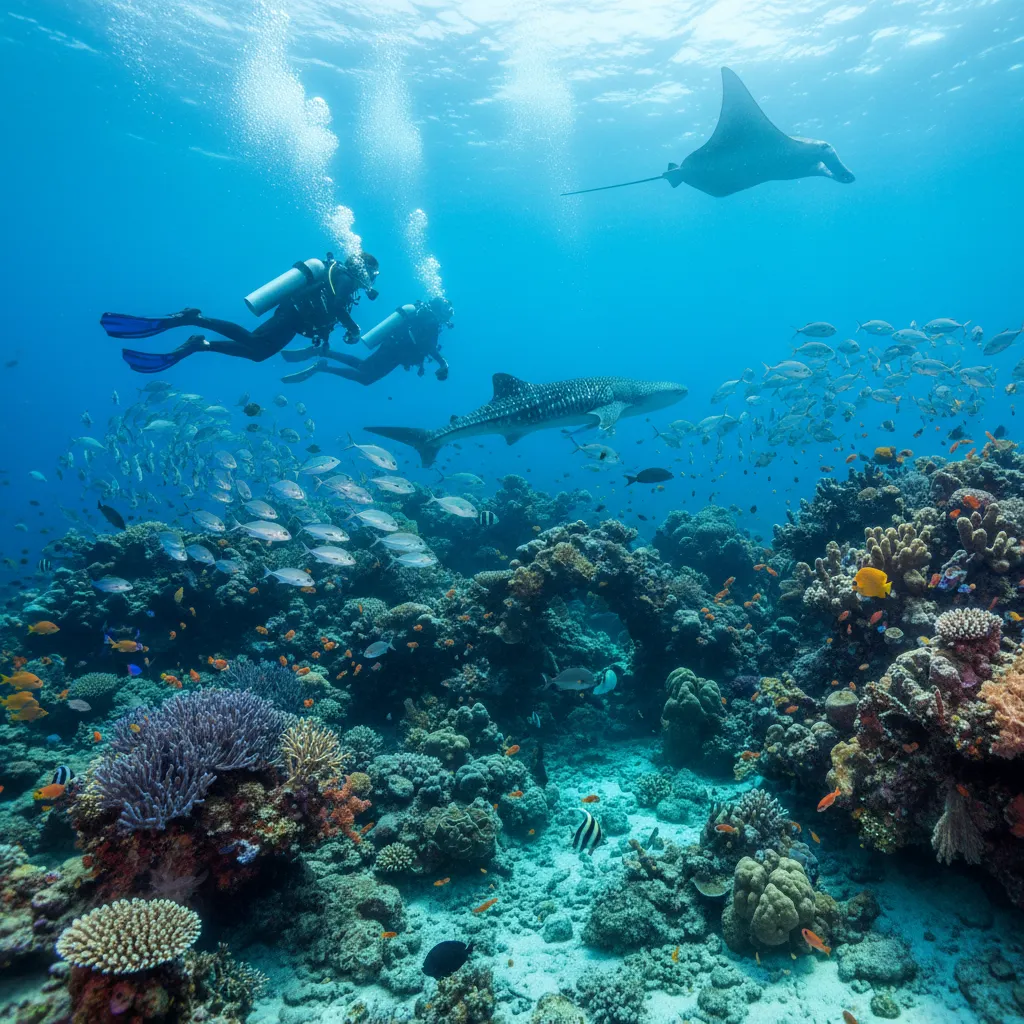
Diving in Gulf of Tadjoura
Why dive here
Gulf of Tadjoura offers some of Djibouti's richest diving, with 197+ marine species recorded in the area - including blacktip reef sharks, blue-spotted stingrays, dugongs, hammerhead sharks and sea turtles. Water ranges 27-32°C, warmest June, September, October.
Djibouti’s Gulf of Tadjoura offers something genuinely different from its Red Sea neighbours. We’re not talking about endless pristine reefs here, though you’ll find some healthy patches of staghorn and brain coral. What we love about Tadjoura is its raw, untamed feel. It’s a place where the water holds a secret, and often that secret is a whale shark. From November to February, these gentle giants gather in the gulf. It’s not just a quick pass-by, either. We’ve had encounters lasting over an hour, just floating alongside them, watching their colossal mouths filter feed. Beyond the whale sharks, the diving is mostly about drift dives along sloping reefs and walls. Keep an eye out for brown-spotted groupers peeking from crevices and the occasional pod of bridled dolphins cruising by. Visibility can vary, especially during the whale shark season when the plankton blooms, but seeing those massive silhouettes emerge from the green haze is truly magical. It’s wild diving, sometimes a bit rugged, but always rewarding.
Gulf of Tadjoura Dive Site Map
Dive sites and dive centres in Gulf of Tadjoura
Gulf of Tadjoura Dive Sites
44 dive sites in Gulf of Tadjoura
AL SAID
The Al Said wreck sits upright on the sandy bottom at 29 metres, and we love finding it. It’s a sailing vessel, which means a beautiful silhouette against the blue. She went down in ‘76, caught in a storm on her way from Berbera to Sharjah, and time has been kind. You can still make out the mast structure, though it’s heavily draped in soft corals now. Dropping down, the first thing you notice is the way the light filters through the remaining rigging, creating these dancing patterns on the deck. Schools of fusiliers often swirl around the bow, catching the current, so thick they almost block the light for a moment. We often find large groupers tucked into the shadowed areas of the hull, and there’s usually a resident moray eel or two peeking from beneath a plate coral. It’s a gentle dive, really, for anyone comfortable at depth. Take your time exploring the deck; the coral growth is impressive, forming miniature gardens with anemones and their clownfish. Visibility here is usually excellent, giving you a clear view of the entire wreck as you approach.
ARCHON RAPHAEL
The Archon Raphael, a good-sized steamship, went aground off Musha Island back in '68, and it’s become one of our favourite dives in Djibouti for good reason. She lies in just 18 metres, making it an easy, relaxed exploration, perfect for divers who want to spend some serious time soaking in the history without deep deco obligations. We love finning along her 134-meter length, picturing her journey from Sunderland to Shanghai. The wreck itself is a playground of twisted metal and open holds, all now completely colonised by the reef. Look for the schools of snapper and fusiliers that swirl around the davits and superstructure; they’re often so thick you can barely see the bow. Keep an eye on the deck, too, for crocodilefish tucked against the plating. The light penetration into the holds is often spectacular, painting the interior in shifting blues and greens, making for some dramatic photo opportunities. Our tip: go early to beat any potential boat traffic and enjoy the wreck in peace. The calm, shallow water means you can really take your time, picking through the details of a ship frozen in time.
Arta Beach
Arta Beach is the place to be from November to February for whale sharks, particularly juveniles. At 5-20m, it’s shallow and usually calm, making it perfect for snorkelers or newer divers wanting to swim with these gentle giants. Beyond the whale sharks, the site itself is fairly unassuming; think sandy bottom rather than dramatic coral. It's really all about that seasonal encounter.
Banc de La Clocheterie
Banc de La Clocheterie offers a solid dive in the Gulf of Tadjoura. We’ve seen a decent scattering of corals here, nothing to write home about, but certainly enough to hold the attention. Look out for checkerboard wrasse zipping between the coral heads, and we often spot longfin bannerfish hanging around the reef's edge. Keep an eye on the blue too; blacktip reef sharks make occasional passes. This site is a good pick for a relaxed dive, suitable for most experience levels, especially if you’re keen to tick off some common Red Sea residents without fighting a strong current.
Banc de la Pointe Noire
Banc de la Pointe Noire, tucked into the Gulf of Tadjoura, isn’t about huge pelagics, it’s about a quieter exploration. We’ve found it’s a site where slowing down pays off, especially if you’re keen on the smaller residents. Keep an eye out for the Peacock-tail Anemone Shrimp doing its thing, or a shy Seahorse clinging to a gorgonian. The reef here, while not massive, holds its own charm. It’s a good spot for a relaxed dive, maybe for divers who appreciate the intricacies of reef life over big fish action.
Banc des Salines
Banc des Salines gives us a proper glimpse into what the Gulf of Tadjoura can really offer. It’s not just another reef; it’s a living example of how hardy Red Sea corals are, thriving despite everything. We love drifting along the reef wall here, spotting the flashes of Arabian angelfish and the more subtle movements of the ocellated plesiops tucked into crevices. Keep an eye out for the Red Sea butterflyfish, their colours really pop against the deeper blues. The currents can pick up, so it's a site we'd suggest for divers comfortable with a bit of drift, though it's rarely a washing machine. Our favourite time to dive Banc des Salines is mid-morning, when the sun hits the coral just right, making the checkerboard wrasse and rainbowfish shimmer. It’s a truly peaceful dive, often just you and the marine life, a quiet contrast to some of the busier Red Sea spots. You’ll leave feeling like you’ve been let in on a secret.
Banc du Héron
Banc du Héron, in the Gulf of Tadjoura, feels like a secret handshake among Djibouti divers. It’s not about huge pelagics here, though you might catch a distant glimpse of something larger in the blue. For us, Banc du Héron is all about the reef’s texture and the sheer volume of small, intricate life. We love drifting along the coral formations, spotting Arabian angelfish weaving through the polyps. Keep an eye out for painted spiny lobsters tucked into crevices – they’re surprisingly shy, but rewarding to find. The visibility here can be incredible, sometimes pushing past 25 metres, giving the whole place a sense of wide-open space even when you’re focused on the small stuff. We’ve had some fantastic dives just hovering over a patch of reef, watching Indo-Pacific sergeants dart around while checkerboard wrasse pick at the coral. It’s a site that rewards a slow pace and a keen eye, perfect for photographers or anyone who appreciates the quieter beauty of a healthy reef. Don't rush it; the real treasures here are in the details.
Banc du Pingouin
Banc du Pingouin is a standout for us in the Gulf of Tadjoura, especially if you’re into the smaller, more unusual reef residents. The reef structure itself is pretty impressive, dropping down into the blue with plenty of ledges and overhangs to explore. We’ve had some truly fantastic dives here just hovering over a patch of coral, watching the drama unfold. Our favourite dives at Pingouin usually involve a slow drift along the main wall. Keep your eyes peeled for those iridescent Ocellated Plesiops darting into crevices, and you’ll often find Blotchfin Scorpionfish perfectly camouflaged on the rock. The Angelfish here, both the Arabian and general Angelfish species, are particularly bold, allowing for some great close-up viewing. We've even spotted Dugongs in the seagrass meadows nearby, so always keep an eye on the sand flats if you're lucky. The currents can pick up, so it's a spot that rewards confident divers who are comfortable with varied conditions.
Banc Gutta Tella
Banc Gutta Tella, in the Gulf of Tadjoura, isn’t just another reef in Djibouti. This place has a real pulse to it. Drop in and you’re immediately enveloped by the density of the coral. We're talking massive formations of honeycomb coral and brain coral, some of them so old they look like ancient sculptures. Then there’s the fire coral, a vibrant orange against the deeper blues, making you remember to watch your buoyancy. We’ve had some cracking dives here, often spotting Blue-spotted Stingrays gliding over the sandy patches between the coral heads. And keep an eye out for the Longfin Bannerfish, their dorsal fins trailing elegantly as they pick their way through the reef. It’s a site that feels alive, not just visually but almost audibly, with the subtle crackles and pops of the reef. We’d suggest an early morning dive if you can swing it; the light filtering through the water really brings out the colours of the Galaxea and Cactus corals. It's a proper healthy reef, and perfect for divers who appreciate intricate coral structures as much as the fish life.
Banc Moidubis Kebir
Banc Moidubis Kebir has a reputation in the Gulf of Tadjoura, and we can confirm it lives up to the hype. This is a proper coral kingdom, a place where you'll find yourself slowly finning over acres of Favites and Leptastrea, with massive stands of staghorn coral reaching towards the surface. It feels ancient down here, the kind of robust reef structure that reminds you why we love the Red Sea so much. Our favourite time to dive here is early morning. The light catches the tips of the flowerpot corals in a way that just makes everything glow, and we’ve often found the blunt snout gregories are a bit more active, darting in and out of the crevices. Keep an eye out for the rock cod too, often lurking patiently under a table coral. This isn't a site about pelagics, it's about getting intimate with a genuinely healthy, vibrant reef. It’s perfect for divers who appreciate intricate coral formations and the smaller, shyer residents of the reef, allowing for slow, contemplative dives.
Banc Moidubis Seghir
Banc Moidubis Seghir often gets overlooked for Ras Eiro, but we think that’s a mistake. This place is a masterclass in coral complexity. You drop down into a shallow garden, maybe 8-10 metres, and immediately you’re surrounded by these massive colonies of staghorn, lettuce, and table corals. It feels like swimming through an ancient, gnarled forest. The light plays through the branches, creating these incredible patterns on the sand below. We love just hovering here, watching the edgeblack groupers cruise through their territory, fat and unbothered. As you drift, you’ll spot patches of yellow scroll and starflower corals, adding pops of colour to the otherwise earthy tones. The current here is usually pretty gentle, making it perfect for photographers who want to really compose their shots without being buffeted about. It’s a site for divers who appreciate the intricacies of a healthy reef, rather than chasing pelagics. Our favourite time to dive it is mid-morning, when the sun is high enough to illuminate the reef but before the heat haze really sets in. It’s a genuinely peaceful dive.
Banc Ousal
Banc Ousal is a standout for us in the Gulf of Tadjoura, a site where the coral really puts on a show. We’ve drifted over some truly impressive staghorn formations here, stretching out like underwater forests. Look closely, and you’ll spot those cheeky crested sabretooth blennies darting in and out, or maybe an African eel blenny peering from its crevice. It’s not just about the big picture either; the variety in the corals, from delicate table corals to robust starry cup corals, is fantastic. We’d suggest hitting this one early in the morning, before the thermocline deepens too much, when the light really makes the coral colours pop. We love Banc Ousal for its healthy, thriving reef, a real testament to Djibouti’s underwater appeal. It’s perfect for divers who appreciate intricate reef structures and the smaller, more unusual reef fish that call them home.
Show all 44 dive sites in Gulf of Tadjoura
- FONTAINEBLEU
- GHINDA (POSSIBLY)
- Ghoubet al-Kharab
- Grand Récif
- HMS Khartoum
- HMS KHARTOUM
- HMS PARVATI
- La Faille
- La Passe
- Le Canyon
- Les Sept Freres
- Maskali Island
- Maskali Island
- MEDITERRANEAN PRINCESS
- Moucha Island
- Moucha Islands
- NEKTARIOS
- NIKOLAOS K
- ORCHARD REEFER
- RAJA
- Ras Corali
- Ras Eiro
- Récif d'Ambouli
- Récif du Météore
- RIG
- Seven Brothers Islands
- SHANNO
- SIR MICHAEL
- Siyyân H̱imâr
- TADJOURAH
- TAYGA (PART OF)
- TAYGA (PART OF)
Gulf of Tadjoura Dive Centres
No dive centres listed in Gulf of Tadjoura yet. Browse all dive centres.
Ocean Wildlife in Gulf of Tadjoura
197 species recorded in Gulf of Tadjoura
Gulf of Tadjoura Daylight & Sunrise/Sunset
Sunrise and sunset times for Gulf of Tadjoura, calculated from coordinates
Today - Sunday 11 October
Sunrise
05:57
Sunset
17:52
Daylight
11h 55m
Golden Hour
17:24
First light (dawn) at 05:36 · Last light (dusk) at 18:14
Monthly Averages
| Month | Sunrise | Sunset | Daylight |
|---|---|---|---|
| Jan | 06:32 | 18:02 | 11h 29m |
| Feb | 06:30 | 18:15 | 11h 45m |
| Mar | 06:16 | 18:19 | 12h 3m |
| Apr | 05:56 | 18:20 | 12h 24m |
| May | 05:44 | 18:25 | 12h 41m |
| JunLongest | 05:44 | 18:33 | 12h 50m |
| Jul | 05:51 | 18:37 | 12h 46m |
| Aug | 05:57 | 18:29 | 12h 32m |
| Sep | 05:57 | 18:10 | 12h 12m |
| OctNow | 05:58 | 17:50 | 11h 52m |
| Nov | 06:05 | 17:40 | 11h 35m |
| DecShortest | 06:20 | 17:46 | 11h 25m |
Times are approximate local times based on longitude. Actual times may vary slightly depending on the exact timezone observed in Gulf of Tadjoura.
Where to Stay near Gulf of Tadjoura
Prices from Booking.com. We may earn a commission at no extra cost to you.
Marine Protected Areas near Gulf of Tadjoura
4 protected areas near Gulf of Tadjoura - please respect local regulations when diving
Iles des Sept Freres ainsi que Ras Syan, Khor Angar et la foret de Godoria
Iles Musha et Maskhali
Haramous
Arta Plage
Getting to Gulf of Tadjoura
Djibouti City
Aden
Hargeisa
Plan & book
Ways to dive Gulf of Tadjoura, from day trips to liveaboards.
Day trips & courses
via GetYourGuideGuided dives, courses and snorkel trips with instant booking.
Find dive trips in Gulf of TadjouraPlaces to stay
via Booking.comHotels and dive resorts near Gulf of Tadjoura.
Search stays in Gulf of TadjouraDive insurance
Most travel insurance excludes or limits scuba. Check what you need before you go.
Dive insurance explainedPartner links: we may earn a commission if you book, at no extra cost to you. How we make money