Diving with Sea Snakes & Sea Kraits
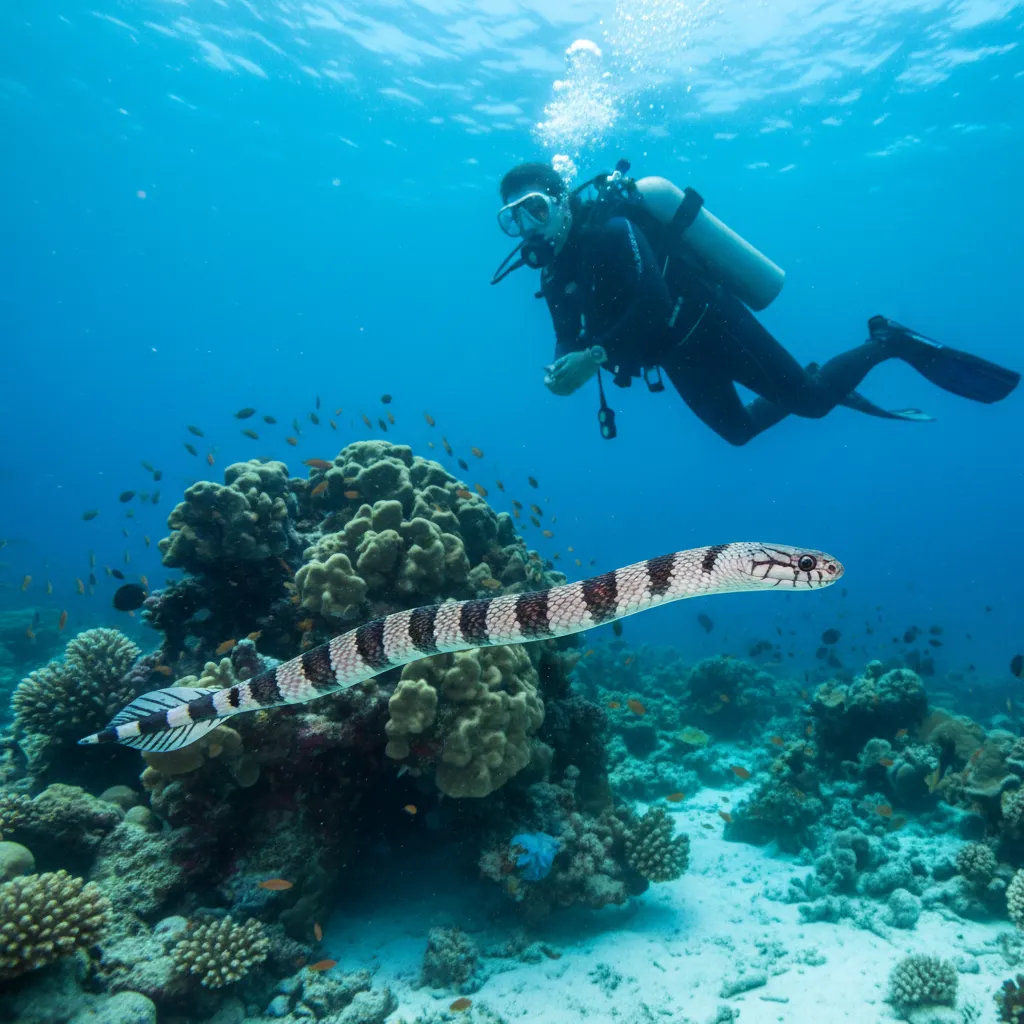
Sea snakes are simultaneously one of the most feared and most misunderstood groups of marine animals. These elegant reptiles, which evolved from terrestrial ancestors and returned to the sea some 15-20 million years ago, are found throughout the warm waters of the Indo-Pacific, from the Persian Gulf to the coast of Central America. There are approximately 70 species of true sea snakes (Hydrophiinae) and several species of sea kraits (Laticaudinae), all of which are air-breathing reptiles that must surface regularly - though some can remain submerged for over two hours. Sea kraits, particularly the strikingly banded Laticauda colubrina with its black and white/blue bands and distinctive yellow snout, are the species divers encounter most frequently. These graceful animals are often seen hunting on coral reefs, threading through crevices in search of small fish and eels, or ascending to the surface for air in a smooth vertical rise that is utterly mesmerising to watch. Despite possessing some of the most potent venom in the animal kingdom - drop for drop, many sea snake venoms exceed those of any terrestrial snake - they are remarkably docile and bites on divers are extraordinarily rare. For those who can look past the instinctive fear of snakes, an encounter with a banded sea krait weaving elegantly through a coral garden is one of diving's most graceful and captivating experiences.
Where to Dive with Sea Snakes
Found across 8 countries, based on 188 verified observation records.








Best Time to See Sea Snakes
Indonesia (Komodo, Bali, Raja Ampat): year-round sea krait encounters, with the best visibility and conditions from April to November. Philippines (Visayas, Palawan): year-round, with the dry season (November to May) offering the best conditions. Malaysia (Sipadan): year-round, with sea kraits extremely abundant on the reef and on the island itself. Okinawa, Japan: best from May to October when water temperatures are warmest. Niue (South Pacific): famous for sea krait encounters in underwater caves; best from May to October. Ashmore Reef, Australia (liveaboard only): extremely high sea snake density, best from March to November. Sea kraits are diurnal and most active during daylight hours, making them ideal subjects for daytime diving.
How to Dive with Sea Snakes
The banded sea krait (Laticauda colubrina) is the species most commonly encountered by divers, found throughout Southeast Asia, the western Pacific, and parts of the Indian Ocean. Indonesia is the premier destination - Komodo National Park, Bali, Raja Ampat, and the Banda Sea all produce regular encounters. The Philippines (particularly the Visayas and Palawan) and Malaysia (Sipadan) are equally reliable. Okinawa in Japan has healthy sea krait populations. In some locations, sea kraits are so abundant that seeing 10-20 on a single dive is routine. They're most active during the day, hunting in coral crevices and reef structures. Watch for their distinctive behaviour: they swim with a sinuous, serpentine motion, dive into holes to flush out prey, and regularly surface for air. Their ascent is typically a direct, graceful vertical rise that makes for wonderful photography. Sea kraits also haul out on land to rest, shed their skin, and lay eggs - at some sites you may see them basking on rocks between dives. True sea snakes (Hydrophis species) are more pelagic and less predictable, but can be encountered in river mouths, estuaries, and shallow coastal waters. Ashmore Reef in the Timor Sea and the coast of northwestern Australia have some of the highest sea snake densities on Earth.
Is it Safe to Swim with Sea Snakes?
Sea snake venom is among the most toxic in the world - the beaked sea snake (Hydrophis schistosus) has venom 4-8 times more potent than a cobra's. However, sea snakes are overwhelmingly non-aggressive toward humans. Sea kraits in particular are famously docile - they will often swim directly past divers or even over them without any aggressive behaviour. Bites are extremely rare and almost always the result of handling, stepping on them in shallow water, or entanglement in fishing nets. The critical rule is simple: do not touch, handle, or obstruct sea snakes. Give them space when they surface for air. If a sea snake approaches you (they are naturally curious), remain calm and still - it will investigate briefly and move on. Never corner a sea snake in a cave or crevice. Fishermen are at far greater risk than divers, with most bite incidents occurring during net handling. In the extremely unlikely event of a bite, treat it as a medical emergency - antivenom exists but must be administered promptly. Apply pressure immobilisation as with terrestrial snake bites and seek immediate medical evacuation.
Conservation Status
Sea snakes face multiple threats including bycatch in trawl fisheries, habitat degradation, pollution, and in some regions direct harvesting for their skin and meat. Several species have experienced significant population declines - the short-nosed sea snake (Aipysurus apraefrontalis) and leaf-scaled sea snake (Aipysurus foliosquama) were considered possibly extinct for decades before being rediscovered in Western Australia. Coral reef decline directly impacts sea snakes by reducing the habitat of their prey species and eliminating the reef structure they depend on for hunting. Climate change may affect sea snake distribution and breeding patterns. In some Southeast Asian countries, sea snakes are hunted commercially - Vietnam's sea snake fishery alone takes an estimated 70,000-225,000 animals annually. Sea kraits that haul out on islands are vulnerable to introduced predators like cats and rats. Marine protected areas that include healthy reef systems are essential for sea snake conservation.
Species Profile


Recommended Equipment
A mid-range zoom (24-70mm or 24-105mm) is the most versatile lens for sea snake photography - it allows you to capture both close portraits and environmental shots of snakes swimming through reef scenery. A macro lens (60mm or 100mm) captures stunning detail of their scales, eyes, and the distinctive banding patterns. Wide-angle can work for dramatic shots of sea kraits ascending to the surface against blue water. Strobes are important for illuminating the beautiful banding patterns and bringing out the subtle colours of their scales. For video, a wide-angle setup captures the sinuous swimming motion beautifully. Standard tropical dive gear is appropriate - 3mm wetsuit or shortie in most sea snake habitats. Full-length exposure suits provide peace of mind for nervous divers, though bites through neoprene are essentially unheard of from non-provoked animals.
Browse dive equipmentFrequently Asked Questions
Are sea snakes dangerous to scuba divers?
Despite having extremely potent venom, sea snakes (particularly sea kraits) are remarkably docile and almost never bite divers. Bites are overwhelmingly the result of handling or entanglement. The simple rule is: don't touch them. If a curious sea snake approaches you, remain calm and still - it will investigate briefly and swim away. Divers who follow this advice have nothing to fear.
Where is the best place to dive with sea snakes?
Indonesia is the premier destination, with Komodo National Park, Bali, and Raja Ampat all producing regular encounters with banded sea kraits. Sipadan in Malaysia is famous for abundant sea kraits both on the reef and on the island itself. The Philippines, particularly the Visayas, offers reliable encounters year-round.
What is the difference between a sea snake and a sea krait?
True sea snakes (Hydrophiinae) are fully marine - they give live birth at sea and never come on land. They have flattened paddle-like tails and cannot move effectively on land. Sea kraits (Laticaudinae) are semi-aquatic - they hunt in the sea but come ashore to rest, digest food, shed skin, and lay eggs. Sea kraits have a more cylindrical body and retain some ability to move on land.
How venomous are sea snakes?
Sea snake venom is among the most toxic of any snake. The beaked sea snake's venom is 4-8 times more potent than a cobra's. However, sea snakes deliver very small amounts of venom per bite and many defensive bites are 'dry' (no venom injected). Anti-venom exists and is effective when administered promptly.
Can sea snakes breathe underwater?
No - sea snakes are air-breathing reptiles and must surface regularly. However, they have highly efficient lungs that extend nearly the full length of their body, and some species can absorb a small amount of oxygen through their skin. Most can remain submerged for 30 minutes to 2 hours before needing to surface.